

One of the more constant things in life is change, and there are a bunch of new changes rolling out as new standards in the RV industry. To my eyes, they’re all a really good thing.
Like the auto industry of the past, RV companies will generally build a product with as few safety systems as they can get away with. That makes sense because buyers have historically shown a preference for cheaper products rather than safer ones.
Do you remember how some car dealers would cut the seat belts out of cars in the late 1960s, or tell buyers they could just stuff them under the seats? While we tend not to want to pay for new safety technologies when they first appear, we often come to demand them once we’ve seen their benefits.
Typically, though, few companies want to be the first to add something because of the added cost or resistance from some buyers. Going back to seat belts, I remember people saying they’d rather be thrown clear in an accident than be trapped inside a car.
The RV industry is, for the most part, self-regulated. While the book of regulations for the auto industry is like the New York phone book (are there any more phone books?), the RV industry is more self-regulated, and most of that is through the RV Industry Association (RVIA). This was brought up at the most recent RV Industry Power Breakfast, where several dealership principals were on stage discussing the state of the industry and customer dissatisfaction.
“If we don’t take care of things ourselves, then the regulators are going to come on us…”, said Ben Hirsch, COO of Campers Inn RV. “It is the wild west and the customers are screaming for this. This is one of the things we’re going to have to get ahead of as an industry otherwise we’re going to be regulated upon.”
A number of new things are coming within the next model year or two, and I think every one of them is a good thing.
Tire pressure monitoring
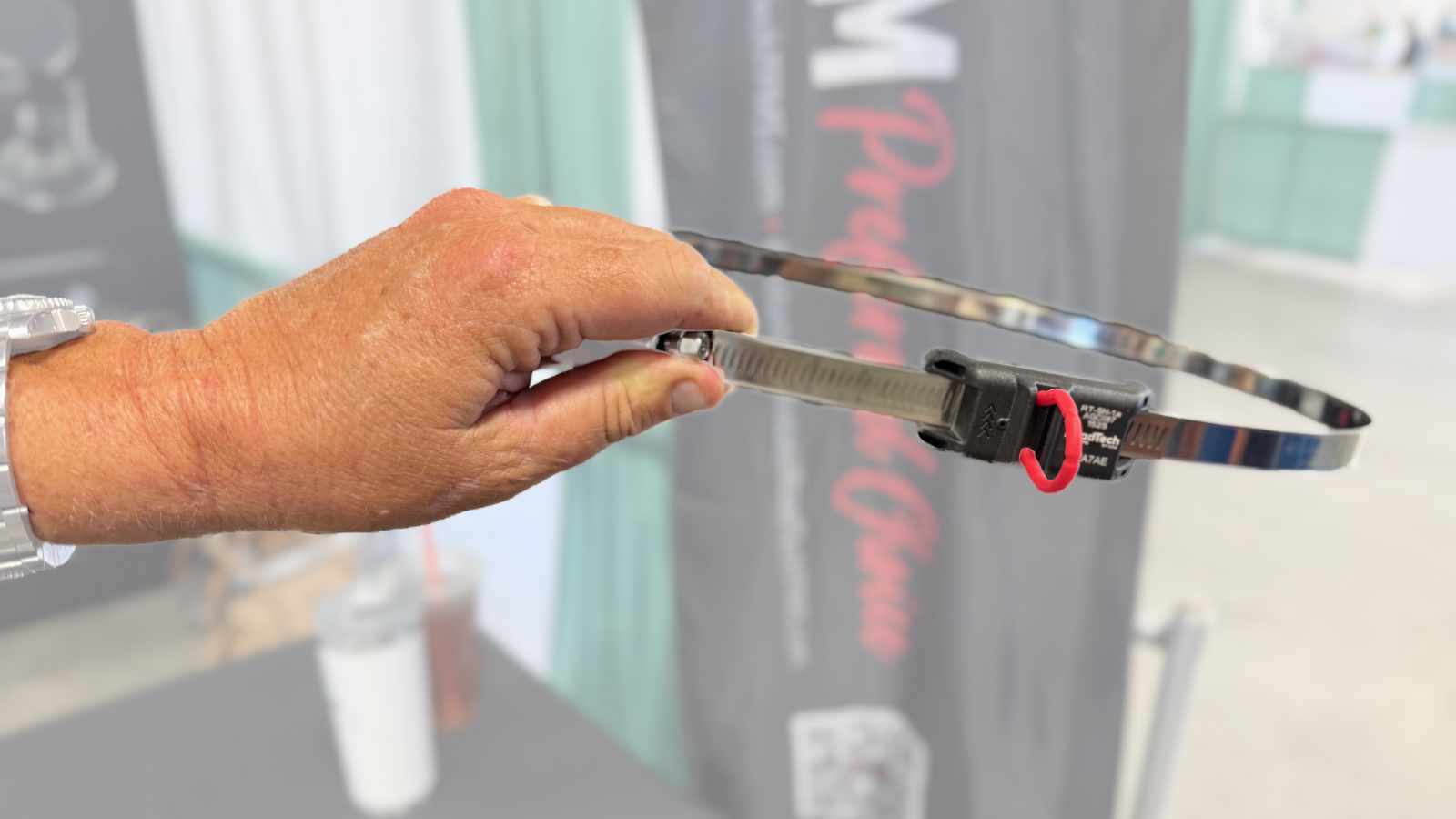
I can’t imagine ever buying a towable RV without a tire pressure monitoring system (TPMS). This type of tech has saved me from a potential disaster several times. I am so happy that the RV industry has made tire pressure monitoring technology a standard for all towables beginning with the 2028 model year.
Of course, several RV companies have offered this as standard equipment for years now, and this has been a factor in why I bought what I bought. IYKYK. [If you know, you know,]
If your RV maker doesn’t care enough about you to install this type of technology now, you can always add it after the fact. I strongly suggest that you do.
The interesting thing about this standard is that it doesn’t specify what type of system must be used. As a result, some trailers could have band-mounted systems, where the tire pressure monitor is attached to the inside of the wheel, much like on most passenger cars. Others could use valve stem-mounted systems. Or they could use something I haven’t even considered.
Your RV and how it talks to itself
The details of this are still being worked out. At present, there really isn’t a lot of control over how systems inside an RV work. For example, if you buy one brand of air conditioner, it doesn’t necessarily work with other brands of thermostats. When I upgraded my RV’s A/C to the Furrion Chill Cube, it was a big deal to figure out how the thermostat interacted with the A/C unit.
Being the nerd that I am, I recently changed A/C units again to try another new product (I keep hinting at this). Once again, we had to figure out the wiring for the thermostat.
With this kind of thing in mind, the RVIA is working on a series of standards for how things inside the RV communicate with one another.
This is referred to as RV-C: The Open Communications Recommended Practice for RVs.
RV-C was created by the RV Industry Association to provide a standardized, open communication protocol for recreational vehicles, built on the proven CAN (controller area network) bus framework. Its purpose is to enable seamless interoperability among multi-vendor RV components—such as lighting, HVAC, power, and chassis systems—while simplifying wiring, diagnostics, and control.
By replacing proprietary and incompatible systems, RV-C reduces manufacturing complexity, lowers costs, and allows for easier integration and maintenance across diverse RV platforms. This industry-wide recommended practice ensures that modern RVs can operate more efficiently, reliably, and intelligently through a unified data and control network.
This would be a great change and, of course, we’ll keep you in the loop as it progresses.
GMI is another good thing
Another good thing coming our way is something called Grounding Monitor Interrupters, or GMI.
Essentially, this is a protection technology that will be installed on all RVs beginning in the 2028 model year. What this does is measure the ground at the pedestal and, if the ground is no good, it shuts the power off.
At present, the technology is still being developed, but know that the GMI device will be installed in the RV and will shut the power off if it detects an issue with the ground. This is a big safety plus, and while I know it will cause a lot of confusion at first, it’s a good thing.
Unfortunately, there has been a tremendous amount of misinformation surrounding this technology, thanks to a press release written by AI. But it’s also important to know that, at present, there isn’t a great way for RV parks to test their pedestals except to make sure they’re correctly wired.
Talking to Mike Sokol, the RV electricity expert, about his involvement in this technology and some of the takeaways includes the fact that there really won’t be an aftermarket system initially, just because demand for new RVs will likely consume much of the supply. But who knows?
Anti-lock braking
In 2011, equipping your new vehicle with anti-lock braking (ABS) became the law of the land, and we’re so much better for it. Semi trucks and trailers, too, have been required to have ABS since 1997! In fact, there’s even a light on semi-trailers that indicates if a fault is detected, and you know law enforcement is keeping an eye out for those lights.
But travel trailers and fifth wheels are not required to have ABS. In fact, it wasn’t until recently that it became readily available for towables.
What ABS can do is shorten stopping distances by quickly pulsing the brake system if it detects that a loss of traction is occurring. It also helps with keeping control of the vehicle, since it helps to maintain traction on the road.
Once again, this is one of those things where I encourage you to shop from the road up for your next RV. I urge you to look for anti-lock brakes because a few manufacturers are incorporating this as a standard feature on their new RVs.
You can also have an ABS system installed if you don’t have it already. Lippert and Dexter both make really good systems.
New propane monitors
As usual, Russ and Tiña De Maris have a great, detailed article about the new standards for propane and carbon monoxide detectors. But there is a new, more common-sense technology coming out in the propane and carbon monoxide detector world that just makes a lot of sense.
Other than being very much in favor of these new monitors, I don’t have anything to add to the article on this, so I suggest you go check it out.
Safety first
I’m all for logical improvements to the systems that keep us safe. I know there’s always pushback on these for a variety of reasons, including the cost, /but I’d rather be alive and have spent some money than not be alive and realize that I can’t take it with me.
I applaud the changes coming to the 2028 RVs.
Incidentally, the photo that I used as the hero (featured) image for this came from my visit last year to the Nevada Northern Railway. This tourist train is one of many that I’ve visited. Its slogan, “Safety First”, is on everything. The photo I chose is of their extensive shops.
I have details of my visit to the Nevada Northern Railway here. I’m a huge fan of anything related to trains and hope to spend my summers volunteering at tourist trains at some point.
Catch up on all the latest news for RVers here.
RVT1263b

Excellent article. Thanks for sharing. I’m glad the updates are coming and it helps to hear your opinion. I wish our Norcold refrigerator error display gave better details. We had a generic “NO FL” (no flame) when testing it on propane a few months ago in Az during a hot spell. An RV tech removed the refrigerator thermostat monitor which fixed it, but I think the fridge was TRYING to say ‘working as designed, it’s too hot, don’t run me on propane now’. Improved messaging from the fridge would help!
It would be nice if all the manufacturers addressed the bad plumbing fittings and fasteners. Certainly not a high safety issue, but it is an all too common issue for RV owners.
Yes Tony, safety first. I don’t think people buy less expensive units because they knowingly are avoiding safety features. The main thought is they found a niche where the manufacturer has decreased its profit margin. Having volunteered for local government, regulation is a way to level the playing field for all, even if some never notice a pothole in the middle. If it works, self-regulation keeps the politicians out. If it doesn’t work, government will eventually step in.
Thank you for creating and maintaing this feature in the Saturday newsletter, Tony. I, too, greatly enjoy riding trains and do so at every opportunity. Should you get well and far east in your travels, Chattanooga has the Tennessee Valley Railroad Museum (https://www.tvrail.com/), which makes regular train trips of various lengths. Some are short (65 minutes) and others long (up to 9 hours). Meanwhile, have a great weekend and safe travels!
The trouble with anything electronic anymore is problems. Have majors issues off and on with my 2025 F150 hybrid and some problems with my wife’s Mazda. So if the Automobile dealers don’t know what to fix. Things will be worst with RV’s including the new safety issues.
Trying to find qualified RV techs has always been a major problem. That and the service centers paying for these people, especially the BIG chain dealers.
The workers on the assembly lines can’t get water and electrical circuits installed correctly.
I can’t imagine these people installing and calibrating computer controlled devices.
Plus, RVIA can suggest or demand these safety features, but are they going to inspect and enforce their use?
They don’t do it for the basics now.
RVIA is centered more on the manufacturers and not the consumer.