


Dear Dave,
I have always heard that oil should be changed once a year because it will degrade just sitting there. I have also read that people who have their oil analyzed report no degradation because of time. Cummins recommends 18 months for my L9. Does oil actually degrade because of time? Or is the recommendation because of contamination? —John, 2023 Renegade Verona
Dear John,
That has been the million dollar question for years. It seems everyone has a different opinion of when the oil should be changed in your vehicles.
Recommendations for oil changes
I worked at a gas station in high school and college, and we actually washed windows, checked tire pressure, and checked the oil. Originally, I thought it was just customer service. But then I found out that was how we generated service work—by pointing out improper tread wear or low pressure, worn out fan belts, and dirty oil. We changed oil and slapped on a sticker that showed another oil change was needed in 3,000 miles or 3 months.
We had a few customers challenge the recommended intervals, stating that the oil had been in the ground for millions of years, so why does it need to be changed so often? Because we did not make much money pumping gas. The real money was in the service bay!
The timing of your question is ironic as I just read an article posted in Popular Mechanics about this very thing. Yes, I still read Popular Mechanics, although it’s now the digital version. You can read the article here.
Testing oil
The article was written by Ezra Dyer and Stef Schrader. The interesting item was that the oil left in a Troy-Bilt lawn mower with a Honda engine for 10 years was sent to a test lab for analysis. It was still in good condition! The test lab was Blackstone, and for $40 you can get your oil tested. The 10-year- old oil was dirty, but tested normal for an engine with approximately 65 hours of wear and tear. You can get your oil tested by Blackstone Laboratories here.
Blackstone’s standard test includes a Spectral Exam for wear metals, antifreeze, silicone, and additives. It also tests for Flashpoint, Viscosity, and Contamination.
I would not recommend running your oil for 10 years, or even 5 years. But I do think it is a good idea to at least change it once a year. I have gone more than 10,000 miles on my 2002 Chevy Silverado and put 175,000 miles on it before the catalytic converter plugged up and blew out the intake manifold gasket. It had nothing to do with the oil breaking down and not protecting the engine.
Why changing oil once a year is a good idea
I do think that once a year is a good idea, since you can’t control the condensation or moisture that can accumulate in the oil. It is more severe the less you drive or run the engine, since there is little heat to burn off any moisture.
In my newer 2016 Chevy Silverado, I have a local garage change the oil and use synthetic. Even though they put a sticker on the windshield recommending 3,000 miles, I still stretch it to about 5,000 or more. I pull the sticker off so they don’t see if I let it get more than that.
Follow owner’s manual for recommendations or risk losing the warranty
Again, I am not recommending you follow my oil change interval, but rather check your owner’s manual for recommendations. One thing that will be affected is your warranty, if you cannot document the recommended oil change intervals. Your Cummins engine most likely has a 100,000-mile or 10-year warranty. It is void if you don’t have documentation on proper maintenance.
As for your Cummins recommendation of 18 months, I believe that is what they feel is a safe interval as there are many variables when it comes to engine wear. Those include temperature, humidity/condensation, and how hard you work the engine with weight and driving conditions.
Every engine will wear differently and manufacturers are going to err on the safe side. The only way you know for sure is to get the oil tested, and most of us are not going to do that.
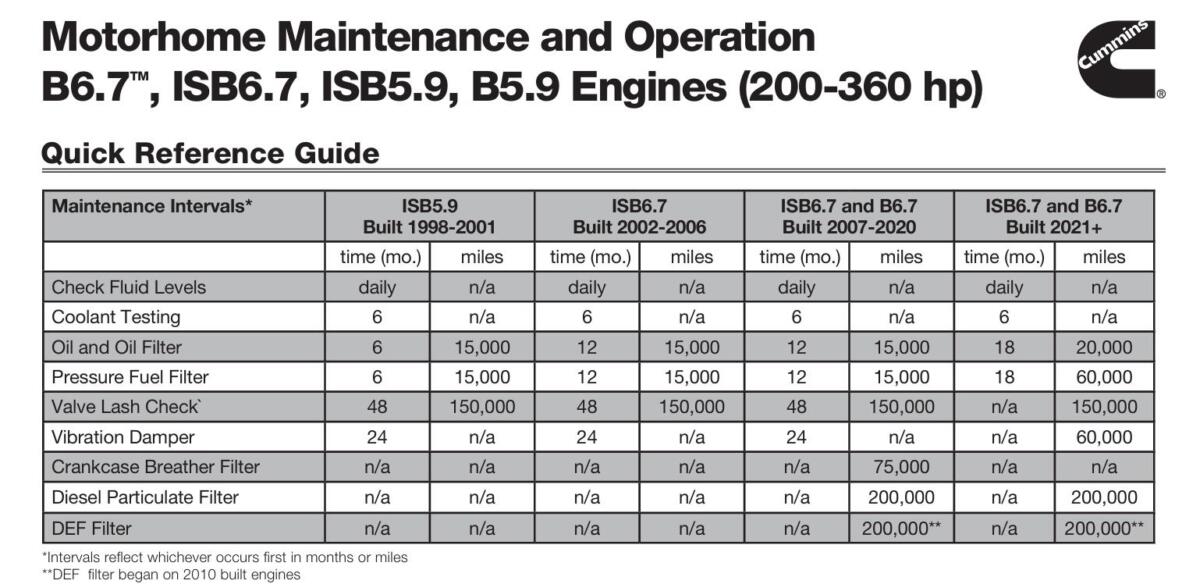
Here is what Cummins recommends for maintenance on their engines.
You might also enjoy these posts from Dave
- My RV’s decals are faded and cracking. Can I just paint over them?
- Can I use a pressure washer to clean off my RV?
- Update on Audi with bad fuel; additive recommendation from RVtravel.com reader
- Is Top Tier gasoline really necessary?
DAVE HAS ANSWERED MORE THAN 1,000 readers’ maintenance and repair questions. Read a directory here. There is so much to learn!
Dave Solberg is a leading expert in the RV industry and the author of the “RV Handbook.”
HAVE A QUESTION FOR DAVE?
Send your inquiries to him using the form below.
RVDT2914

Running a lawn mower for 65 hours is nothing like running car/truck engine for 6,000 miles. The tolerances in the vehicle engines are very close and that engine is put under a lot of strain with fluctuating rpm’s, changing loads, high temperatures and even weather conditions that affect the wear and oil contamination from moisture in the air. Not to mention the sludge that lays in the oil pan and valve covers.
BTW, I change the oil in my lawn equipment and snowblower at the end of each season.
Car and truck between 4-5000 miles.
I fully agree that engine tolerances are a big part of the oil change frequency. It isn’t so much that the oil is bad. It can be recycled, whether it came from the dirt or the lab. The issue is the contaminants. Even the best filtration has its limits. Our lawnmower has a B&S engine made in 1990. Yes, it is starting to burn some oil. I realized I was doing the equivalent of an oil change each season, so I let it go 3 years. I just drained it. The oil was likely good except for the built up sludge at the bottom. So it isn’t the oil, it is what has accumulated in the oil.
What I’ve heard over the years is that on some small engines, the crankshaft dips into the oil to splash it around on the internal parts for lubrication. After the oil’s been in the running engine for a while, it will contain contaminates. If the engine has stopped with the crankshaft throw sitting in the oil, over time, the contaminates can corrode the crankshaft bearings.
An oil change at the recommended intervals is going to help save that engine. After all, 4 or so quarts for an auto engine or one quart for a mower is not that expensive. I have always told my sons to change the engine oil as recommended – It’s the cheapest insurance you can buy.
Bill
Due to the limited use of my motorhome, I have the oil tested each Nov by Blackstone labs. Reports are very interesting and complete. I use Valvoline or Mobil 1 synthetics oil. I also start the engine about every 30-45 days or on warmer days in the winter running the engine OIL to operating temp., which is substantially higher and takes longer than to cooling system operating temp.. The debate is whether wear and tear on the starter is worth the use vs wear on the engine. The problem with oil is the condensation which can pit rod bearings and other soft metals. Blackstone Labs offer recommendations with each report – “…pay me now or pay me later”! Well worth the info and wear trends!
Oil comments are valid, today’s oil is a far cry from 50 years ago. With the new VI’s and
ashless additives some auto makers have upped the change interval to 10,000 miles or more. Modern multi-vis oils don’t start to break down until the temperatures approach 320 degrees, the oil in my Harley on the hottest day in Florida never got above 210.
Farris metal is picked up by the magnet in the drain plug, other contaminants are filtered out depending on the size ( 5 to 10 microns ) friction, heat, degrades oil. Watch the temps, run engine to operating temperature to dissipate condensation and change your oil in intervals you feel comfortable with.
Thank you for sharing the question and subsequent discussion, Dave. I have seen some synthetic oil listing a 7,500 mile separation between oil changes. Not so? Have a great day and safe travels!
While oil does not “wear out “ yes you can buy recycled oil. The problem is the person that drives to the grocery store once a week and the oil never gets up to operating temperature +210 F to boil off any condensation which will ruin the bearings. The reason you need to change your oil every 3-5 thousand miles is the additives that is in the oil that wear out and need to be replaced. The other issue is the combustion process is not perfect and fuel vapors and exhaust gases get in the oil and contaminate the oil. Anything newer than 2000 model year should be running synthetic.