Home Blog Page 2107

Adjustable cutlery tray expands to fit your drawer


Adjustable Cutlery Drawer

By Bob Difley

No more fishing around in a cluttered cutlery drawer for what you need. No more wasted space between your cutlery tray and the sides of your drawer.

It’s not exactly magic, but a simple idea that works. The Camco Adjustable Cutlery drawer pulls out from either side to fit your drawer, from 9 inches to 13 inches wide.

  • Features:
    Adjusts from 9″ to 13″ x 1.75″ tall
  • White
  • Easy to use and store
  • Durable

You will find the cutlery tray on Amazon

You can find Bob Difley’s RVing ebooks on Amazon Kindle. Follow on BoondockBobblog.

##bd1-17; ##RVT778

The readers write — Rants and back-pats


Edited by Russ and Tiña De Maris

Rambling Reviews

The video feature, A bit of rambling on a Friday Night, took plenty of commentary from readers. Most of it positive, and we’ll acknowledge too, that some with limited Internet bandwidth access feel a bit slighted. Here’s just one of the notes that came in.

Pamela had a suggestion on doing something about woeful quality control issues from RV manufacturers. “What if consumers made buying an RV like buying a home? When the RV came to the dealership, before signing the contract and paying for the RV – what if the consumer had an inspection done and a “punch list” that had to be taken care of before the final purchase went through? A buyer could then have another inspection done before signing and if items weren’t fixed right the first time, another “punch list” would be generated that had items to be done before the purchase actually took place. Do you think that would encourage manufacturers to get it right the first time and place more emphasis on quality control?

And we couldn’t resist publishing a “back pat” letter from Sandra A. “My friend’s father recommended that we get hooked up with your newsletter, and I must say… I’m so very grateful for his suggestion!!! My husband and I are getting prepared for our very first RV purchase, and the information you have here has taken us from ‘Oh my gawd, what are we getting ourselves into!’ to, ‘Oh hey that’s what that is! Ok, that’s not so bad!’

“So, please know that you’re information is definitely helping this newbie family learn the ropes about RVing while still enjoying our wanderlust call! (Without breaking into full blown tears of misery cuz we didn’t know how to properly manage our tanks…)
Thank you for the video (hope they become regulars) and thank you for fighting for better quality in RVs! My whole family is riding on them, they better make them good dangit! (I’m sure y’all feel the same way too.)”

Carbon Monoxide (Issue 777 news item)

Greg Illes sent his own experience to emphasize the importance of this matter.

“We use (rarely) a portable generator, and one rainy day we ran it at the rear of the motorhome, underneath the overhanging tail. The exhaust was pointed away from the rig, and the wind was blowing in the same direction, taking the exhaust away. Within about 10 minutes, our CO alarm went off, even though we couldn’t smell anything and had no symptoms at all. No headache or smarting eyes, no odor of any kind. Needless to say, we moved the generator away from the rig, but it took another 10-15 minutes for the CO to clear out and all to be well again.

“CO is about the same density as air (which is mostly N2), and so neither rises nor falls in an enclosure. But since it’s in exhaust gas, which is warm, it will initially rise. That’s how it got into our motorhome.

“Lessons Learned

“ALWAYS have a CO detector, and make sure it’s working. NEVER run our generator underneath our rig. (Note: If the wind is blowing wrong, you might even have issues with a built-in generator, with wind blowing the exhaust back under the rig.)”

Boondocking Blight

Yes, it’s true, Chuck did tell everyone to hold their ‘boondocking recommendations’ in his Editor’s Corner piece last week, still Jim couldn’t resist sending a cautionary note: “We have been full timing for over eight years now and spend a lot of time each year boondocking. The news I have for you is those locations, too, are becoming overrun. There is no shortage of inconsiderate campers. Enjoy the garbage, clay pigeons and used ammunition even when there aren’t noisy campers to contend with.

“That said, boondocking is still the better option.”

Selling the house to go Full-Timing

Bob Godfrey got the ball rolling as he pondered the situation: “Having sold off our “stuff” and moved into our motorhome full time in 2010, we have seen 45 states and eight Canadian provinces and have loved the travel. However, I will state that there are times (for me not my wife) where I just want to return to a ‘home base’ and have a garage again and workshop, so I see one of the considerations as ‘Can you afford to purchase again?’ when you return from your adventures; and since we are all aging, where would you like to stay for the rest of your life once you can no longer live on the road?

Tommy Molnar had a quick response: “Your last sentence says it all, Bob. ‘Where would you like to stay for the rest of your life once you can no longer live on the road?’ Because at some point I think we all will arrive at the time when we can no longer drive. That kind of puts a clamp on your wanderlust. We will keep our house as a ‘base camp’ and head out on multi-month trips with our travel trailer knowing we have a place to return to – and PLOP for a while.”

Still, at least one other fulltimer takes a bit of a different view. This thought from P. Jane McRae: “I will always live on the road, live and die this way. It has been the best decision of my ENTIRE life. Been three years now, with just me and my Winnie class A, and I cannot possibly imagine living anywhere else. So, no, for me there’s no going back to ‘home base.’

Again, thanks for all of your comments, rants, and cheers. We’re limited on just how much we can publish in our review, but know, all of your comments are read – and appreciated! And thanks to KristinNador on flickr.com for the 1924 Corona typewriter keyboard image. 

Where to go to find warm winter weather?

10


Dear RV Shrink:rvshrink
We have decided to spend our second winter on the road in Florida. We spent our first winter in Arizona and froze to death. We thought Arizona was like Hawaii but found out that is not the case. Now we are cold in Northern Florida and I want to go to Mexico next year. My husband refuses to take our RV into Mexico, so where the heck can I go for the winter and be warm? I might just as well stay home next to the wood stove. —Cast member from the movie “Frozen”

Dear Frozen:
If you don’t want to go to Mexico and keep heading south until you find warm weather, do it in Florida. It’s a very long state with lots of micro climes. The farther you head south the better your chances of finding warmer weather.

You are right, the desert gives up its warmth at night and you will experience many more cold nights and mornings in the West. The days are typically warm and sunny, but you have your windows opened at night much less than if you were in a climate like Southern Florida.

How about meeting halfway? Try Brownsville, Texas.

You may not find the utopia of weather in the South during the first couple months of the year, but it still beats chopping firewood. You could be like the cast member Elsa and just “Let it go.” —Keep Smilin’, Richard Mallery a.k.a. Dr. R.V. Shrink

Can’t get enough of the Shrink? Read his new e-book: Dr. R.V. Shrink: Everything you ever wanted to know about the RV Lifestyle but were afraid to ask or check out his other e-books.

##RVT778


Forest River recalls Toyhauler, Fifth Wheels

0


Forest River is recalling 556 model year 2017 XLR Toyhauler and Prime Time Spartan recreational fifth-wheel vehicles manufactured August 21, 2016, to December 12, 2016. The affected vehicles have rear cargo door hinges with welds on the hinge pin and hinge plate that may be insufficient, and as a result, the top of the door may swing down with more force than normal, increasing the risk of personal injury.

Forest River will notify owners, and dealers will replace the ramp door hinge, free of charge. The recall is expected to begin February 27, 2017. For more information, XLR owners may call 1-574-642-0432 and Spartan owners may call 1-574-862-1025. Forest River’s number for this recall is 51-12312016-0310.

##RVT778

Full-time RVing: Self-storage insurance for peace of mind


By Russ and Tiña De Maris

A wannabe full-timer posted this query on an internet forum:

John R. Southern on flickr.com

“We are planning to RV full time for about a year. When our home sells, we will place our personal effects (furniture, etc.) in storage and go on the road. Our problem is that our insurance company will not insure our goods when they are placed in storage. As long as we have a house, our homeowners insurance covers the items in storage, but as soon as we sell the home it stops. We were offered insurance through the storage company, but it was very expensive.”

What’s a person to do? Many wannabe full-timers face similar decisions: Unsure if they’ll really enjoy the lifestyle, they don’t want to burn their bridges, so they hang on to various possessions and see how things develop. Not all insurance comes from a “homeowner’s policy.”

Some self-storage outfits will be happy to point you in the direction of insurance – and it may well be that these folks aren’t always looking out for their customers’ best interests. It could be what you’re offered in terms of rates could, in fact, meet the criteria of the poster’s description of “very expensive.”

The Internet comes to the rescue, however. Depending on what “very expensive” is in your book, we were able to set up a scenario wherein an RVer wanted to insure his storage unit items for $10,000. Using an Internet advertised self-storage insurance program, we got a quote for $38 a month. If that’s not expensive, it may be a way to give yourself peace of mind. Here’s a link to one such provider, MiniCo Customer Storage Insurance. [Editor: Not connected with RVtravel.com, and we are not making an endorsement — just listing for information purposes.]

Read the “frequently asked questions” and the “terms and conditions” closely. Not everything that can be stored is covered, and not every peril is something that comes with a payoff. For example, this company excludes payoff if your stuff is damaged by a flood — and there are several ways to define a flood. But if you find your situation is compatible with the insurer, it may take care of a nagging problem and let you get on with your new lifestyle. 

##RVT778

Wash your rig with dish soap?

By Russ and Tiña De Maris

When RVtravel.com ran a video that espoused the idea of cleaning RV exteriors with water and liquid dish soap, it didn’t take long for a reader to respond. We were well chastised for the suggestion. “Dish soap is known to soften automotive paint,” came the comment. “Never ever, ever use it on a painted surface.”

To these writers, who’ve been using Dawn in a bucket on their trucks and cars for years, it was a “new wrinkle.” But you learn something new every day, so we set out to find out the facts behind the stories. And it’s hard to pin down a truly authoritative “horse’s mouth” on the subject while there are, admittedly, a lot of other horse’s parts ready to spout off on the matter.

The consensus of opinion from what we’d consider the professional sources seems to boil down to this, as lifted from autos.com: “Dish washing detergent, for the most part, is safe for car finishes. Nothing in dish washing detergent will actually harm your vehicle’s finish, but there are some differences between dish washing detergent and soap that is made specifically for vehicles. One of the differences is that some of the ingredients in dish washing detergent will also effectively strip the waxes and polishes you may have applied in the past off of your vehicle’s paint.”

Will you “hurt the paint”? Doesn’t sound like it. Will you make yourself more work? Pretty likely. If you want a shiny surface, you’ll be back to rewaxing after you wash your rig with liquid dish soap.

But hang on — How many of us have RVs with a finish job like on our toad cars? Not too many. In fact, the swing in industry is to fiberglass with gel coat. What about using liquid dish soap? Here again, the consensus is similar: It won’t actually harm the rig itself, but dish soap will wipe out any wax, leaving you with a need to rewax to get that old shinola back.

If you have a fiberglass-sided rig that’s been seriously neglected, a bit of bleach and dish soap in your water bucket may actually clean the nastiness off the rig. And then you’ll have an opportunity to build up your biceps doing the Mr. Miyagi (“Wax on, wax off. Wax on, wax off” — from “The Karate Kid”).

In any event, if you want to preserve the wax finish, spend a couple extra bucks and pick up soap designed for auto or fiberglass washing.

##RVT778 ##RVDT1285

Ask BoondockBob: Do you leave your porch light on?


Here’s a question from a reader of RVtravel.com about boondocking. Do you have a question for Bob? Email him at bob.rvtravel (at) gmail.com .

Hi, Bob,
In last Saturday’s RV Travel newsletter, Chuck mentioned that his neighbor leaves his RV’s outside lights on. He commented, “I don’t think he had given any thought to other campers who might enjoy something at night other than his light show.” I’ve often left my porch light on when boondocking as a safety measure. Do I need to rethink this practice as well? —Barry M.

Hi, Barry,

Boondocking

It’s a common practice for many RVers to leave their porch lights on when away from their RV, especially if they intend to return after dark. This could be interpreted by would-be thieves that there is no one home and therefore an easy break-in target. So leaving your light on is not necessarily a good safety measure.

Secondly, thieves do not usually roam around boondocking areas looking for targets, so providing you take other security measures, e.g., locking your door, not leaving loose items outside, etc., should be enough security. But I do admit to being grumpy when other RVers diminish my camping experience, especially leaving the porch light (and other outside lights) on when they are not outside to enjoy them, maybe thinking they are providing an enjoyable light show for their neighbors. However, I would much rather see the night sky full of stars, the absolute darkness of a lightless night, and the scurrying about of night critters, which I am unlikely to see if my vision is compromised by bright lights. And not leaving these lights on will also prolong your battery power to produce electricity when you really need it. 

Read more about boondocking at my blog.
Check out my Kindle eBooks about boondocking at Amazon.

Do you have a question for Bob? Email him at bob.rvtravel (at) gmail.com .


How to thaw frozen holding tanks

2


gary-736Dear Gary,
I think I really messed up. Last night the temperature dropped to minus 5 degrees. I thought about the fresh water and left it dripping at a faucet, but I never thought about the holding tanks. They were left closed and by the time I thought about it at 2:00 a.m., it was too late. What is the best way to get them thawed out? The temperature is supposed to stay below freezing for a couple of days. Thanks! John R.

Dear John,
If your holding tanks are not in a heated compartment but are protected by a subfloor or an enclosure on the bottom of the coach, a drop light with a 100-watt bulb placed within the same void will eventually thaw the contents of the tanks, albeit somewhat slowly.

If the tanks are exposed underneath the RV, a common hair dryer, or better yet a heat gun, can be used to gradually thaw the tanks. But be extremely careful to not allow the gun to stay focused on one portion of the tank for very long; it can easily melt the plastic container. Slowly moving the heat gun over the bottom of the tanks in a slow arc will eventually de-ice them. It may take a while, depending on how large the tanks are, but they will eventually thaw.

Be very sure the tanks are completely thawed prior to operating the waste valves for evacuation. It’s okay to also use the heat gun on the valves themselves, just don’t linger too long in one spot. In the future, you can always add windshield washer fluid (if permissible in the sewer system in your area) or RV anti-freeze to each tank to keep them from freezing. The fuller the tanks, the less likely to freeze. Just keep adding a half-gallon of anti-freeze each day the temps remain below freezing.

Read more from Gary Bunzer at the RVdoctor.com. See Gary’s videos about RV repair and maintenance.

##RVT778

Prevent theft with heavy-duty battery lock


Battery Shackle battery lock

By Bob Difley

Prevent theft with a heavy-duty dual-or single-battery lock from Battery Shackle of Redding, CA. Perfect for anyone out hunting, camping, or fishing or leaving an RV in storage. It is the only dual/single battery lock of its type on the market.

Top-Quality Materials

The American-made locks are manufactured from the finest steel by certified welders. These dual-battery locks feature all-steel, welded construction and cannot be broken into by most common burglary tools. This is a potential thief’s nightmare.

How It Works

The Battery Shackle comes in three pieces:
One that goes underneath,
One that goes on top,
And a bar that goes through the middle of the battery boxes.

It is very user-friendly and easy to install. It typically takes under two minutes – no tools required.

You can find the Battery Shackle on Amazon.

You can find Bob Difley’s RVing ebooks on Amazon Kindle. Follow on BoondockBobblog.

##bd1-17; ##RVT 778

Question about installing 50-amp RV outlet at home


Hi Mike,
I’m about to have a 50-amp RV outlet installed at my home. I’ll have the 50 amp installed or purchase a 50 to 15 adapter and run an extension to the garage. The 15 amp would probably be fine as the only reason desired is to charge the batteries overnight. Worst case would be to run 15 amps from one of the two outlets in my 2016 F250. Thank you. —John

Hi John,
So, if you’re going to use a 15-amp male to 50-amp female adapter (rather than a 50-amp male to 15-amp female adapter) that will be safe for charging batteries and running some lights, but you’ll certainly not be able to start an air conditioner with that limited amount of power. I think when you said 50 to 15 you really meant a 15-amp to 50-amp dog-bone. Here’s the difference and why it’s dangerous to run a 50-amp to 15-amp adapter.

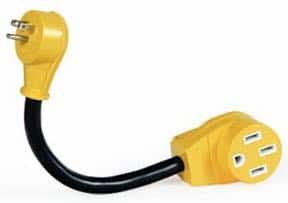
To the right is a 15-amp male to 50-amp female dog-bone. Since the circuit breaker feeding the 15-amp outlet will limit the current to 15 amperes, you’re safe using this with a standard 14-gauge extension cord. And if you do happen to draw too much current, the 15-amp circuit breaker in your house will trip, protecting the extension cord from overheating and possibly catching on fire.
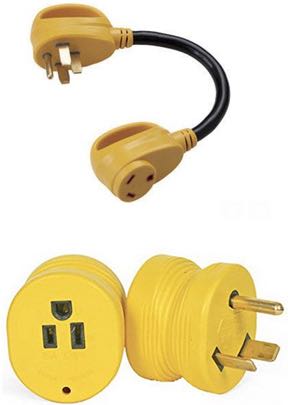
However, I’ve seen a few forums that recommend the opposite, where you use a 50-amp male to 15-amp female adapter to power a small RV from a 50-amp pedestal outlet. Usually it’s by a combination of two adapters, a 50-amp male to 30-amp female, then going to a 30-amp male to 15-amp female.
That would allow you to easily overload a 15-amp extension cord with up to 50 amps of current. And that’s not only an electrical code violation, it’s a real fire hazard. Watch my video below where I overload an extension cord on purpose while monitoring it with an infrared temp gauge.

Let’s play safe out there….

Mike Sokol is an electrical and professional sound expert with 40 years in the industry. Visit NoShockZone.org for more electrical safety tips. His excellent book RV Electrical Safety is available at Amazon.com. For more info on Mike’s qualifications as an electrical expert, click here

##RVT777


RV Travel Reader RVs, Jan. 21, 2017

4


Send a photo of your RV and a 150- to 200-word description of it, how and where you use it, and what you like or don’t like about it, to Diane (at) RVtravel.com . Be sure to include your name(s) and hometown, or if you’re a full-timer. (These are posted in the order received.)


The RVs of RVtravel.com readers and how they use them

Issue 70; Posted Jan. 21, 2017


Joe Kleinsmith, Full-timer

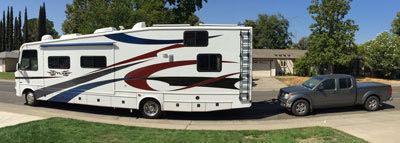
In the 1950s I helped my father build a 12-foot pop-up trailer, and in 1967, when slip-on campers were introduced, my father and I, then 16 years old, built a 25-foot Class C mounted on a 1-ton Dodge with a 440. Since then Dad had all Class A’s, a 30-foot Apollo and a 36-foot Elite pusher.
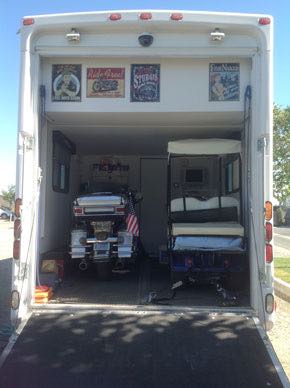
Since retiring from the Army, I purchased, new, my own 2008 Damon 37-foot Outlaw Class A Toy Hauler with an 8.1 L GMC engine on a Workhorse chassis. Inside is a full-dress Harley and Cricket golf cart, and behind I pull a ’07 Nissan Frontier with a 6-foot bed.

Like many, I made some improvements and upgrades to make life easier. I removed all decals and replaced with custom paint, upgraded the suspension with steering stabilizer, rear track bar, front and rear anti-sway bars, satellite, solar system, added a Total Vision Pan and Tilt camera system, replaced the garage bed with a storage box, added a side collapsible ladder, and changed over to LED lighting, among others.
I’ve done my share of travel overseas in the military and now travel with my biker dog, a miniature English bull terrier, exploring the U.S. and Mexico. I have visited popular RV cities and sites such as Branson, Nashville, Dollywood, Mount Rushmore, Sturgis, Indianapolis Raceway, etc. Now I visit a different state each year and travel all over searching out history, national parks and places of interest en route to a particular state and then returning to my snowbird nest. Like many, I try to avoid traveling on the same roadways so I can see and experience more. In 2016 I visited Colorado, in 2015 I went to Utah, 2014 was Oregon and Washington, and this year Tennessee is on my list. Even while snowbirding I take side trips to RV rallies and Quartzsite, and next month I’m going to Puerto Peñasco, Mexico.

I’ve put over 50,000 miles on both the Outlaw and Harley, and we’re only getting started.


Steve and Yvonne Barnes
, Kamloops, British Columbia

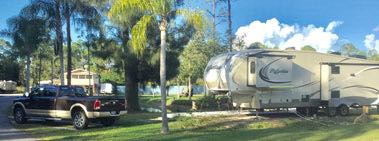
The photos are of our 2015 Grand Design 36-foot Reflection and 2017 3500 Ram at Punta Gorda, Florida.
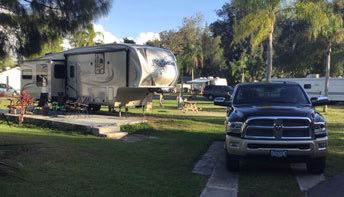
We recently started our return, five-month trip from Kamloops, B.C., to Dry Tortugas, Florida Keys, across the Gulf to California and return to B.C. Our predecessor 2004 Ram took us 90,000 kilometers, 50,000 miles, over seven years, in 43 months. This current trip was a benchmark. Ohio completed our visit to, or at least touching on by RV, 48 contiguous states and 10 provinces including Newfoundland and Labrador.

Unlike most Snowbirds, we like to keep moving, one week or less per site, because there is so much to see in this great land. New York City is our favorite but the most expensive camping ever: $90 for a “parking lot” site in Jersey City on the Hudson looking at the Statue of Liberty. Worth it, for you never use your car. This site is the closest to NYC, just 20 minutes downtown by train under “Sully’s” Hudson River.

Never thought NYC would seem cheap. Florida Keys, especially Key West, rates go $135 per night or more. State Parks are the bargain at $45, for two weeks maximum, but must reserve a year in advance. Senior residents of Florida are half-price.

Alaska may have to be a spring inside passage cruise because living on Kamloops Lake at the north tip of this Canada desert extending north from the Spokane, Washington, area, in occasional 40 degree Celsius, 100 degree Fahrenheit heat, keeps us enjoying the lake most summers. Yes, we have cactus, but only 2″ high. Our rattlesnakes are the same size as the American ones.

Anyway, we make the most of our time on the road while we still can. We say to anyone who will listen: Do it now, on any budget you can; incapacity comes without warning.


Copyright © 2017 by RVtravel.com

MORE IN A COUPLE OF WEEKS

Click here to see the last issue of RV Travel Reader RVs.

Make water last longer when boondocking


Here’s a question from a reader of RVtravel.com about boondocking. Do you have a question for Bob? Email him at bob.rvtravel (at) gmail.com .

Hi, Bob,
I find that I run out of water too quickly when boondocking. How can I either carry more water or conserve better? —Mike P.

Hey, Mike,

Coyote Camping near Lake Havasu, Arizona

There are two main ways to make your water last longer when boondocking. The first is to learn how to conserve your water usage, like taking “Navy” showers, not letting the water run when brushing teeth or washing dishes (turn on and off as needed), and collecting the water you run while waiting for it to get hot to use for rinsing dishes, cooking spaghetti, etc.

The second is to carry extra water in portable containers. Collapsible 5- gallon containers and Jerry jugs are the most common way. As your water tank level drops, pour the extra water into the outside water fill using a funnel to reduce spillage. Carry the empty jugs with you when you drive for supplies or sightseeing and refill them.

Read more about boondocking at my blog.
Check out my Kindle eBooks about boondocking at Amazon.

Do you have a question for Bob? Email him at bob.rvtravel (at) gmail.com .

##RVT777