Home Blog Page 2173

Macerator pump makes RV dumping easier

By Bob Difley

My best guess — and this is just a stab in the dark — is that there aren’t too many RVers that look forward to their visits to the dump station. There is a way, however, to ease the pain of dumpstationitis. FloJet’s portable RV Waste Pump System enables emptying your waste tanks with minimal hands-on (the ugly part) requirements.

The macerator section of the system grinds waste down to a particle size of 1/8″ maximum so it can easily be pumped through a garden hose (5/8″ minimum). The pump section is self-priming, permitting the unit to be mounted above the tank in a convenient location.It will empty a typical 40-gallon holding tank in less than 5 minutes. You should never run into an issue as the pump operates and empties tanks very quickly. When pumping through a 5/8″ hose you have a maximum range of about 25 ft., but when using a 3/4″ hose you have a pumping range of about 50ft.

The 18555-series waste pump will macerate and pump all waste and tissue normally found in recreational vehicle waste systems. But, it is not a garbage disposal. It will not handle solid objects like sanitary napkins or rags.

Learn more about the FloJet Waste Pump System at Dyers RV Parts and Accessories or on Amazon.

##rvt742

Decoding motor oil container mystery codes

By RVtravel.com staff

Q: What do the numbers and letters in a motor oil designation mean?

A: There are several different items encoded. There is a two-letter code indicating the type of detergent package that the manufacturer uses in the oil; this looks like SE, SF, CD or such. The S codes are for gasoline engine applications; the C codes are for diesel engine applications. The second letter is assigned in sequence as new levels of protection are developed; thus SF is considered better than SE, SE is considered better than SD, and so forth.

The more noticeable designation is the oil weight. This is either a single number (e.g., 30 weight) or a pair of numbers separated by the letter W (e.g., 10W30.) The latter type is much more commonly used these days, and are the only type that most automobile manufacturers specify in operators manuals. The first number in the designation (10W) is the apparent viscosity of the oil when it is cold; the W stands for “winter.” The second number (30) is the viscosity of the oil when hot. There is a trick here: The oil doesn’t actually get thicker (turn from 10 weight to 30 weight) as it gets hotter. What is actually happening is that when the oil is cold, it has the viscosity of a cold 10 weight oil. As it gets hotter, it doesn’t get thin as fast as a 10W oil would; by the time it is up to temperature, it has the viscosity of a hot 30 weight oil.

Note that these numbers actually specify ranges of viscosities; Not all 10 weight oils have exactly the same viscosity when cold, and not all 30 weight oils have the same viscosity when hot.

photo: iowadnr.gov

Beware of RV gas pains!

0

By Russ and Tiña De Maris

When RVers think of gas pains, they may think about the price they have to pay for a fill-up in California. Ah, but there’s more to gas than gasoline.

RVers are rightly concerned about having enough battery power. But with batteries come dangers — some not easily recognized. Charging batteries produce hydrogen gas, a highly explosive byproduct. Hydrogen is not something to fear, but respect.

To keep safe:

  • Always have plenty of ventilation in the battery compartment. Make sure that hydrogen gas can easily vent to the outside atmosphere.
  • Never operate RV batteries inside the coach. The living quarters of the rig is no place for an explosive atmosphere.
  • Don’t set up equipment in the battery compartment that could spark — that includes power inverters.

Move your travel trailer by remote control

By Eric Brotman
RVtravel.com

Power trailer movers can make an RVer’s life a whole lot easier — if certain criteria are met. The mover should be powerful, not too greedy with battery power and, as rolling backwards on a hill ranks high on the RVing nightmare list, the mover must hold position when your trailer is stopped on an incline.

Purple Line’s e-go power trailer mover claims all those qualities, and more, so I was curious to hear what Paul Liner, the company’s managing director, would say when asked, “What makes your mover different from the ones manufactured by the competition?” He gave an unexpected answer. “It fills the objective,” Liner said, “of doing something for you.” Meaning, he explained, it makes life easier for the RVer in the following ways:

• Once installed, the e-go is a permanent fixture — no hassles with storing and retrieving the mover.
• Adjustable roller pressure on your tires results in secure traction under various conditions.
• Its “soft start” allows for steady, gradual motion — there’s no lurching.

Hitching and unhitching also looks easy with a cleverly designed handset remote control. Six buttons let you move forward, forward right, forward left, backward, backward right and backward left. Holding down buttons simultaneously in various combinations allows for tighter turns. The e-go maneuvers a trailer out of, or into, a sloped driveway safely and provides the control necessary to park in spaces where clearance on both sides of your rig is tight.

One of Liner’s customers told him, “The e-go makes parking my trailer between my 4 x 4 truck and the house a breeze.”

The e-go can be purchased for either single or tandem axles. The Safe Working Load (SWL) provided by two motors on a flat, dry surface is 5,000 pounds. On a 25-percent incline, its SWL is up to 3,300 pounds. With four motors, the SWL on a flat, dry surface is 7,800 pounds; and on a 20-percent incline, up to 5,500 pounds.

In addition to the introductory video, above, the Purple Line website has an installation tutorial video and a comparison test video. (NOTE: The videos were produced in Australia. Aussies call all trailers “caravans,” so don’t mistake their use of the term as endorsement of a particular brand.)

The e-go can be purchased at Purple Line’s website and elsewhere online, including Amazon.

RhinoFLEX sewer hose works exceptionally well

By Chris Dougherty
Certified RV technician

One of the most unpleasant tasks in RVing is handling waste. Nothing incenses an RVer more than a dump station visit gone bad, and yet all too often people opt to purchase substandard sewer hoses and fittings to save money and end up with a mess.

Inferior sewer hoses are susceptible to cracking, crushing, unraveling and punctures. Poor fittings may not stay secured to the hose or may not fit properly in the sewer connection. This can result in a messy situation and spill that the RVer is responsible for.

There are many RV sewer hose systems on the market, from the aforementioned cheap products to “Cadillac” systems that cost hundreds of dollars. Now these “Cadillac” systems work well, for sure, but most RVers are priced out of buying them.

I have found and extensively tested a system with multiple clients that is holding up exceptionally well. Its Camco’s RhinoFLEX sewer hose system, which the company touts as the world’s toughest sewer hose. They have designed a hose made of heavy-duty polyolefin reinforced with steel wire that, like a straw, will hold its shape no matter what position you bend it into. This is a great feature for storage as, once disconnected, the hose compresses down into a firm collapsed package, while traditional hoses spring around everywhere. A 10-foot hose compresses down into a 32-inch package, and the 15-foot hose to just 45 inches for storage.

The connection system for the RhinoFLEX is also unique and very strong. Utilizing a four-pin connection over the standard two, the bayonet connectors have built-in swivels and the removable hose ends lock onto the hose with locking rings, which allow the ends to be swapped around as needed.

I am particularly fond of this system for fifth-wheels that have multiple sewer connections at different points on the RV. Utilizing one or more RhinoFLEX wye (“Y”) fittings and a variety of hose lengths, all the sewer connections can come together to feed into one sewer connection.

RhinoFLEX hoses are available in complete kits of 15 and 20 feet each, and hoses are available in 10- and 15-foot sections, and 5- and 10-foot extensions, all with removable and swappable ends. In addition to the wye, translucent and clear fittings are available in 45- and 90-degree bends, as well as a swivel elbow fitting with a 4-in-1 sewer adapter.

While these systems aren’t cheap, they’re cheap insurance against a poo bath and will outlast the competition by a long shot.

The RhinoFLEX hose is available at Amazon.com, and at your favorite RV retailer.

More information on RhinoFLEX as well as Camco’s other sanitation products can be found at camco.net.

Stick on pods add storage in unused spaces

There are few really active RVers who claim to have enough storage in their rig. And, unfortunately, too many of the storage places we use end up with stuff out of sight on the bottoms of drawers or unseen at the back of lockers.

pods-737One solution for the storage of small, easily misplaced items is to make use of areas not normally designed for or used for storage, such as the inside of cabinet doors. StickpOnPods are a clever new solution that will do just that.

The clear and tinted plastic pods stick on to the backs of cabinet doors (such as your medicine cabinet) for storing cosmetics, toothbrushes, eye-liners, lipstick, Q-tips, nail polish–in fact all those items that migrate into places where you can’t find them.

They stick on easily, leave no residue when removed, and can be stuck onto any wood, granite, glass, or tile surface. Stick them on the refrigerator to keep pencils, pens, note pad, and swizzel sticks, inside a closet door for quickly accessed tools like screwdrivers and pliers, or in the crafts closet for brushes and pins for your voodoo dolls.

Let your imagination be your guide and you will find numerous uses and locations to stick up your StickOnPods, which you can find on Amazon.

Siphon vent removes sewer odors from inside RV

You’ve heard of the venturi effect, and you likely know that there are people who make a life’s work out of studying how wind and air currents work. Some of these people specialize in sewer vent systems. Aren’t you glad there are, as that means the rest of us don’t have to?

So some of these people came up with the 360 Siphon vent, designed to not only suck out odious fumes from your sewer system (that’s tech talk for toilet) but also be easy to install, work forever, affordable, and other good stuff. RVtravel.com editor Chuck Woodbury has reported that after he installed his vent, toilet odors almost entirely vanished.

The manufacturer claims these 360 Siphon advantages:

1. ODOR FREE
By design the 360 Siphon can only create an updraft (laws of physics), and the possibility of odors and gasses from the holding tanks entering the RV living space are totally eliminated.

2. ENVIRONMENTALLY FRIENDLY
Waste breakdown will occur 3 to 4 times faster and more completely because of the constant, oxygen rich environment provided by the 360 Siphon. Caustic Chemicals such as Formaldehyde and perfumed cover ups are no longer necessary.

3. A HEALTHIER LIVING ENVIRONMENT
Breathe Easier when noxious fumes and gasses are no longer allowed to enter the RV living space.

4. EASILY INSTALLED
The 360 Siphon can be refitted to any existing RV usually in less than 20 minutes by anyone who can use a screwdriver and a putty knife (to scrape off any old sealants). This permanent, one time, maintenance free application replaces the existing factory installed vent caps.

5. AFFORDABLE
The 360 Siphon can be purchased from the 360 Siphon website. It is also available from several sources at Amazon.com.

Keep mildew away with compact dehumidifier

It’s only natural during the rainy season to close our RV windows to keep the heat in and the rain out. That’s all good, but this also traps moisture inside that results from cooking, showering, etc., setting up the potential for mold and mildew to develop. With little air circulation inside, it is important to dehumidify our RVs interior to prevent the mold and mildew gremlins from attacking in hidden and dark spaces.

dry-737The Eva-Dry Electric Petite Dehumidifier uses Peltier Technology (no compressor) which makes it light and quiet. It is perfect for RV’s which have small to mid-sized rooms, and is small enough to easily fit on a counter top or dinette. It extracts the moisture from the air and stores it in a spill-proof reservoir. Just plug it in and let it quietly dry the air.

Features

Automatic shut off switch shuts unit off when the water resevoir is full and “full” indicator light to alert you when the resevoir needs to be emptied.
Detachable tank that holds 16 oz. of water
Whisper Technology (no compressor) which makes it light and quiet
Small and easily portable- weighs 3 1/2 lbs
Off White Color
1 year manufacturers warranty from any manufacturer defects
UL and CE listed
Voltage: 9 Volts
Watt Usage: 23.4 watts
Draws 2.6 amps
Product dimensions: 8.5″H x 6″W x 4.5″D

The Eva Dry Humidifier is available from Amazon for about $48 (as of April, 2016).

Wife wants outdoor activities; husband wants TV

0
Dear RV Shrink:
rvshrink
After my husband retired he bought a TV satellite dish and internet card boosters for our rig and we started traveling full-time. I wanted to see the country, hike, bike and live in natural areas like National Parks and National Forests. I am finding we are spending most of our time looking for campsites with good tower signals, few trees that can block the satellite dish, and little opportunity for hiking and biking. It takes him almost an hour just to get his dish pointed in the right direction.

Every time I want to do some sightseeing there’s a big game on or something he just can’t miss on ESPN. We might just as well be parked at home in the driveway. I need your help if I am to enjoy this lifestyle of travel. How do I approach this problem without alienating my husband? —Signal Problem in South Padre

Dear Sig:
This should be fairly easy. Your husband just needs a little bit of reprogramming. You should spend an hour or so getting him pointed in the right direction. There is nothing wrong with having good communications. In fact, that is exactly what the two of you need. Your husband likes his sports and in this day and age with satellite communications he can take that with him anywhere, as you well know. It is the addiction to it that seems to be his problem. I would go as far as saying his couch potato ways will eventually cause him health problems. You should approach it from that standpoint.

I’m sure you have a travel budget for your finances. You also need a budget for your time. You both should budget time for your personal interests and time for activities you both enjoy together. It is easy to get into the slow mode and get stuck. You have to take the initiative to let your husband know your expectations of the RV lifestyle and negotiate how to blend it with his. Once you come to an understanding, you both should find plenty of time for the activities you enjoy both separately and jointly.

You don’t want your husband’s retirement to become your full-time job, so be more of a spectator and less of a referee. This early in his retirement he is still enjoying doing nothing and not having to worry about getting caught. Give him some slack and a little direction and I think you will find harmony and happier trails. —Keep Smilin’, RV Shrink

The RV Shrink is not really a psychologist (or professional RV technician). But he does knows a lot.

Read more by the RV Shrink

#rvs737

Where there is smoke, there is “firewood”

0
Dear RV Shrink:
rvshrink
We have our thirteen-year-old grandson traveling with us this summer and my wife and I are enjoying him tremendously. However, we never get any alone time, if you catch my drift. My wife is paranoid he might come bounding in the trailer at any time. He will be with us for two months and does not like to take part in campground activities without one of us tagging along. Do you have any suggestions on building his confidence to do things on his own? Frustrated in Fargo

Dear Frustrated:
The first thing you need is a code word. Make a joke of it. Start yelling “firewood” every time you approach the trailer, as if you are selling firewood. Your grandson will soon catch on and you will find him yelling “firewood” every time he comes back to the trailer. What this kid really needs is a paper route. Find out when the paper is delivered to the nearest campground store. Send your grandson for the paper an hour earlier than it arrives. Tell him if it isn’t in yet to wait for it. When you hear “firewood” you had better be done smoking. If this works for you your wife will really be surprised. Behind every successful man they say there is a surprised women.
Keep Smilin’, RV Shrink

The RV Shrink is not really a psychologist (or professional RV technician). But he does knows a lot.
#rvs737

Cooking fires: Bad news. What to do!

0
From the National Fire Protection Association (NFPA):

Cooking fires are the number one cause of home fires and home injuries. The leading cause of fires in the kitchen is unattended cooking. It’s important to be alert to prevent cooking fires, especially in the small confines of a recreation vehicle.
•Be on alert! If you are sleepy or have consumed alcohol, don’t use the stove or stovetop.

•Stay in the kitchen while you are frying, grilling or broiling food. If you leave the kitchen for even a short period of time, turn off the stove.

•If you are simmering, baking, roasting or boiling food, check it regularly, remain in the home while food is cooking, and use a timer to remind you that you are cooking.

•Keep anything that can catch fire — oven mitts, wooden utensils, food packaging, towels or curtains — away from your stovetop.If you have a cooking fire:

•Just get out! When you leave, close the door behind you to help contain the fire.

•Call 9-1-1 or the local emergency number after you leave.

•If you try to fight the fire, be sure others are getting out and you have a clear way out.

•Keep a lid nearby when you’re cooking to smother small grease fires. Smother the fire by sliding the lid over the pan and turn off the stovetop. Leave the pan covered until it is completely cooled.

•For an oven fire, turn off the heat and keep the door closed.

Download these NFPA safety tips on cooking. (in PDF format)

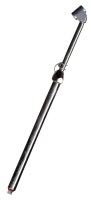
RVers’ tools: Dual foot tire gauge

Maintaining the proper air pressure in your RV’s tires is essential, as it is for your tow or towed vehicle. There are lots of cheap tire gauges out there, but do yourself a favor and invest in a good-quality gauge.Dual foot tire gauges have a special foot that makes it easier to access different types of valve stems, including those on dual wheels without valve extenders. Dual foot tire gauges are designed for the trucking industry, so they are calibrated to much higher PSI ratings than automotive ones and tend to be much more accurate.

Have an electronic Tire Pressure Monitoring System or TPMS? You still need one of these. If one of the sensors is giving wacky readings, you need a good gauge to confirm whether it’s right or not!

There’s a good selection of these gauges at Amazon, Camping World, or at your local Pilot Flying J. They’re in the tool section with all the big rig stuff!