


By Steve Savage, Mobility RV Service
I don’t understand. Given how simple it is to weigh an RV, whether driven or towed, and how little it costs, why aren’t folks weighing their RVs? On the Internet, I read frequent discussions related to weight: “Can my truck pull this?” “Can my tires carry that?” Yet it is seldom the case that the folks participating in the discussion know the actual weight they will be towing or carrying, let alone the total weight of their truck or tow vehicle when it is full of fuel and loaded as it would be for whatever foray they have in mind.
 For those who are not sure how to weigh their tow vehicle and trailer, I normally proceed like this:
1. Find a travel center that has a CAT scale where tractor trailers weigh their trucks. You can find a list here.
2. Go to one with your rig in tow. You can do this on a trip. Fill whatever is going to do the pulling with fuel, along with whatever will be riding in it on the trip.
3. Tell the person at the counter you want to weigh your RV. They will say, “Go for it” — as your money spends just like truckers’ money does!
4. Drive up on the scale and run your front wheel over the first divider. Your rear wheels will be on a separate part of the scale and your trailer will be on its own pad.
5. In a second, a green light will signal you to come in and pay your money and get your weight receipt. On the receipt will be weights for your steer wheels, your drive wheels, and your trailer.
The procedure may vary slightly, but it is always very simple, and never once has anyone sent us packing when we asking about weighing our truck and RV.
Now, in the best of all worlds, it would be great if you weighed your truck by itself and then hitched up, but I will take what I can get. At least a single run will tell you where you stand in relation to manufacturers’ ratings.
I know some folks get caught up in side-to-side weights, and you can get those by making a second run with only one side of your wheels on the pads, provided there is room around the scale— but in most cases I think that is overkill.
Yes, I understand there are exceptions and the weights on each wheel can be helpful, but that is probably more easily obtained at an RV show where the RV Safety & Education Foundation (RVSEF) is present. They are great folks and they will have scales to weigh each wheel. Their schedule is here.
Editor: Here is additional information from RV tire expert Roger Marble:
One simple step to add when you only know your total load by axle but not side-to-side weights. Simply assume the weight split side to side is not 50/50, but more likely something like 47%/53%— except you don’t know which side is heavier. Just use the 53% figure when consulting the Load & Inflation tables.Another thing to consider is you have a multi-axle trailer. You also need to assume the axle-to-axle load split is more like 47/53 on a two-axle trailer, and on a triple it probably isn’t 1/3-1/3-1/3, but one axle might have 35% of the total. After that calculation I would still apply the 47/53 and be concerned if the 53% number is higher than the tire max capacity. If it is, then it becomes very important that you at least get the load on the individual axles if not on the individual tires.
Remember: Axle weights can only give the average weight is you simply divide by the total number of tires, but in all probability the tire with the heaviest load is the one most likely to fail first, unless you have a different tire lose air for some reason.
photo: public domain
 How much water is in your gray water tank? Can you push the button on the monitor panel and be really sure that the reading you get is accurate? Many RVers would say, “No!” It’s true — a major curse in RVing is those faulty readings. Why so?
 Now for the vent line: When I installed ours I removed a panel that exposed the black tank vent line that just happened to run behind the existing toilet. I then installed a tee fitting, using a hole saw. I drilled a hole in the panel for the tee to protrude and reinstalled it, hooked the fan line to that tee and voila!
 After many years of anywhere from serious to casual cycling, bicycle water bottles had become a familiar accessory to us. So it was no leap of imagination when we saw opportunities to use them outside of our cycling activities.
 real problem isn’t so much what’s in the black water tank, but a poor seal at the bottom of the toilet that allows that black tank odor to migrate back up into your bathroom.
 flammable material. [Editor’s note: Not all catalytic heaters offer the feature of outside venting. Still, they may be used safely — read on.]
.jpg) the propane storage rack to the heater inside my coach. You can use a portable propane bottle with this model as well; however, you may not bring the bottle indoors. Follow the manufacturer’s directions carefully when using it in this manner.
the propane storage rack to the heater inside my coach. You can use a portable propane bottle with this model as well; however, you may not bring the bottle indoors. Follow the manufacturer’s directions carefully when using it in this manner.

 It’s safe to say that most RVers don’t keep tabs on their tire pressure anywhere close to the recommended checks by manufacturers, which could be as often as once a day when on a long driving trip.
 Many RV dealers and part stores can sell you a new bumper-mounted carrier. For a quite a few dollars less, we picked one up from a surplus RV peddler on eBay for less than $23 (including shipping). This typical carrier is formed from square metal tube and flat plate, and mounts on your bumper with u-bolts.
 Set the tire carrier on location on the bumper. Ours had a welded tab that sits atop of the square bumper, which made installation much easier. Slip one of the u-bolts through from the back of the bumper and through the mounting plate. Be sure to install a lock washer before sticking the nut in place, as vibration will surely loosen that nut without it. We found it easy with one nut in place to then install the second u-bolt, then the balance of the lock washers and nuts. Torque all the mounting nuts firmly.
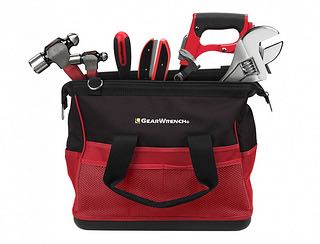 Include in the bag:
 RVers love to collect things. The problem is that some collectables are too large or heavy to carry along with you in the confines of your rig.