Home Blog Page 2182

Alternatives to expensive RV toilet sprayers

by Russ and Tiña De Maris

RV toilets, by their design, at times don’t flush quite as cleanly as we might hope. To that end, manufacturers often provide a spray nozzle feature to assist in cleaning the bowl. It’s a Star Trek solution, not because of being high-tech in nature, but it does allow you to deal with Klingons. But what if your biffy doesn’t come equipped with the spray nozzle — are you stuck with stickies? Not at all — you can often add your own spray nozzle.

Some toilet models allow the addition of an after-market spray nozzle kit. Do you flush a Dometic? There’s an after-market kit for that. It includes a spray nozzle, a clip to hang the nozzle on, and an installation kit that includes a vacuum breaker. The purpose of the latter device is to prevent any liquids from the spray nozzle assembly from making their way backwards and back into the RV water supply system. Camping World will sell you one for a little more than $60, but by being smart and shopping around you can beat this price.

Keep in mind, in addition to the issue of these hissing water critters being a bit on the pricey side, some RVers have complained that because the thing is plumbed through the toilet supply line, there can be a bit of a loss of pressure, making your cleaning efforts a bit more difficult.

There are alternative approaches to this matter. Some RVers report (and we personally have experienced) that their shower head will reach out from the shower stall and down to the throne with ease. They just use the shower head to blast away at any undesirable bowl dwellers. OK, this is a really cheap solution, but unless you can hang onto the shower head while holding it over the bowl, then stretch and reach the shower control valves to turn on the pressure, you’re apt to get a few drips on the floor. You pays your money …

Other alternatives? Sure enough. Put a plumbing T in the water line that serves your toilet. Incoming water flows into the T, then one side out to the toilet, and the other to a hose line leading to: (1) a shower head (with appropriate shut off valve), (2) a toilet bowl rinse head, or (3) a garden spray nozzle. The latter seemed like overkill to us but, hey, it does develop quite a stream. One reader assures us that keeping water pressure where it belongs makes the use of garden sprayer a great idea.

But what about a vacuum breaker? If you’re clumsy and apt to drop your new toilet bowl blaster in the pot and leave it there, yeah, you might want to add the vacuum breaker. Otherwise, it would seem pretty unlikely that icky stuff could make its way back into your fresh water system.

Craft a clothing kit for any encounter

0


By Greg Illes

My wife and I have a running joke — she asks me how the weather is going to be, and I tell her that it will be either warm, cold, or balmy. Should be sunny, but it might rain. (Sometimes, I reverse that last one.)

On any given day, we can find ourselves in almost any kind of weather and traversing any imaginable terrain. We’ve taken spontaneous hikes while headed for the supermarket; we’ve been snowed on in August; we’ve gotten sunburn on what promised to be an overcast rainy day. These things have occurred while traveling in our RV, in our toad, on foot and in our inflatable kayak.

Contrary to Mark Twain’s lament, we do talk a lot about the weather, but we actually do something about it, too. We know that the most common advice for versatile wardrobing is “layering,” and we take this to the ultimate.

We layer our clothing, for sure, but in addition we “layer” our entire ensemble. Zip-off pants are hardly elegant, but they can accommodate a wide variety of wind and weather. Lightweight nylon long-sleeve shirts afford great sun protection. They can be buttoned up tight for cold winds, or unbuttoned and sleeves rolled up when temps rise. Down vests are light, compact, and surprisingly warm under a windbreaker.

We also keep extra copies of essentials in the toad, just in case an unplanned impulse strikes us. What essentials? Sun hat, wool cap, hiking staff, windbreaker and a rain poncho. In winter or cold climes, a warm vest. Always a pair of good-fitting gloves for work or warmth. If we start out the day wearing “comfortable” shoes, we make a point of keeping our hiking boots and sandals in the toad. That way, we’re ready for a troop through the woods, or wading along the shoreline — whatever comes our way.

And one last item — although it’s not exactly a piece of clothing — we also keep a ground pad in the toad. If I need to get underneath for a mechanical problem or rough-road issue, I can keep all my carefully-crafted clothing layers relatively clean and reusable by lying on the ground pad instead of dirt/leaves/mud/rocks. It can even double as a “picnic blanket” for an impromptu relaxing snack on a hillside.

You probably have your own ideas about a versatile trousseau. Be creative, let your imagination be your guide, and know that whatever you start out wearing in the morning doesn’t have to be what you are wearing that night. And remember, anything is in style when you’re camping.

Greg Illes is a retired systems engineer who loves thinking up RV upgrades and modifications. When he’s not working on his motorhome, he’s traveling in it. You can follow his blog at www.divver-city.com/blog.

How do I find an owner’s manual for a used RV?

By Steve Savage, Mobility RV Service

The bad news is you probably can’t. The good news is most of the owner’s manuals for early models consisted of nothing more than the collection of manuals that came with the appliances and components when they were installed at the factory. If you have a newer-model RV, perhaps within the last five years, contact customer support for the manufacturer of your RV, if they are still in business.

If they have gone out of business, simply write down the make and model number of the appliance or component in which you are interested, or all of them, if you are putting together your own manual and go the component manufacturers website or search the Internet. Most manuals are available online and can be printed on your home computer. If you have a great deal of patience (we don’t) you can even burn them to disc or keep them in a file in your laptop.

photo: bsabarnowl on flickr.com

Renting an RV? Questions to ask first

0

By RVTravel Staff

Not everyone owns an RV — perhaps you’re “sticking your toe in the water” first to determine whether or not to jump in. Here are some questions you should ask before renting a recreational vehicle, as reported in Arthur Frommer’s Budget Travel magazine (along with some suggestions of our own):

1. Which type of RV is right for me? Motorhome? Trailer?

2. How many people will it sleep?

2. Do I need a special license or extra insurance?

4. Where do I camp and how much does it cost?

5. How much does it cost for the RV?

6. Am I too old or too young for this?

7. When and where do we eat?

8. Where should we go?

9. Which season is best? (Rental bargains await outside of the prime travel season.)

10. What kitchen items, linens and other basic necessities will an RV rental company furnish?

Renting an RV? Questions to ask first 

0

By RVTravel Staff

Not everyone owns an RV — perhaps you’re “sticking your toe in the water” first to determine whether or not to jump in. Here are some questions you should ask before renting a recreational vehicle, as reported in Arthur Frommer’s Budget Travel magazine (along with some suggestions of our own):

1. Which type of RV is right for me? Motorhome? Trailer?

2. How many people will it sleep?

2. Do I need a special license or extra insurance?

4. Where do I camp and how much does it cost?

5. How much does it cost for the RV?

6. Am I too old or too young for this?

7. When and where do we eat?

8. Where should we go?

9. Which season is best? (Rental bargains await outside of the prime travel season.)

10. What kitchen items, linens and other basic necessities will an RV rental company furnish?

Avoid tow bar tragedy

By Russ and Tiña De Maris

Imagine looking in the rearview mirror and seeing traffic behind you scattering in every direction – trying to avoid your toad. It could be every motorhome owner’s nightmare: A runaway towed car because of a fault with a tow bar. Make sure this stays a nightmare and not a real-life scenario; keep up with tow bar maintenance.

What could cause a tow bar failure? Most often abuse, and sometimes age. Folks with the tow bar industry say that the most common form of tow bar abuse is backing up, a definite no-no, or because of jackknifing the toad when a panic stop is made and there’s insufficient or non-existent towed vehicle braking. The stresses placed on tow bar components because of these actions can severely compromise or kill your tow bar system. NEVER back your toad vehicle with the tow bar, it’s as simple as that.

But what about age? At what age should you consider retiring your tow bar? Like the joke among us old folk runs, it’s not so much the age, it’s the mileage. Your tow bar is a lot like you: Every mile you put on the tow bar begins to slowly wear away at the joints. There’s not any real practical “joint replacement” operation available for tow bars. At least once a year, experts recommend, push and pull on your tow bar, feel for looseness. If it feels loose, have it inspected by a professional.

What applies to the tow bar also applies to that all-important connecting surface to the vehicle — the baseplate. Here’s an inspection habit for you: Every time you hitch up the toad car, grab those connecting points. Pull up and push down. You should feel “give” in the toad car’s suspension system, yes, but never should you feel looseness or “give” in the baseplate or connecting bracket. If you feel any give or looseness, towing can put you at big risk. Don’t tow — get it fixed.

Check out your tow bar manual for lubrication instructions and follow the suggestions given. Tow bars and accessories need to be cleaned and lubed with regularity. And when you’re not using the tow bar, store it away from the weather. Rust can cause you grief over the long haul.

Need a new tow bar system? Have a reputable shop do the install, and ask them to walk you through the hitch-up procedure. Smart RVers will want to use their phone or video equipment to make a record of how it’s done for future reference. Keep a copy of the owner’s manual in the rig and in easy reach.

photo: Jim Twamley

Tooling around — with a truck toolbox

By Jim Twamley

I pulled my 5th wheel next to my assigned RV site in the pouring rain. I had a hard time backing into a tight spot at an RV park in Arizona. I wasn’t expecting rain — after all, it was Arizona — so I was glad to have all the tools I would need for a quick set up close at hand.

For a travel trailer or a 5er you need a stabilizer crank, some boards for the landing gear, tire chocks, water hose, channel lock pliers, electric cord adapter, water pressure gauge, and a multi-meter (to check out the utilities). I kept all these things in my handy locking truck-bed toolbox.

These toolboxes come in various sizes and are made from aluminum, steel or plastic. They can insert in your truck bed with wings that hold the box up off your truck deck so you can slide lumber and other long items under it. You can also get boxes that rest on the bottom of the truck bed without wings. Downdraft off the face of a 5th wheel trailer will blow stuff out of your truck bed if it isn’t secured, and these toolboxes keep your stuff safe and dry.

Clearance is an important consideration if you’re pulling a 5th wheel because the thickness of the toolbox could interfere with the operation of the king-pin pivot overhang. So before you purchase one, make sure you have adequate clearance tolerances. I enjoyed my truck-bed toolbox because it held a large amount of gear and it locked so I didn’t have to worry about people walking off with my stuff. Since I used the truck as a touring vehicle, I liked having my tools with me.

My biggest problem was keeping it clean and organized. Most of them come with sliding trays that will help you with this task. Even trucks with modified tow bodies employ these boxes. They are a “must have” if you pull a travel trailer or 5th wheel. Some folks even mount them on the back of trailers.

Replacing RV door glass — Don’t lose your temper!

By Russ and Tiña De Maris

Strange things happen along the road. A flying baseball, rock or tree limb can make a mess of that “relight,” or window, in your RV entry door. If your glass is a mess (or you get to that point down the road), it’s sometimes tempting to look at the cheap side and just charge down and replace that broken glass with an off-the-shelf chunk of window glass at the local glass shop. Cheap, but not wise.

The original glass is tempered — for a good reason. When broken, non-tempered glass has a nasty way of shattering into long, deadly, sharp shards. When replacing glass in an RV, code calls for tempered glass which, when broken, typically chunks into smallish, rounded pieces, far less likely to cause great bodily harm.

Your local glass shop can probably sell you tempered glass, but it may require a few days from order to readiness. Tempering requires cooking the cut-to-size glass in an oven, and many shops have to send out the glass for the tempering process. Yes, you could replace your door glass with acrylic, but don’t use inexpensive Plexiglas. Plexi is easy to work with, but it gets brittle at low temperature and breaks easily. Lexan, although more expensive, is your best alternative.

Before you fire off an order for tempered glass through a glass outfit, check with local RV parts dealers. Many keep replacement glass in stock, and their price and availability may shine in comparison. Or, if you know you have a change-out job coming up, look on eBay or Amazon— you may find sellers that will equip you with a complete two-piece frame and glass for far less than you’d imagine.

While we’re on the subject: Entry door window frames are a two-piece design. You’d think to replace the frame you’d just go down and buy a “pair” of frame pieces. Here’s one of the RV manufacturing world’s great mysteries: The frames are sold as halves, either an exterior half for the outside of the door, or the interior half. But you’ll probably find a dire warning printed on the packaging: “It is strongly recommended that both interior and exterior frames be replaced at the same time.”

The “duh” question then becomes, “Why not sell both halves at a reasonable price, together in one package?” And what’s the big deal, anyway? Our job was to replace a weather-cracked exterior frame half, and cheapskates that we are, we simply bought the exterior half because the interior side looked good enough to us. We later found out one possible flaw in the reasoning. There was a slight bit of warping in our old interior frame, which made alignment a bit tricky. Like any good follower of the “Red Green Show,” we said, “What the heck?” and grabbed screws that were just a bit longer than the originals. After all, that little bit of extra length made alignment so much easier. The first screw put in practically nicked the helper’s hand on the far side of the door — the screws you take out are precisely the correct length.

So get the right glass and, if you can hack it, buy both sides of the frame when you need ’em. You’ll be happier in the long run.

Keep that closet rod in place

By Jim Twamley

Those of you with rear kitchen 5th wheel RVs know just how hazardous a bumpy road can be to the stuff in your cupboards. The rear section of an RV is the most vulnerable to the rock-n-roll of the RV road.

On one of our trips, after we pulled into camp, Mrs. Professor opened the rear clothes closet to discover the wooden clothes hanger bar had fallen down along with all the clothing. On closer inspection I found that the plastic retainer screw was yanked out of the wall. It is amazing to me that one little screw was holding up that bar of clothing.

For a fix, I busted out the cordless electric drill (a tool every RVer should have) and promptly reattached the retainer with not one but four new screws. I didn’t drill a hole, just powered the screws through the existing plastic plate. I did the same with the opposite side retainer which already had two screws. Now all is well in closet-land.

Looking for a campground? Think alternatives

0

By Bob Difley

Traveling unfamiliar territory and need a place to put up for the night? Pull out your Trailer Life or Woodall’s Campground Directory and find one, right? Or there’s always the National Association of RV Parks & Campgrounds that will point you to the fanciest of amenity-filled RV resorts or a near-the-freeway overnight mom-and-pop campground with easy in and quick entry back on the freeway in the morning.

But, hey! Not all of us are blessed with excess cash on our RV excursions. Simply put, not all of us can afford campgrounds that have excess funds to spend on advertising and camper magnets like swimming pools, recreation halls and golf courses. Or maybe you just like a little more space for yourself and don’t need a bunch of amenities.

Think alternatives: Forest Service (both federal and state) campgrounds usually have overnight fees less than half of what privately owned campgrounds and resorts charge, but don’t expect hook-ups, Wi-Fi or cable TV connections. Go to the Forest Service website to find federal campgrounds along your route of travel, or do a Google search for state forest campgrounds wherever you are.
When traveling on Bureau of Land Management Lands, which are spread over the 11 western states, primitive camping (boondocking) is allowed anywhere you can pull safely off the road. Follow a dirt road for a hundred yards or so and you may discover a nice, quiet, desert campsite all to yourself — and it costs you nothing.

When traveling through the countryside of many states, particularly in the Midwest, stop at small-town police stations, chambers of commerce or recreation departments and ask about local or regional campgrounds (almost always for the use of local campers and usually deserted except on weekends) that are never advertised or listed in campground directories.

Also look for camping possibilities when in or near national or state wildlife refuges, fishing access areas, regional or county parks, Indian reservations, national monuments, national grasslands, state fairgrounds and on public utility lands.

If you use a GPS, log what you find into your waypoints or locations log so you can find them the next time through.

You can find Bob Difley’s RVing e-books on Amazon Kindle.

photo: Grand Canyon National Park on flickr.com

How do I test my propane leak detector?

0

By Steve Savage, Mobility RV Service

People have asked me: “How do I test my propane leak detector?” The short answer is: Most detectors cannot be reliably tested. Some detectors even come with directions noting attempted testing will void the detector warranty.

The reason you can’t simply spray propane or butane at the detector is straightforward. Detectors are designed to sample what is called “parts per million.” If you spray hair spray or something which uses butane as a propellant at the detector and it goes off, it tells you only it will detect a 100% concentration. In most cases, you would already be on fire with that high a concentration.

Propane detectors are to be replaced every five years or according to the date sticker on their face. Carbon monoxide detectors also have a five-year life span, and smoke detectors have a 10-year life span. No detector can be repaired.

photo: blprnt_van on flickr.com

Keep your hitch ball covered — DIY RV project

By John Cook with Russ and Tiña De Maris

After walking into the hitch ball on my tow rig while wearing my “dress” blue jeans, not long after greasing the hitch ball, I ran the risk of using some colorful metaphors.

What a shame that I was still a couple of years from hearing from our reader, John Cook. John, too, hates the risk of having a greased hitch ball exposed to the elements, or is it having the human race exposed to a greased hitch ball? In any event, John has come up with a simple, inexpensive cover for his hitch ball, which he’s graciously shared with us.

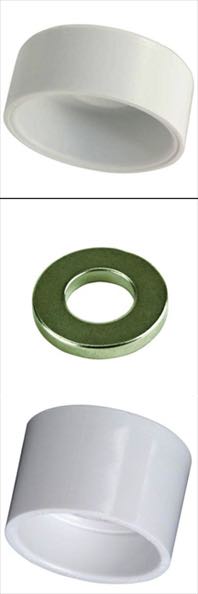
John obtained a 3-inch PVC drain pipe end cap to use as a hitch ball cover. Inside the cap, he affixed a 3/4-inch round “super magnet,” using JB Weld as an attaching medium. The magnet, glued to the cap, ensures the cap will stay in place atop the hitch ball, no matter how much grease is sitting atop the ball. To make sure the entire ball (and shank) is covered, John coupled the cap to a 3-inch PVC drain coupler, sawed off to the correct length to cover the hitch ball. The coupler is glued to the cap using general purpose PVC cement.

All of the “parts” can be purchased at your local Home Depot. Cap: Store SKU # 811440. Coupling: Store SKU # 18903. Magnet: Store SKU # 63380.

Thanks to John for his ingenious “coverage”!

photos: Home Depot