Home Blog Page 2191

Keep dishes safe while on the move

By Cheryl Probst


We all have nightmares of cupboards coming open and dishes crashing to the floor as our RVs rumble down the road. One solution to this problem is to store your dishes in a dish drainer installed in the cupboard.

A standard-size dish drainer should fit in most cupboards, but measure the inside of your cupboard to be sure. A wire dish drainer works best for this project. Place the drainer in the cupboard, then measure the distance from the bottom of the cupboard to the bottom of the dish drainer. If you will be storing glasses in a side holder, you’ll probably need to install the drainer to one side of the cupboard, unless your cupboard is wide enough that it can be centered with room for glasses on each side.

After your drainer is positioned, mark spots in the back of the cupboard where you’ll put the two cup hooks that will hold the back of the drainer in place. Remove the drainer and screw the cup hooks in. Next you’ll need two blocks of 1 x 3/16-inch wood cut to the height of the distance you measured earlier. Attach a cupboard latch to each piece of wood that is high enough for the drainer to go down into it, and then screw the blocks to the cupboard bottom. Set the dish drainer in place and fill with dishes and glasses.

The dish drainer can be taken out and the cupboard space used for something else, and then the drainer put back in when you’re ready to store dishes again.

Don’t be suckered in by RV resort advertising

0

By Jim Twamley


It was late in the day and we had been driving since morning. We were looking for a place to spend the night and continue our journey the next day. As we were driving along at about 55 miles per hour we saw this sign. Wow! Camping on the river for only ten bucks a night. I thought that would be nice, so we drove the additional six miles past our turn-off to find the RV resort.

We were met at the entry booth by a young woman who informed us we could indeed stay for $10 a night for three nights maximum but the catch… we would have to sit through a one-and-a-half-hour sales pitch to join this membership park.

We didn’t have the time or inclination to sit through a high-pressure sales presentation so we declined and went to a free overnight camping area. What I didn’t appreciate was the blatantly deceptive advertising and the fact that I wasted the fuel to go 12 miles out of my way. The deception lies in the “small print” located in the lower corner of the sign. I’ll admit my eyes aren’t good enough to read this small print while driving past at 55 mph. They suckered me, and I didn’t like it at all.

I wouldn’t want to belong to a park system that stoops to this kind of “bait-and-switch” advertising. That said, some of these park systems can be worthwhile as long as they remain solvent and they offer tangible benefits to their members. They can be quirky requiring rotation of stays, transfer limits, and a laundry list of rules and regulations requiring a law degree to understand.

Overall, I am not a fan of membership parks but I know many other RVers who use them. Just be very careful and be as informed as possible before signing up for one of these resort memberships. You also need to be aware that some resort park systems use high-pressure sales tactics to get you to sign up. Caveat emptor, “let the buyer beware,” applies in this instance.

Male chauvinist husband won’t let wife dump septic

Dear RV Shrink:
rvshrinkMy husband is a bit of a Male Chauvinist Pig. I want to be the total RV woman and he won’t let me dump the septic. He says it wouldn’t look right and that it’s too complicated and messy for me. Can you help me convince him that I am perfectly capable of handling a crappy job like this. It would make me feel whole if I could just add this to my RV resume’. Thanks in advance. —Down in the Dumps in Davenport

Dear Down:
Most people write me because someone is giving them a bunch of crap. You are the first one asking for it. I totally agree with you. He’s a pig and hogging all the slop. I think I should actually be treating your husband. I long-distance hike a lot and my wife travels alone in an RV for days and months at a time looking for me (not too hard). She loves to do the dump, and I love to watch her. She wants me to do it once in awhile but I tell her, “It just wouldn’t look right!”

I am guessing that many couples share this duty. It looks right, it feels right — it just smells bad. It’s not that complicated. If you do something wrong, it’s jump or swim. When traveling in an RV, everyone should share all the duties, even the dirty swirly. Thousands of women traveling alone have mastered this movement. Remember, Ginger Rogers used to do everything Fred Astaire did, only backwards and in high heels. Stop dancing around this issue. Take the bull by the horns and show him you can pull the plunger just as fluidly as he can. —Keep Smilin’, RV Shrink

#RVS737

The RV Shrink is not really a psychologist (or professional RV technician). But he does know a lot.

“Beam me up, Scotty.” Those handy walkie-talkies

By Greg Illes

Everybody knows about walkie-talkies — we’ve seen them ever since Kirk and Spock showed us how they work. But in the last several years, these handy devices have really come into their own. They are smaller, handier, more powerful, and lower in cost than ever before.

For the RVer, a walkie-talkie set can be a real boon. How about parking the rig in that tight campsite? One person on the outside with a walkie-talkie can give directions and warnings to the driver without having to shout, open windows, make hand signals, run back and forth, etc. Trying to caravan with a friend in another rig? Give them a W-T and you will be able to talk to each other up to a mile or two apart, without cell phone coverage or using up your cell minutes. You can even take one along on a solo hike away from camp, to keep in touch or for that unforeseen emergency. The opportunities are limited only by imagination. At one RV park (with lousy cell coverage), the laundry room was a quarter-mile from our site so we stayed in touch with the hand radios while the washers and dryers hummed away.

Today’s higher-end W-T units come with other useful features such as weather radio reception and NOAA weather alert service (very useful when you’re out of cell/Internet coverage). You can even get a walkie-talkie which uses the CB frequency, but most walkie-talkies typically use other dedicated FM channels which are less crowded.

Looking at the product “hype,” it’s unfortunate that the manufacturers brag about “36-mile range,” because these are FM radio devices and range is limited to line-of-sight. The true effective range in most practical situations is likely to be a couple of miles, and less in hilly terrain. But that is still quite useful — just don’t expect “Star Trek”-style performance.

Parked in their charger, walkie-talkies don’t take up much space, and the units can stay tucked away in a cupboard or drawer until you need them. You can get a complete setup (two hand units, a charger, two ear-set cords) from Target, truck stops, Best Buy, Amazon, and many other locations, for anywhere from $30 to $60, depending on features. For this cost, how could you not have such a useful tool?

photo: France1978 on flickr.com

Greg Illes is a retired systems engineer who loves thinking up RV upgrades and modifications. When he’s not working on his motorhome, he’s traveling in it. You can follow his blog at www.divver-city.com/blog.

Got an “uncool” RV refrigerator? This could be the issue

0

By Steve Savage, RV Mobility Service


Do you have an RV refrigerator that’s not keeping its cool? We often make service calls for this very reason – and often the call wasn’t necessary. Why? Many times a customer could make their own diagnosis. Here are a couple of things to look at before calling the service tech, or dragging your RV to the dealer.

First, check the controls on the front of the refrigerator. These are properly called an “eyebrow board” or “upper board.” Is the board getting power? You’ll know it if any of the lamps or indicators on the board are lit up when the power switch is on. If the upper control board has power, you’ll find your problem on the back of the refrigerator. Do your checking behind the vent lid on the rig’s exterior wall.
Locate the burner unit. This is the tube where your propane flame heats up the cooling unit and where one or two electrical heating units are found. If the burner is working with a hot flame, you can be sure the refrigerator controls are working. If after a few hours’ operation you find your fridge still isn’t cooling, it is almost invariably that the cooling unit has lost its charge. Feel the cooling unit — if it’s very hot to the touch but still not cooling, it’s possible you’ll hear gurgling noises or notice a yellow coloration on and around the burner tube.

Gurgling and/or yellow on the burner tube are dead giveaways the cooling unit has leaked. The same is often true for a hot cooling unit with no cooling — a “leaker.” The only decision to make at that point is whether you want to spend the several hundred bucks to have a new cooling unit installed or whether to replace the fridge. If the RV is just sitting stationary, it’s a simple (and less expensive) task to replace the fridge with a small electric household model. Replacing the cooling unit is doable but requires a good bit of labor. In the event you are thinking a completely new refrigerator, keep in mind a replacement will normally set you back “north of a grand.”

(photo courtesy austinado16 on photobucket.com)

When your toad is a motor scooter

0

By Cheryl Probst


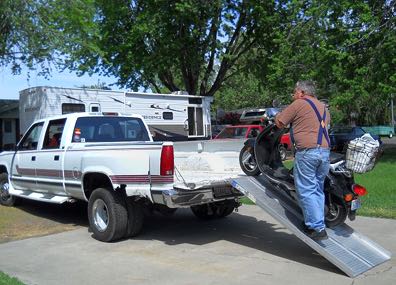
As the price of gas climbs, the popularity of motor scooters climbs, too, because it’s hard to beat their 90 to 100 mpg. This makes them perfect vehicles for RVers who want to ride around the campground, make quick trips to the supermarket, or sightsee.

When you’re traveling between RV parks, hauling scooters around can be challenging. The most important thing is to know what your RV can handle, since what works for one rig may not work on another.

Motorhomes and pickup/camper combinations can tow small trailers. Before you invest in a motorcycle trailer, however, make sure the tracks are wide enough to accommodate scooter tires, which are frequently wider than motorcycle tires. You’ll also need to consider clearance, since scooters are not as high as motorcycles. Getting a scooter onto a motorcycle trailer can present challenges, so you might want to adapt a small utility trailer. Motorhome owners who still want a car can put scooters in the bed of a small pickup and tow it.

RVers who don’t mind sharing their living space can haul scooters in travel trailers and fifth wheels known as toy haulers. This may be the best option for fifth wheelers, since travel trailer owners can put the scooters in the back of their tow pickup.

Some companies make carriers especially to haul motorcycles and scooters. These work best when attached to the pickup’s front or rear bumpers. Manufacturers do not recommend attaching these to the rear of fifth wheels and travel trailers because of the shift in weight. The carriers, as well as platforms that can be installed in the rear bumper’s hitch receiver, also bounce around a lot and your scooter could bounce right out of the tie-downs. Some RVers claim to haul lightweight scooters on these platforms without any problems, however.

Laptop desks make RVing easier

0

By Russ and Tiña De Maris


Sizing down” for the RV lifestyle can be tough. Where do you put your laptop — other than on your lap — when you have some serious computing to do? Enter the laptop desk.

There are a couple of different approaches: Simply put a more solid platform under your computer and set the whole works down in your lap. Some are wide enough to use a mouse in conjunction with your laptop. All of them help to keep you from getting “laptop burn.” One such desk that retails for less than $30 is marketed by LapWorks (www.laptopdesk.net). This one uses a folding hinge trick, allowing you to set your laptop on a table; the device then gives a bit of an angle to the laptop making for easier typing. One problem: When you need to move, you’ll need to set the desk and laptop aside.

A similar system, but one that gets the  laptop off your lap entirely, is to use a “bed table.” These little stands take a flat platform and add legs, usually folding ones. Many have room for a mouse and also prevent burnt laps. But what to do when you need to move and don’t want to disrupt your work in progress? The one pictured above left is from Sam’s Club. Careful though — those handy drink and silverware holders could create issues with free mouse movement.

Here’s another idea: Coupling the flat and stable platform with “full-to-the-floor legs,” the “Table Mate II” is made with lightweight plastic and is adjustable in height and platform angle. There aren’t any side braces, allowing users to slide their legs in and out from under the rig without fear of banging knees or legs. The whole rig slides right up over your lap, bringing the computer into reach and at precisely the right height. They’re adjustable so you can use it with more than one chair or even the sofa.

We snagged a two-pack of these from Walmart for $50, drop shipped to a nearby store. We found we could use the second Table Mate as a printer stand.  Set for the correct height, we could roll our plastic file cabinet right underneath the stand, saving even more floor space. Try Google “shopping” for “Table Mate” and you’ll find many sellers offering single packs for around $30.

Budget woes: How can we afford to follow our RV dream?

0
Dear RV Shrink: 
rvshrinkWe have been planning our retirement and mostly full-time RV travel for several years. Everything was on schedule until the bubble burst and the economy tanked. We still want to retire but we lost half our investment savings in the crash. We fired our investment advisor and put what was left in bonds, but our travel budget and dreams are shrinking. We read articles about people working on the road, hosting campgrounds and using various strategies to live the dream. I have a fear of not being able to survive financially on the road. Can you help me overcome this hang-up. —Panic in Pottstown

Dear Panic:
There are a million ways to retire and another million ways to travel and live full-time in an RV. I kept telling my wife I wanted to retire and she would always say, “You have to have a JOB first!” What a killjoy. I would tell her about an article I read that said, “You only need two things to retire successfully, a spouse and a TV, and they both have to be working.”

I am no financial advisor and do not know your personal situation. I can say that when you retire, how well you live at home or on the road depends on your lifestyle. To some people, “roughing it” is bad room service. Some people travel ten thousand+ miles per year and others have a few favorite places they drop anchor for months at a time. My wife and I traveled for seven years working three months on, three months off. We always found interesting work, lived on one paycheck and saved the other.  After three months we would National Park hop for three more. Made money and many lifetime friends around the country working our various jobs. My point is, “Where there’s a will, there’s a way.”

I would advise you to be careful taking any of the various volunteer positions available to RVers, if you are having a regular financial shortfall. Besides free camping, these jobs make no cents.

Adjust course with your shrinking budget and full steam ahead. The economy is continuing to recover. If you keep thinking you’re shrinking with those low interest bonds, I can still treat you — maybe I can help you be a little patient. —Keep Smilin’, RV Shrink

The RV Shrink is not really a psychologist (or professional RV technician). But he does know a lot.

#rvs737

Making your RV grocery budget stretch

0

By Russ and Tiña De Maris


Aside from fuel, one of the biggest expenses RVers cope with is that of groceries. Tight budget? Here are some food-dollar-stretching tips:

Don’t go grocery shopping without a list, as you’re more likely to buy things you don’t need. We “word processed” a list of all our frequently purchased grocery and non-grocery items. Broken down in basic categories, our list is laid out roughly as to where we’ll find things located in the store. For example, milk, cheese and other dairy items are in one clump on our list. We keep copies of the list hanging on a hook inside a galley cabinet. When something is needed, we put a check mark next to the item on the list.

If you find yourselves in a little “burg,” with less store competition, buy only essentials needed to get by in that area. Later, in the big city, take your list and do major shopping.

“Coupon” where you can. Not always easy on the road, but we’ve found that the big chains will often email their weekly ad specials. Once a week we get a big ad from Safeway — and we print manufacturer coupons from their site. Most manufacturer — as opposed to “store brand” — coupons can be used in any store that takes coupons, including Walmart.

Not everything sold in “club” stores like Costco or Sam’s Club are cheaper than at the regular retailer. While milk tends to be less expensive at a club store, other items may actually cost more when compared on price-per-unit basis. And produce at the club stores is usually way out of line in terms of price, and not necessarily of any better quality than at a more upscale supermarket.

When shopping, try to stay in a dollar limit. After our major once-a-month blast, we take the remaining grocery money and divide it out according to the remaining number of weeks until “payday.” A hundred dollars left means $25 a week for the rest of the month.

So how do you avoid “overspending” when trekking through the store? Set your spending limit before you step in the door. Don’t worry about trying to keep track of how much you’ve put in your cart to the cent — especially if you “do it in your head.” As you stick an item in the basket, round the dollar amount up or down. For example, if the loaf of bread is $4.15, then mentally add $4 to your tally. If the hamburger is $6.67, then mentally add $7. We’ve found it better to use a calculator, but sometimes you can forget to punch in a number.

photo: Poldavo (Alex) on flickr.com

Full-time RVing husband driving wife crazy

0
Dear RV Shrink:

rvshrinkWe have just started full-time RVing. There has been a lot more adjustment than I expected. My husband worked in an auto plant in Flint, Mich., for 32 years. Before the industry caved in, and he took a buy out, he was working 60+ hours per week. Then when he was home, most of that time he was sleeping.

Now we live in a 30-foot 5th wheel and he’s awake. I think I still like him, but after 30 years of me running the ship, he now thinks he’s the Captain all of a sudden. When I’m cooking, he’s over my shoulder; when I’m balancing the checkbook, he’s double-checking my math; when I’m doing the laundry, he’s measuring the soap. Bottom line, he’s driving me crazy. I know it’s not right, or normal, but I keep having urges to pull away from the gas pump while he is in paying for the fuel. Can you help me with this stressful transition into a lifestyle we have dreamed about for 25 years. —Stressed in Stuart, Fla.

Dear Stressed:
This is one of the most common ailments I deal with in my practice. You must approach it with simple management skills. Being blunt with your husband will only cause resentment. What your husband needs is a job, and he needs to be closely managed without it feeling like supervision. Whether he is handy with tools or not, start finding things wrong with the 5th wheel that you know he could fix if he tried long enough. If there is nothing wrong (fat chance) start breaking stuff.

You have to think outside of the box in these situations. You can even make up problems that don’t exist. Those will be the hardest for him to fix and easiest for you to control. You also have to continually think ahead to the next project just in case he actually fixes one. You will find that after a short list of these projects he is going to avoid you like the plague. You will soon represent management to him, and he already realizes that the less contact he has with management the happier he is. You will know you’re making progress when he starts putting in a grievance. That’s when you explain to him that domestic engineers have no union protection. —Keep Smilin’, RV Shrink

The RV Shrink is not really a psychologist (or professional RV technician). But he does know a lot.

#rvs737

Getting ready to apply a new RV roof coat

1

Courtesy Dicor Corporation


Just like painting, much of the work in coating an RV roof is in the preparation. Roof coating is a multi-step process, beginning with lap sealant replacement or touch-up performed one to two weeks ahead of the actual coating. This will allow the sealant to be well-cured before the coating covers it, helping the sealant and coating to bond with maximum effectiveness. In the same vein, peel-and-stick patches are best applied one or two days before coating.

Next comes cleaning. A very clean surface is key to making any coating stick well. First, sweep any loose dirt, debris, sticks, stones or leaves from the roof. Then use the appropriate Dicor Products cleaner/activator for your kind of roof and for the coating system you are using.

The type of roof you have will determine the type of coating system you will be applying to the roof surface. Each roofing material has its own individual characteristics that require a certain type of coating system. Because of this, Dicor Products offers three coating systems: one for EPDM and TPO, a specially formulated roof-coating system for fiberglass, and a metal roof-coating system.

Tip: Mask off sidewalls. For the cleaning and coating procedure, I always mask off the sidewalls and caps of the RV with a good-quality tape, such as FrogTape. The cleaning/activator agent is designed to loosen dirt from the roof material. The chemicals in the cleaning and coating materials are made for the particular roof material they are acting on, not for your sidewalls and end caps. Masking off the sidewalls and front and rear end caps takes a little more prep time, but then you don’t have to keep constantly rinsing the walls and end caps (unless you like the exercise). This prevents the dirt, debris, and cleaning agent from having an opportunity to affix themselves to the sidewalls and end caps. It also prevents any accidental contact with the coating and these surfaces. It’s easier and safer all the way around.

Even bigger tip: Read the instructions! Before starting anything (listen up, guys), read the instructions! Different cleaning and coating formulas are made for different roof materials. I have been mostly talking about EPDM and TPO roofing here, but there are materials, processes, and products designed for fiberglass and metal roofing as well. Such instructions can help you make best use of your time and your product.

As for your tools, I find a medium nap roller is the best way to apply the coating material.

[Editor’s note: This information is provided by roof membrane manufacturer Dicor. While there’s plenty of “promotion” for their product included, some of the information and principles may be of assistance to our readers.]

Temperature controlled shower unit – high-end but so comfortable


By Greg Illes

Many modern homes enjoy the benefits of a temperature-controlled shower. No more hot and cold valves, but rather one handle for setting water temperature, and one handle for controlling the flow. Once hot water reaches the valve, the output temperature never varies, and you never have to “fiddle” with the hot and cold knobs (in fact, there aren’t any) while you’re being frozen or scalded by a bad adjustment.

Different users of the shower simply remember their personal temperature setting, and set the handle to that position before turning the flow on. Variations in hot or cold input water temperature are no longer a problem — the temperature controller compensates, and you still get your requested water temperature.

Unfortunately, most such valves take up a LOT of space behind the wall, and are difficult to retrofit to an RV. Also, most valves incorporate a separate shower feed, which then requires a separate hole and fittings in the shower wall.

Enter the Grohe Grohtherm 3000 series of thermostatic control valves. These are available from plumbing supply houses and even from Amazon. It’s a well-made European product that works well for retrofit applications. This model has all of its control valving on the shower side of the wall — virtually no space is required behind the wall — and it will fit almost any existing RV. Furthermore, the Grohe also has a built-in shower hose connection, making it even more compatible.

In addition to providing guaranteed comfort, the temperature-controlled shower will also save water. You will not have to spend “water time” adjusting the temperature, nor will you have to wait that extra half-gallon to make sure the hot water is there. Since the valve has built-in backflow-prevention valves, there is no necessity for that water-wasting trickle when you shut off the water to soap up — you just turn the flow handle off. It even has a “soft-start” feature which prevents surges and temperature fluctuations.

Installation can be a three- to four-hour DIY project that costs around $300. The valve is somewhat heavy, and you’ll want to add a reinforcing piece of plywood to the outside of your shower stall. A new backing plate can be made from a piece of half-inch white polyurethane.

Greg Illes is a retired systems engineer who loves thinking up RV upgrades and modifications. When he’s not working on his motorhome, he’s traveling in it. You can follow his blog at www.divver-city.com/blog.