Home Blog Page 2210

The basics of mobile Internet systems

0

By Rene Agredano
Getting online while RVing has become a necessity for everything from location research to keeping in touch with friends and family. While connecting to the web with your cell phone provider is becoming easier, many places still elude cell tower signals. That’s when having a mobile satellite Internet system comes in handy.

System Types
RVers can get online using one of two different types of mobile satellite hardware. The first is a fixed, rooftop-mounted dish that sets up with the push of a button. Although it’s the most expensive type of system, it’s convenient when you need to get online in a hurry. A stand-alone tripod with a mounted satellite dish is an inexpensive alternative, but the tripod must be manually pointed to an orbiting satellite using a GPS, which can be time-consuming.

Setup and Maintenance Costs
When you buy a rooftop mounted mobile satellite system, you’ll pay a professional installer a few thousand dollars for hardware and installation. Monthly Internet access fees start at around $100 and go up depending on your plan’s bandwidth speed allowance. A stand-alone tripod system costs less than $1,000 in hardware and at least $60 a month in access fees.

Pros and Cons of Mobile Satellite Internet
Mobile satellite Internet systems allow you to get online anywhere on the continent, but they’re not perfect. Connection speeds are slower than DSL, and hardware and software often needs fine-tuning for optimal performance. If you aren’t a mechanically-inclined, computer hardware geek, a rooftop mounted system probably isn’t for you. Tripod systems are less complicated, but can be cumbersome and tricky to connect to the web.

Mobile satellite Internet has its challenges, but it’s your best bet to ensure connectivity. For more information, check out the Datastorm Users Forum.

Rene Agredano and her husband Jim publish an excellent website about full-time RVing, LiveWorkDream.com.

The many uses for WD-40

There are few RVers who don’t consider a can of WD-40 an essential item in their tool arsenal. This “can do” lubricant has a wide range of uses, making it a very handy and useful product. Need to get rid of some road tar and grime from your RV or car? WD-40 can come to the rescue. Is the zipper on your favorite jacket refusing to work without lots of pulling and tugging? Spray on WD-40.

Here are some uses for the product that may come in handy, some of them especially relevant to RVers:

•Lubricates door hinges on vehicles.
•Restores roof racks on vehicles.
•Keeps rust from forming on saw blades and other tools.
•Removes all traces of duct tape.
•Removes black scuff marks from a kitchen floor.
•Removes love bugs from grills and bumpers.
•Lubricates and stops squeaks on electric fans.
•If you spray WD-40 on a distributor cap, it will displace moisture and allow the engine to start.
•Use WD-40 to help get rid of bugs on your RV or car’s paint (if not removed they will eat away the finish).
•Keeps scissors working smoothly.

Rumor has it that WD-40s main ingredient is fish oil, but that’s not true: it’s mostly petroleum-based. Do you know how it got its name? It was in 1953 when scientist Norm Larsen at the San Diego Rocket Chemical Company was attempting to develop a formula to prevent corrosion on missile parts, achieved by displacing water. On his 40th try, he got it right. And so we have WD- (“water displacement”) 40.

How to store your tires

If you have multiple sets of tires, proper tire storage is a must. (Just setting them off in the corner of your garage isn’t enough.) Proper storage ensures that your tires’ appearance and performance are maintained. Before you store your tires, be sure to inspect each one for damage or uneven wear.

Some quick tips
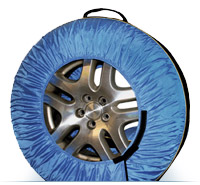
Store your tires in a clean, cool and dark location away from heat or gas. Preferably under a tire cover, which you can purchase at your local tire dealer or auto parts store.

  • If your tires are mounted on rims, stack them underneath a tire cover. (When stacking tires, be sure to stack no more than four tires for safety reasons.)
  • If you tires are not mounted on rims, store them upright and cover. Do not stack on top of each other or hang from ceiling.
  • If your tires have whitewall or raised white lettering, store them with the whitewall or raised white lettering facing each other. Otherwise, black rubber could stain them. (The results are not pretty.)

Article courtesy of Michelin Tires.

Rude behavior on the road

I have been on the road now for 12 days. All together, I have pulled over about 20 times to let the car behind me pass. Of all those times, only one person raised his hand to thank me. The others just went by. Sometimes I wish I could just go back ahead of the people who did not thank me, and then slow down to show them that they should be polite. In most cases I was going the speed limit or faster. I don’t get upset about this rude behavior — not really, really upset, that is. But it bothers me. If someone pulls over to let you by, please raise your hand to thank them or blink your lights if it’s dark. It’s a very good thing to do and takes almost no effort.

How to retile your RV kitchen

Mark Polk of RV Education 101 shows you how he improved the look of his RV’s kitchen with new tile.

RV co-pilot making navigation harder. What to do?

Dear RV Shrink:
When we bought our RV my wife and I decided we had to act as a team. Since our rig is so big I needed a copilot. My wife can read a map about as well as Columbus and that causes many arguments. I bought a GPS to solve the problem and now I find myself arguing with both my wife and the woman in the GPS. My wife also has a problem reading the leveling bubble. After the last bubble battle my copilot is threatening to take a bus home. What should I do?  —Cockpit Problems in Las Cruces

Dear Cockpit:
Get to the bus station quick, you don’t want to miss it. You can then find the group “Loners on Wheels” and join up. Many people think the “Loners on Wheels” are single and widowed individuals that want to travel the RV lifestyle and meet others with similar interests. You will find most of them are semi-widowed just like you. Like you they couldn’t get along in the cockpit and one or the other caught a bus home. You will find a sympathetic ear and a lot of good information on how to pilot solo. Consider a rear view camera and self-leveling jack system for starters. I would suggest you keep the GPS you have. It will give you someone to argue with and someone to blame when you are wrong. You will have to learn to enjoy solitude and Solitaire and learn to do the many things your spouse used to handle. If you find your spouse handled most everything, and did all the cooking, you might consider developing a taste for crow.
The RV Shrink is not really a psychologist, but he IS very smart. 

How to fix a sticky black tank valve

By Chris Dougherty

Editor’s note: Chris Dougherty is a certified RV technician in western Massachusetts. Here is a letter he received from a reader while he was serving as RVtravel.com’s technical editor.

Dear Chris,
Pulling the black water handle on my 2012 Entegra is getting more difficult compared to the gray water side. Is there any way to ease this or prevent it from getting even more difficult? —Ed

Dear Ed,
This is a common issue that black valves have over time and with repeated use. Lubrication wears off and material can get trapped in the track for the knife valve.

The best way to fix this for the long haul is to service the valve. The valve manufacturers like Valterra make seal replacement kits that are inexpensive and pretty easy to change. Once the tank is emptied, rinsed, and has been left open for 24 hours to ‘dry’ out, you can go ahead and begin the job.

All you will need is a wrench, the kit, and a good valve grease. Dow-Corning 111 is recommended. Remove the four bolts from the valve head, and while lightly prying the pipes apart, remove the valve from the two flanges. There will be a rubber seal on each of the flanges. Remove those taking note of how they seat in the flange.

Thoroughly clean the valve using a brush, cleaner (like Spray 9) and copious amounts of water. Look for any damage on the valve that might indicate it needs replacement. Once dry apply the Dow-Corning 111 to the blade of the valve on both sides and operate the valve until it moves smoothly. Install the new seals that come in the kit on to the flange and coat them with the Dow-Corning 111 to help hold the seals on to the flange, then while prying the pipes apart slide in the valve and align the bolt holes and install the new bolts that come with the kit.

While there are other ‘homebrew’ ways of treating sticky valves that may work for a little while, the repair I noted here will make the valve operate like new for a long time.

As a side note, you may not ‘need’ to replace the seals, however any kink in the seal can result in a leak. For the minimal cost, I think its better to go ahead and change the seals. You can also replace the entire valve for a bit more money, but I would still apply the Dow-Corning 111 to the new valve before installing it.

##RVT923

Is this motorhome beautiful or ugly?

This is the actual interior of a motorhome. I will make 10 or 11 people in America (and maybe a few in Canada) angry with this statement, but here’s is what I think of this RV: I think it looks like a bad Las Vegas hotel room.

Now, I realize this isn’t a camper you take to Yellowstone with the kids for a summer vacation. This photo is from an ad in a motorhome magazine. There is no price shown but I can pretty much guarantee that the motorhome goes for at least a half million dollars, probably more.

Who buys a motorhome that looks like this? Don’t ask me, because I don’t get it. My own tastes run toward a much smaller RV, one that would fit in a space somewhat smaller than a football field — like maybe what you would find in a national forest. This RV looks like a Greyhound bus on the outside except there is no picture of a dog and it’s shinier.

What do you think?

Mac and cheese and guilt

I wonder if some nights around dinner time if Bill Gates chooses to cook a package of macaroni and cheese. Does he, with all his billions, every so often yearn for something so simple? Even though he comes from an affluent family, I bet back in his college days at Harvard there were a few nights where mac and cheese were the evening’s entree. I wonder if Queen Elizabeth ever dined on Mac and Cheese? I’m thinking that she did. I’m sure that Elvis ate a lot of Mac and Cheese.

The trouble with this particular meal is that it’s addictive. You never outgrow your taste for it.

Tonight, I ate macaroni and cheese. I’m talking about Mac and Cheese from a box. While I am not nearly as rich as Bill Gates, I can easily afford to spend more than a dollar for dinner, which is about what I paid. Around 6:30 p.m., out of the blue, I got the urge for macaroni and cheese. Once I got the urge I could not help myself.

Now that I ate it, I feel guilty. My stomach feels fat, which makes me feel ugly. I ate the whole package. It’s shameful. I am being brave even confessing to you that I ate such a meal, and I am being especially brave telling you I cleaned my plate of every single piece of macaroni in the little cardboard box.

Why do I tell you this? I think it’s to ease my guilt by telling someone. And for right now, that’s you. Will you please forgive me?

Dolly for truck camper comes in handy

0

RVing with a truck camper certainly has its advantages – but at times there are some drawbacks. Storage for some can be an issue. We’ve heard situations where a truck camper owner’s landlord wouldn’t permit him to off-load the camper and store it on the slab with the jacks supporting it. “It’s gotta be on wheels!” came the argument. Or then there was the camper owner who wanted to store his rig under cover – but the ceiling height wouldn’t allow him to back the rig into storage while on the truck bed. Oh, wouldn’t it be nice to be able to move a camper around easily, when off the truck bed.

Some enterprising truck camper owners have come up with solutions. Think about a truck camper dolly – a wheeled platform you can off-load your camper to, then push theunit around. “OK, landlord! It’s on wheels!” And with lower overhead areas, with the camper on the dolly, the height issues are erased. One camper owner had what he needed – a narrow, flatbed trailer with low-slung axles that he could back under the camper and drop the unit onto the trailer.

A few years back, one of the mail-order tool companies had what they described as a “utility wagon,” that boasted a 4,000 pound capacity. Alas, they don’t seem to carry it any longer. Ah, but a little research yielded up this idea: A commercially built camper dolly, specifically designed for truck campers. With a price tag of less than $600 Reico-Titan’s carrier will handle “most campers up to 6,000 pounds.” No, we haven’t tried it – anybody out there had experience with one? Drop us a line, Russ at rvtravel dot com. —Russ and Tiña De Maris

Mauve provides an RV with both convection and microwave cooking options

Convection_microwave_oven-4-300x205Exclusively designed for the recreational lifestyle, SalVinCo’s built-in stainless steel convection microwave oven Muave’ model MUCMKT120S offers a sophisticated ‘boutique-ness’ to enhance your boat, RV or compact kitchen area.
Differing from traditional cooking, convection cooking utilizes a circulating fan which spreads the heat throughout the chamber and allows for food to heat more uniformly and quickly at comparatively lower temperatures.

In a built-in situation it is important to have proper ventilation in order for the convection to operate optimally. For ease of installation  the Muave’ convection is ready-fitted with a fully attached vent duct system that carries both UL and CUL approvals for built-in use.

Unique to Muave’ is the easy-find green ‘start” and red ‘stop’ buttons found on the distinctive, perspective enhanced touch pad. Complete with a stainless steel interior and oven light, other features include: nine one-touch menu buttons; 10 power levels; 1-6 minute express cook; 30-second quick start; a positive lock, push button door; and child safety control panel lock.

Compactly sized this 1.0 cu. ft. MUCMKT120S provides 1000 watts of cooking power with 1,500 watts of input power and operates at 120v, 60Hz.

This stylish unit requires a cut-out of 22.44” W x 19.25” D x 15.13” H and includes standard stainless steel trim kit of 24”w x 17”h.(Optional 23”x17” trim kit avail.) This model will fit new or retrofit brands including: Franklin Chef; Contoure; Tappan; Cuisinart; GE and Panasonic.

The Muave convection microwave is available at Amazon.

Turn your tow dolly into a utility trailer in minutes

Leave it to an innovative RVer to come up with the answer to what could be a thorny issue. If you’ve got a motorhome and tow your rig with a tow dolly, what do you do with the dolly when you’re at home and not towing? Probably shuffle the thing off to the corner of the yard and leave it in “stasis” until it’s time for your next RV trip. Why not make that dolly do more?

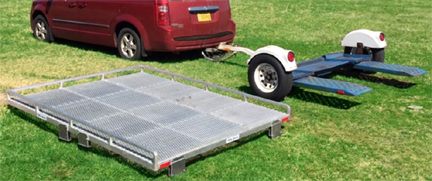
The same thought struck Joe Grape. Joe was a motorhome owner with a tow dolly. After buying a new riding lawn more, Joe had to borrow a utility trailer to get the mower home. Then his eyes lit on his “unused” tow dolly. Wasn’t there some way he could convert that tow dolly into a utility trailer? And go one better – figure out a way so that the same system could be used by any tow dolly owner, regardless of the make or age of the dolly?

The Edgar, Wisconsin man got cracking and sure enough, Joe’s “Tow Mate” is now a patented “universal flatbed attachment.” The flatbed, which weighs in at slightly more than 100 pounds, can be laid down on your tow dolly, attached, and be ready to haul in minutes. With a payload capacity of 1,595 pounds, you can haul a lot of lawn mower, lumber, or what-have-you, keeping your tow dolly busy year-around.

The system doesn’t require you to drill holes or make modifications to you dolly, and with a bed that’s six by eight, there’s plenty of room for hauling stuff. If your “stuff” includes say, a motorcycle, Joe can provide you with an optional motorcycle rail system that keeps your bike stable as you tow it down the road.

While Joe’s website doesn’t list a retail price, a little quick math shows it’ll set you back less than $1,000, as Tow Mate will finance your new dolly bed for $70 a month for 12 months. The new company is looking for dealers, too. Learn more at tow-mateusa.com, or ring them at 715-370-3342.