

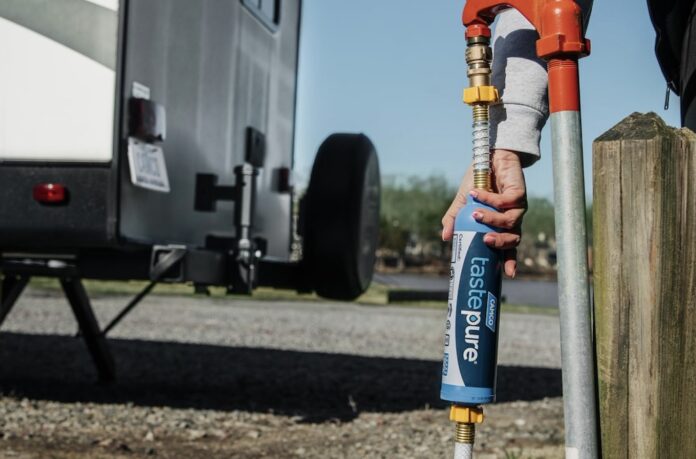
Where should an RVer place a water filter on the fresh water intake hose? Should it be placed between the faucet and the hose or between the hose and the RV? Or, does it even matter?
This question often comes up among newbie RVers. From a water flow perspective, it really doesn’t matter.
One popular thought is that it’s best to place an in-line filter or purifier as close to the water source as possible, typically right at the campground spigot. That way you are protecting the hose itself, as well as the fresh water demand system in the RV.
Often it’s nearly impossible to drain all the water from the hose and, over time, contaminants could gather in the stored hose and then be forced directly into the system the next time the RV hooks up to water.
Additionally, it’s wise to connect both ends of the coiled hose together before storing it in the rig. This practice helps keep insects and debris out, ensuring your hose stays clean and ready for use.
And don’t forget a water pressure regulator
It’s also wise to carry an adjustable city water pressure regulator. Different campgrounds have varying water pressures, some dangerously high. An adjustable regulator allows you to maintain safe and consistent water pressure, preventing damage to your RV’s plumbing.
Having some spare hose washers is also a good idea, as these small items can prevent leaks and ensure a tight connection. Lastly, always remember to sanitize your water system periodically to maintain clean and safe water for all your needs.
• A popular RV water hose filter from Camco is available from Amazon.
• A popular city water pressure regulator is available from Amazon.
RELATED: Water pressure regulators keep geysers out of your RV. Click here.
ALSO RELATED: Can you use a dump station faucet to fill your RV’s freshwater tanks? Should you?
RVDT2698
I prefer this pressure regulator from Amazon. No tools are needed to adjust the regulated pressure. Most, including the suggested regulator in this article, require a screwdriver.
Just remember, the regulator gauge is reading the static pressure between the regulator and the check valve at the RV end of the connection. You have to temporarily open a faucet inside the RV to release the current pressure, close the faucet, then adjust and temporarily open and close the faucet a 2nd time to double-check.
Shows unavailable!
This one is available
RVGuard Pressure Regulator
Just like the one I donated to the next camper recently!
I hope the next camper appreciates your generous gift.
It’s always nice to pay it forward.
One other thing: Those small cylindrical plastic filters need to lay flat. I see so many hanging from the spigot like the one pictured.
Drew, I saw no requirement to lay my inline filter (like the one pictured) flat. Can you expand further as to why you say that? Thanks!
Filter should be after pressure regulator to protect filter
Thank you for the discussion, RV Travel! I have a water pressure regulator that has an analog display that shows what the campground water pressure is (if the pressure is low, then I put some water in the fresh water tank and we shower using that water and the pump). That always precedes the water filter. Next comes a water softener to reduce mineral buildup in the plumbing fixtures, and lastly, the water hose. Have a great day and safe travels!
I notice that most ads show the filter mounted close to the vehicle. Why would you not mount the filter closer to the source to avoid contaminating your fresh water hose?
I use water pressure regulator at source, inline filter, freshwater hose, vehicle.
Make sure the guy before you hooked up his black tank rinse hose so you can get all those good bugs in your “fresh water tank” fill hose and everyone behind you gets a dose of it also. Always spray the hose connection first with sanitizer.