

 Dear Gary,
Thank you for teaching me so much about RVs over the years. You have discussed every aspect of vehicle care, including the importance of taking proper care of the RV tires. In some of those articles, it has been mentioned that something should separate your tires from the concrete. Would you be kind enough to tell me the type of material that should be used? —Harry A.
Dear Harry,
If you’ve ever attended one of my seminars, you know I’m a big proponent of keeping moisture, dirt and grime from accumulating on RV tires as well as preserving and protecting them from ozone and the UV rays of the sun during periods of non-use. Sure, they’ll get dirty while traveling, but be sure to wash them with a mild detergent as soon as you can after coming off the road. Applying a protectant such as 303 to help preserve and protect the rubber will also go a long way.
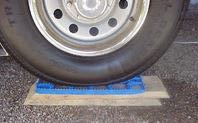 Not so much on concrete, but when parked on asphalt, it’s advisable to have a barrier between the tires and the surface of the asphalt. Though wooden blocking is often used to separate the tires from the asphalt as well as to lift that corner of the motorhome, I also favor a separation between the wooden blocks and the tires to avoid excessive moisture and/or heat buildup. Plastic, web-like blocks are readily available in the aftermarket that allows you to accomplish this. The accompanying photo shows such a separating block. There are many on the market, but look for the type that will drain and not trap moisture.
Editor: Here’s a link to the 303 tire protectant at Amazon, and here’s a link to plastic blocks at Amazon.
##RVT858


Gary,
Good advice on the tires!
Michelin says this for LONG TERM STORAGE
https://www.michelinb2b.com/wps/b2bcontent/PDF/RV_Tires_Brochure.pdf
When a tire is fitted to a wheel and put under load, but it is not regularly used, the tire does not have an opportunity to “exercise” and will prematurely age.
If a recreational vehicle is not driven regularly, care must be taken to preserve the remaining life of the tires.
Best practices include:
1. Store the recreational vehicle in a cool, dry, sealed garage, away from electric generators or transformers. Do not store in an area where welding is performed, or in a garage that has frequently used electric motors.
2. Place a barrier between the tire and the storage surface. Suitable barriers include plastic, plywood, cardboard, or rubber floor mats.
3. Before storing the vehicles, thoroughly clean tires with soap and water.
4. If outdoors, cover tires to block direct sunlight and ultraviolet rays.
5. Inflate tires to the maximum inflation pressure indicated on the sidewall.
I use 16X16″ recycled rubber pavers from Lowes or Home Depot under each tire when storing my coach. Cost about $5 each. They are grooved to make a brick like pattern so water will probably run off from them and not pool.
Gary – Are the tire treatments any good for actually protecting the tire, or do they just make it shine?
I know covering is the right thing for long term, but do the “protectants” protect on the road and in the short term?
Thanks
Avoid any protectants with silicone.
Can you tell me more on Tire Monitoring Systems and if we need them. I have a Class A Holiday Rambler Vacationer gas.
Can any of you tell me if you have ever had a problem with an RV tire where the “weld” of the wheel failed and caused a leak? Not the rim … not by the lugs … but in the (basically) middle of the wheel where the design of the wheel meets the basic piece of the wheel where the tire sits. Difficult to explain when I don’t really know what I’m talking about. My husband and I suspect the wheel received a hard blow when the new tire was put on. Does this make sense?