

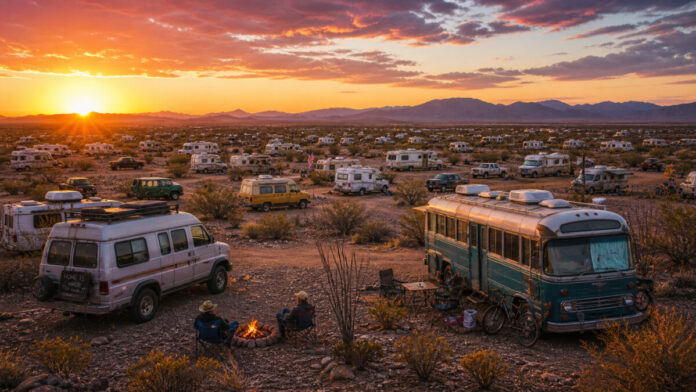
Quartzsite has never exactly been a secret among RVers. But when a major international outlet shines a light on the desert town’s $180 winter camping option, it can change who shows up next season—and how many.
A new feature from The Guardian casts Quartzsite, AZ, as more than a seasonal gathering spot. It presents it as one of the last places in America where a person can legally live for months at a time for less than the cost of a single night in many hotels. That idea carries weight, especially for readers who have never set foot on Bureau of Land Management land and may not realize this option even exists.
Why the $180 number is getting attention
For RVers, the basics are familiar. Quartzsite winter camping has long centered on the BLM’s long-term visitor areas (LTVAs), where a seasonal permit—currently $180—covers camping from mid-September through mid-April. What feels different now is not the program, but the framing. Instead of a lifestyle choice or seasonal migration, the story leans into something more urgent: affordability. Rising housing costs and limited rental options are pushing more people to look for alternatives, and public lands are becoming part of that solution.
Growth in Quartzsite is no longer quiet
That shift helps explain why Quartzsite’s growth is no longer quiet. According to Bureau of Land Management data cited in the report, long-term visitor area permits have more than doubled in recent years, rising from about 4,300 in 2019 to more than 10,000 in 2025. Even in a place as wide open as the desert, that kind of increase changes the feel on the ground.
A changing mix of campers is reshaping the desert
BLM planning documents suggest the mix of visitors is changing, too. More people are arriving in vans, buses, and smaller conversions instead of traditional motorhomes. More are using those vehicles as primary housing rather than seasonal escapes. Shared living setups are becoming more common. And more visitors are relying on low-cost or free services to get through the season. At the same time, the system itself is under strain, with growing pressure on water, dump stations, trash collection, and enforcement.
What longtime RVers may start noticing
For longtime RVers, those changes tend to show up in practical ways first. Camps sit a little closer together. Informal neighborhoods form earlier. Lines at dump stations stretch longer. Enforcement can feel uneven, especially when some campers pay and others don’t. None of that happens overnight, but over time it adds up.
What a national spotlight could change next
What makes the Guardian story worth watching is what could come next. Exposure matters. When a large audience learns it’s possible to stay legally on public land for months at a relatively low cost, with a built-in community already in place, it lowers the barrier to entry in a very real way.
Quartzsite has always been accessible. Now it’s being introduced to people who may never have considered it before.
That doesn’t guarantee a surge next winter. But it does make one more likely. And with growth already trending upward, even a modest bump could be noticeable across the LTVAs and surrounding desert.
There’s also a broader shift underway. Quartzsite has long been a mix of traditional snowbirds and independent boondockers. Increasingly, it’s also becoming a place where people land because it’s one of the few workable options they can afford. Those groups often overlap, but not always, and that can subtly change the character of the community.
The bigger question behind Quartzsite’s future
Behind all of this is a bigger question the BLM has already started to wrestle with. As usage increases, so does pressure on infrastructure and staffing. At least on paper, that has led to discussions about raising long-term permit fees—potentially as high as $600—to help cover costs. Nothing has been finalized. But the idea reflects a simple reality: The more people rely on the system, the harder it becomes to maintain it at the same price and scale.
Quartzsite has always made room for people looking for something different, whether that’s sunshine, savings, or a fresh start. But with more attention now focused on that $180 winter option, the desert may be entering another phase—one where space itself becomes the thing everyone is competing for.
RELATED
- A major I-10 project is coming to Quartzsite; RVers may want answers early
- Quartzsite’s secret weapon? It’s affordable, unconventional, and proud of it
- The top 8 day trips from Quartzsite
- Quartzsite, Arizona: 20 reasons why so many RVers love it
- Everything you need to know about camping in Quartzsite
- Understanding Quartzsite’s long-term visitor areas: What to pay and what to expect
- 7 reasons to RV in Quartzsite and 3 reasons not to
RVT1260b


We were there in January 2020 for about 10 days. We enjoyed the RV show. The permit cost for our stay was $40. It’s no resort! It’s extremely dusty with no interior roads or signs and zero hookups. The lines for water and dumping were long and required us to get in line hours before they opened. Trash piled up at the few dumpsters. There are few restaurants and other facilities in town – not much to do, really. The closest shopping center is in Blythe, CA. There’s no hospital in Quartzsite, only a rural health clinic. Medical emergencies would likely go to Phoenix. Other than the permit fee, you would still need to obtain fuel for heat and battery charging. Once in a life was enough for us.
I guess you get what you pay for at $4 per day.
I can’t say I have noticed more crowds. In fact, this year, everyone in our camp of long time Quartzsite pilgrims agreed, there seemed to be less people in Quartzsite.
I finally made it to Quartzsite this year in January 2026 to experience the hype: boondocking, RTR, RV show, Schooliepalooza, and Fiberglass Gathering. It did not seem overwhelming to me as bloggers imply. I had plenty of personal space. With international attention, some fear the hype and stay away, and newbies take their place. Do not be alarmed, just go.
Full-timers have overrun, overstayed and trashed a lot of the dispersed BLM camping areas in my home state of Utah so much that the areas have been closed and turned into a few designated camping sites. Most recently this has happened at the dispersed camping areas around Zion NP. I sure hope this doesn’t happen in Quartzsite. We have been going every year for decades and have noticed the amount of people and problems have greatly increased.