

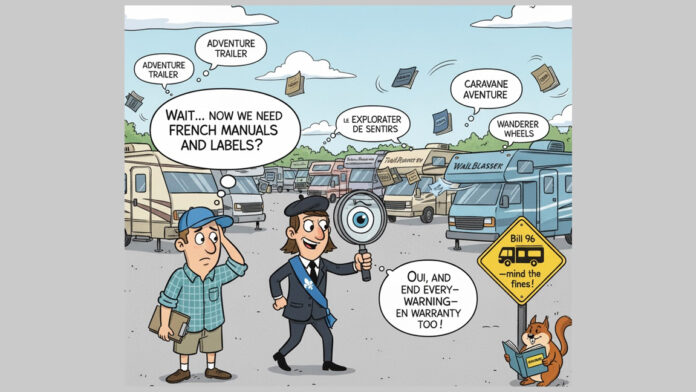
Quebec is making sure French isn’t just for croissants and café au lait. If you’re selling RVs there, it now has to be on your labels, too. It’s a case of RV manufacturers beware. Not only do Canadian bears have teeth—so do the laws! RV manuals in French are la loi!
The province’s Bill 96, updated in 2024, pushes businesses to speak French everywhere your customers can see—on packaging, manuals, instructions, warranties, and even warning signs. Basically, if it’s in the RV box or attached to the RV, it needs a French version.
It goes beyond RV manuals in French
And here’s a twist for branding: Even product names or descriptions in English may need French translations. So that “Roadrunner Adventure Trailer” might need a sidekick called “Caravane Aventure.”
The watchdog? Quebec’s Office québécois de la langue française (OQLF). They make sure all your customer-facing materials follow the rules. And they’re serious—first-time violators can face fines from $3,000 to $30,000 per day, with repeat offenses costing even more.
American manufacturers get the warning
The RV Industry Association (RVIA) warns: “If RV manufacturers sell to RV dealers in Quebec, such manufacturers should be communicating with their respective dealers. The recent amendments in 2022 further expanded the penalties for non-compliance.”
RVIA also reminds manufacturers: It’s not just the RVs themselves—every component, label, warranty, and instruction sheet counts. “For those manufacturers who sell units into Quebec, RV manufacturers should review these laws and regulations with legal counsel to ensure compliance with their respective units and any documentation supplied with those units,” they say.
In short: RV builders! Keep your RVs fun and your fines low—make sure French is along for the ride.
RELATED
- One of North America’s oldest campgrounds is now day-use only
- RVing in Canada is different: Tips for a successful Canadian RV trip!
- Want to RV around Canada, eh? Our readers suggest their favorite routes
- 20 things we wish we knew before RVing to Alaska
RVT1231b

As a former Canadian, I can assure you that the 2 official language laws in Canada have put more small businesses out of business over the last 50 years than Covid could ever have dreamed of doing.
Prior to emigrating from Canada, if you sold bags of homemade candy, or kettle corn at a farmers market on Saturdays your label had to be printed in French and English. Even if your farmers market on main street was in a small farming town in Alberta that had zero French speaking residents.
Bilingualism in Canada has cost the country hundreds of billions of positive economic activity.
🇺🇲🇺🇲🇺🇲🇺🇲
And yet, 75% of the native French speakers in Quebec are fluent in English at least to a conversational level. If I am a manufacturer, I would walk away from that market.
Thank you for the news, Russ and Tina! I suppose that the enforcement of bi-lingual requirements must have gotten lax and this addresses that. Seems, too, that RV manufacturers must create a cottage industry of French speakers creating French translations to supplement the ones in English, or not bother selling RVs in Quebec. Have a great day and safe travels!
Create a cottage industry of French speakers? Perfect job for AI. Computer based language translation tools have been around for ages. AI can read them, translate, and prep the needed docs for production.
Only put things in or on the RV that have to be there by law and the rest become online versions.
Quebec has tried several times to separate from Canada. I say, let them go and take their French language laws with them. It would be a huge relief for the rest of Canada.
I’m sure there will be additional cost for printing everything in English and French and I hope those costs will be paid for by the Canadians and not everyone else. I wonder if all the other manufacturers like car companies, food companies and home products have to also abide by this rule.
I wonder what would happen if the manufacturers didn’t sell in Canada, I would think the people would have a few choice words for the government.