

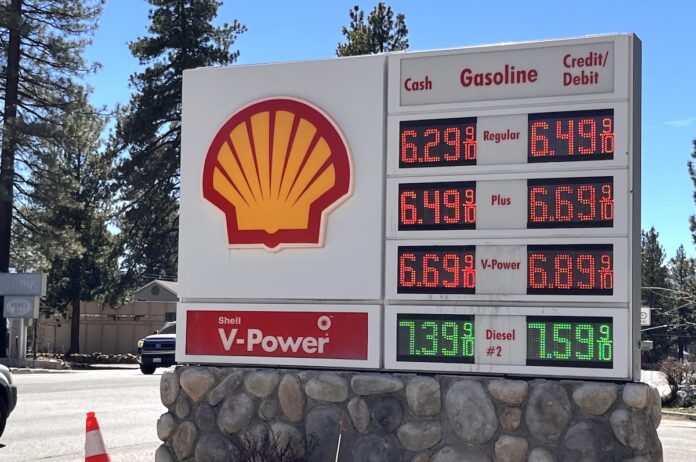
Earlier this week, reader Karen M. sent us this letter. Right now, we (and we know you, too) are doing everything we can to save money on gas, so we thought this would be a much-appreciated note. Thank you, Karen!
Hello. We’ve been reading RVtravel.com for a long time, and first want to thank you for all you do! We have learned so much from you.
I wanted to share something that’s made a noticeable difference in how I travel and something I think your other readers would appreciate. After a lot of miles and more fuel stops than I can count, I realized I’d been approaching getting gas all wrong.
Like many of us, I used to wait until I was down to about a quarter tank before thinking seriously about fuel. Then I’d pull off at the next convenient station that looked big enough to handle my rig. It worked… but I started noticing how inconsistent prices were—sometimes dramatically so—even within the same stretch of highway!
The turning point came on a trip through Nevada and eastern California. Instead of stopping when I needed fuel, I planned ahead and gave myself a 150–200-mile “fuel window.” The night before, I checked prices along my route and picked a couple of good options, plus a backup. That one change saved me close to $40 on a single fill-up, and, more importantly, it changed how I think about fueling altogether.
What I’ve learned is that fuel pricing often comes down to timing and being more flexible. Stations right off major interstates (especially in remote areas) know travelers are low on options, and they price accordingly. But just a short distance before or after those spots, prices can drop quite a bit. If you wait until you’re running low, you lose the ability to choose, and you’ll usually pay more because of it.
Now I start thinking about fuel when I hit about half a tank. I don’t lock myself into one stop, but I always have a “best option,” a backup, and a last resort in mind. It’s made my trips smoother, less stressful, and noticeably less expensive over time.
It may sound like a minor detail, but for those of us who spend a lot of time on the road, it adds up. Thought I’d pass it along in case it helps someone else the way it helped me.
Again, thanks for everything! —Karen M.
RELATED
- Gas prices jump nearly 30 cents in a week
- How to save money on gas: Budget-saving tips for RVers
- Costco to build its first massive standalone gas station
- Gas prices continue to rise. Here’s how you can save
- Visit the gas station designed by Frank Lloyd Wright
- Hungry on the road? These gas station meals are worth a stop
RVT1259

Been using Karen’s process ever since I got my Open Roads card several years ago and have visibilty via their App to my future route’s fuel pricing. Works like a charm. 👍
Open Roads has saved us lots of money on diesel. Plus we know our 40ft rig plus toad can get in and out easily.
I have used that method with open roads for over 5 years today
I looked in to Wex 10-4 and it is even better for a fuel discount
My dear old Dad who taught me how to drive economically told me I should never let the tank get more than half low. A. You might need to go someplace in an emergency when the gas stations weren’t open B. Your mpg dropped after the tank was less than half low. Nowadays I check Costco prices and GasBuddy. I haven’t researched further than 1 day but I’m going to start doing that now. Thanks for waking us up
“ B Your mpg dropped after the tank was less than half low “
Why? Because you are not carrying the extra weight of more fuel?
My same question.
Yes, if anything your mpg would (imperceptibly) go up from less weight. Certainly no reason mpg would get worse based on how full a tank is.
Maybe way back in those days fuel was full of water sitting on the bottom of the tank. But then, the fuel line sucks from the bottom anyway. 🤷
The fuel sensors aren’t necessarily linear. That is, going from full to half isn’t necessarily the same amt of gas as from half to empty. Sensors vary.
Umm,
That would raise the mpg!
Or, if you’re boondocking at Walmart or at a BLM land and need to use your generator, you’ll be confident there is enough fuel in the tank.
When we had the walk around of our then new 2014 diesel pusher (full-time past 6 years!) it included the comment “And this little compartment door is where you put all your money!”, referring to the diesel fuel door. We all laughed, but I immediately began searching for ways to save $ on fuel. After 63K miles, i have 8 recommendations: 1) Use Gas Buddy to search ahead on your route, 2) Start searching when half a tank is left, 3) Try to always fill up just before arriving at your campsite if it is any more than a one-night-stand, 4) Don’t buy at truck stops because they sell biodiesel and your manual tells you to change fuel filters more often if using biodiesel so there go your savings
No biodiesel at the truck stops I go to .. Loves, etc.
Stop at small fuel dealers with very low diesel fuel turnover and you might be changing filters even more often. I’ve never had issues with diesel at high-volume truck stops (though I’m sure it can happen), but I have gotten bad fuel at low-volume places.
5) Use Google maps satellite view to pre-plan and assure your access to the chosen fuel stop, 6) Beware some brand name stations (i mean you, Shell) will have a substantially lower price on diesel because it is not Shell brand fuel!, 7) Remember, your diesel generator won’t run if the fuel tank is below 1/4 full, 8) Don’t go far out of your way to save a few cents per gallon because you will spend your savings getting there and back (know your average mileage and you can deduct the cost of driving there and back in your head).
You’re welcome!
I have not used this approach however I follow several flat bed truckers on YouTube and they use a similar process of never getting so low on fuel that you are forced to take the higher prices.
Gas Buddy is your best friend. I have found almost $1 difference within a mile.
Also, check prices before you cross a Stateline. Waiting to fill up in WA state, coming from ID, will cost you over a dollar a gallon thanks to Olympia!!!
In Washington 70 percent of the gas tax funds go to highway improvements and maintenance. The other 30 percent goes to pay off highway improvement bonds. In essence it’s a use tax.
So?
On our trip in the NW a couple years ago, that’s exactly what we did. Filled up at a Maverik truck stop off I90 in Idaho about a half mile from the Washington state line. With a 150 gallon fuel tank, that got us through Washington and into Oregon where the prices were much better again.
Always fill up before entering Kalifornia too.
thanks Kary
Hi, Pammy. I almost “corrected” your spelling of Gary’s name but then I looked at his comment and decided your spelling was intentional, so left it.😉 Have a good night. 😀 –Diane at RVtravel.com
I use Open Roads TSD card for my diesel. It always ends up cheaper than off the interstate stations and I have plenty of room for my big rig. But I do start looking on my app at half a tank.
I like to stop at about half full for diesel and I use Gas Buddy to help find low prices then check out google earth to make sure I can get my rig into and out of the station easily.
Most experienced RV’ers realize that the station right off the interstate may not be the best price available for gas. Many will use Gasbuddy along with other “fuel price” savings apps. As far as diesel RV’ers go, most will have the Open Roads or Greenlane accounts that will save you from a few pennies to over $1.00 per gallon of diesel at truck stops.
Being a former boater, to me, a half tank of fuel is half-empty, and that has always been my RV’ing M.O. since day one. I scratch my head even watching YouTube RV channels, and these “professional” RV’ers wait until their dash gauge says they have 25 miles left in the tank.
Another little tip which may save some fuel and not cost anything extra – always fill early in the morning – the fuel/gas in the ground is cool/cold – as it sits in your tank it warms and expands. Trucks deliver fuel to stations at a calibrated/ adjusted temp of 59 deg.f standard temp. (The station pays for the fuel at that temp.).
The temperature in an in-ground tank is not going to change significantly during the day, so it doesn’t matter what time of day you buy fuel.
Hi Brian: It will certainly expand when exposed to the heat of the day – I suggest you try it in your car first. I have an 80 gal tank on my MH – it makes a significant difference. Fill a plastic, red, gas can and set it in the sun – be extremely careful when opening it!!!
Truth. On our last trip, I’d googled various fuel stations along our route. We often found better fuel prices a few miles from a major junction. The biggest fuel price drop was a small town 5 miles east of Carson City, NV where we saved $0.68 per gallon.
We avoid using highways as much as possible, and one of the side benefits is that fuel prices are lower once you get away from them.
Besides all the tips already provided, as a full-timer, I download apps for chain grocery stores that have gas stations wherever we land for a while. I usually earn enough points from shopping at the store to get a reduction in the per gallon price. Also used Sam’s Club when we had a diesel truck and now use Costco for the gas truck. Where Walmart’s have a Murphy gas station I have the Murphy app which also give discounts.