

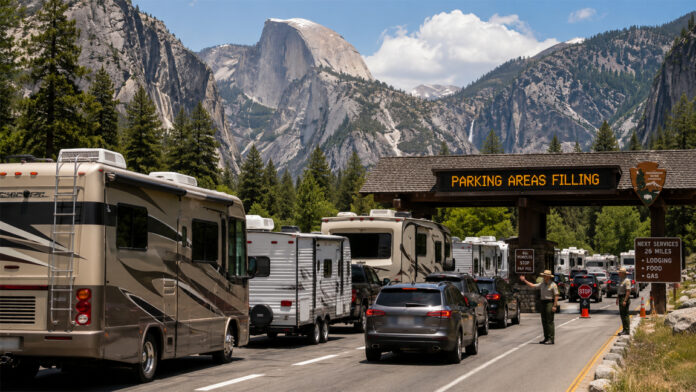
Getting into some of America’s busiest national parks no longer requires the advance reservations many visitors became accustomed to over the past few years.
But that doesn’t necessarily mean visiting has become easier.
Yosemite National Park is providing one of the clearest early examples of what can happen when reservation requirements disappear while demand remains high. For RVers, that means planning ahead is still essential—even if securing an entry reservation isn’t.
The California park welcomed 634,508 visitors in June, about 20% above the June average from 2010 through 2024. That’s just shy of its all-time June record. Visitors reported overflowing parking lots, roadside parking, traffic backups and crowded viewpoints.
The changes aren’t universal. Yosemite largely dropped its broad timed-entry reservation system for the 2026 summer season, while other parks continue to use reservations for entry, certain roads or specific attractions. Requirements vary from park to park—and can change from season to season.
“The end of a reservation requirement doesn’t necessarily mean the end of long lines.”
Instead of wondering whether you’ll get a reservation, you may now be wondering whether you’ll find a parking space.
A different kind of planning
For RVers, the lesson isn’t that planning has become less important.
It’s that planning has changed.
Rather than spending weeks trying to secure an entry date, visitors should focus on when they’ll arrive, where they’ll park and whether shuttle service is available.
Arriving early, checking park alerts before leaving the campground and having a backup plan if parking fills can make the difference between a relaxing day and a frustrating one.
A campground reservation guarantees you a place to stay—not an uncrowded day inside the park. Visitors may still encounter congested roads, full parking lots and crowded trailheads during peak hours.
“For RVers, planning ahead still matters—even if advance reservations no longer do.”
Not every park is the same
One of the biggest challenges this year is that there is no single national park policy.
Some parks have moved away from broad timed-entry systems. Others still require reservations during peak periods or for certain roads, attractions or activities.
Before leaving home—or even before pulling out of the campground—it’s worth checking the specific park’s website to confirm current reservation requirements, road conditions and visitor alerts.
The bottom line
As some parks move away from broad reservation systems, spontaneous trips may become easier to start.
Yosemite’s experience suggests they won’t necessarily become less crowded once you get there.
In other words, reservations may be disappearing at some parks, but planning ahead remains one of the best ways to make the most of a national park visit.
Before visiting a busy national park:
- Check whether entry reservations are required.
- Review park alerts before leaving your campground.
- Arrive early, especially on weekends.
- Use park shuttles where available.
- Have a backup plan if parking areas fill.
- Expect delays during peak afternoon hours.
RELATED
- Fire restrictions spread across Western national parks and forests
- National parks could get billions for roads, campgrounds and other overdue repairs
- National parks drop timed-entry reservations in 2026; RVers may pay the price
- National parks avoid major funding cuts, a key concern for RV travelers
- Why staffing shortages in national parks are changing the visitor experience
RVT1270b
