


When national parks no longer require timed-entry reservations for the 2026 season, RVers are likely to feel the impact first. The National Park Service says loosening or eliminating timed-entry systems at several of the country’s most visited parks will expand public access—but early experience suggests fewer reservations can mean longer lines and tougher conditions for larger rigs.
The changes affect some of the nation’s busiest destinations, including Yosemite National Park, Glacier National Park, and Arches National Park, where park managers used timed entry in recent years to spread arrivals and manage congestion.
While the National Park Service says it will rely on real-time traffic controls and staffing instead, the early results point to a familiar reality: When demand spikes and parking fills, larger vehicles are often the first to feel the squeeze.
Access without reservations, but not without limits
In its announcement, the National Park Service said the new approach is designed to expand access while maintaining safety at high-visitation parks. Rather than requiring advance reservations, park managers plan to use tools such as temporary road closures, traffic metering, and on-site enforcement when conditions become unsafe or overcrowded.
For RVers, that shift trades predictability for uncertainty.
Timed-entry systems were often unpopular, particularly among travelers who prefer flexible schedules or spontaneous trips. But they also offered something RVers value: knowing whether entry would be possible before committing to a long drive with a large rig.
Without that gatekeeping upfront, congestion now tends to pile up at park entrances, along approach roads, and at parking areas that cannot easily accommodate oversized vehicles.
Yosemite as a preview
Recent no-reservation periods at Yosemite offer a glimpse of what the 2026 summer season could look like. During high-demand weekends, traffic backups have stretched for miles outside park entrances, and staff have turned drivers around after parking areas filled.
For car travelers, that can mean a frustrating delay. For RVers, it can mean a full stop.
Limited turnarounds, vehicle length restrictions on certain roads, and full parking lots leave few options for large rigs once congestion hits. Even when passenger vehicles continue cycling in and out, RVers may find themselves excluded simply because there is nowhere safe or legal to park.
Glacier and Arches face similar constraints
At Glacier National Park, the Going-to-the-Sun Road remains one of the most tightly constrained scenic drives in the system. Parking areas are limited, vehicle size restrictions are strictly enforced and, once traffic builds, access can shut down quickly.
Removing timed entry does not expand capacity. It simply shifts demand earlier in the day, encouraging visitors to arrive before dawn or gamble on shoulder-hour access.
Arches National Park faces an even sharper pinch. A short access road, a small number of parking areas, and extremely high visitation mean congestion can escalate rapidly. When entry gates close due to crowding, RVers are often the first vehicles turned away.
One park going the other direction
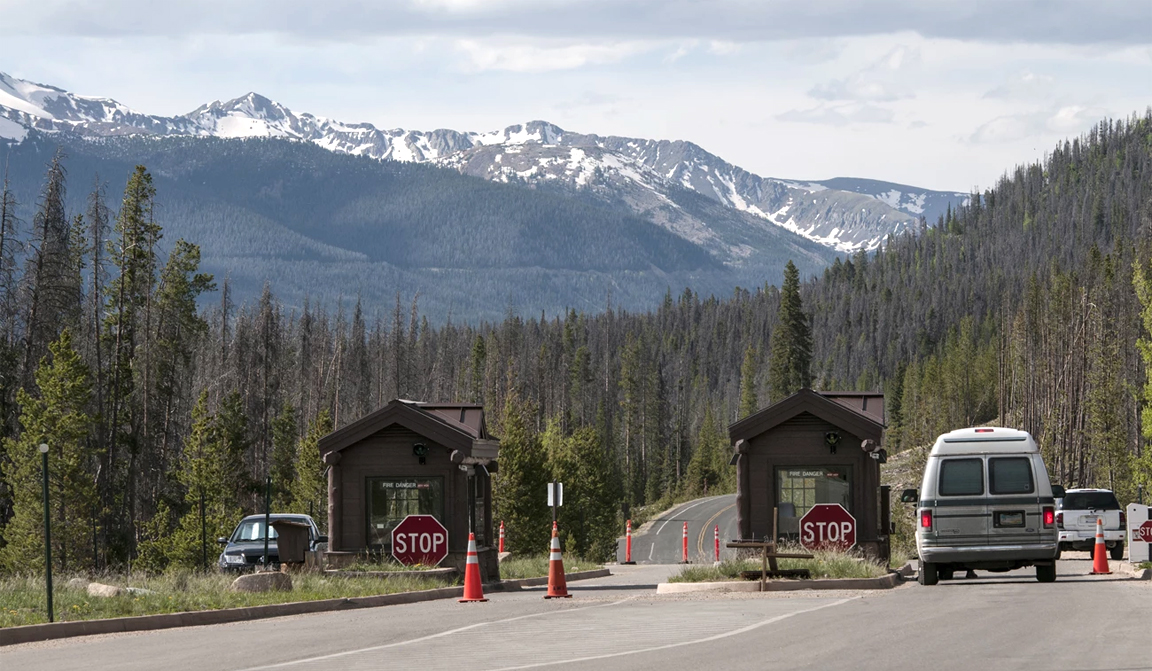
Notably, Rocky Mountain National Park is maintaining its reservation system, offering a contrast that RVers may notice immediately.
By spacing arrivals throughout the day, timed entry at Rocky Mountain has helped reduce long entrance backups and made parking availability more predictable. For RV travelers, that predictability can be the difference between a manageable visit and a wasted travel day.
The contrast raises an uncomfortable question: whether removing reservations actually improves access, or simply changes who bears the inconvenience.
Safety and enforcement replace scheduling
The National Park Service emphasizes that safety remains a priority, and that managers will intervene when conditions demand it. But from an RVer’s perspective, enforcement-based control often feels harsher than reservation-based planning.
Instead of a denied reservation weeks in advance, the denial happens at the gate—after fuel costs, campground reservations, and travel time have already been spent.
Law enforcement discretion, emergency closures, and parking restrictions can change by the hour. Larger vehicles, which require more space and time to maneuver, are inherently less adaptable in those conditions.
What RVers should expect
For RV travelers planning trips in 2026, the takeaway is not that national parks are off-limit. It’s that access without reservations does not mean guaranteed entry—or a smoother visit.
Early arrivals, midweek visits, shoulder-season travel, and backup plans will matter more than ever. So will realistic expectations about parking, road restrictions, and the possibility of being turned away even after reaching the gate.
For years, reservations were the frustration. Going forward, uncertainty may take their place.
And for RVers, who operate with fewer last-minute options than car travelers, that uncertainty is often felt first.
RELATED
- National parks avoid major funding cuts, a key concern for RV travelers
- Why staffing shortages in national parks are changing the visitor experience
- Poll finds 7 in 10 Americans want to protect national parks from budget cuts
- Visitors may not see the strain, but national parks are operating with thinner teams
- It’s official: Foreign visitors will pay more to visit national parks
- National Parks update fees, hike those for nonresidents
- What the public doesn’t see in national park budget cuts
RVT1250b


I know a lot of people complained about the timed entry, but I personally thought it was a great idea. We live fairly close to Arches and decided to visit last Spring which is the busiest time of year. We had avoided going there for a few years because of the crowds and because you had to arrive so early to get in. With the timed entry (we had 1:00PM) it was wonderful. We found parking at every site. The trails weren’t too crowded, and it was a very nice experience. Everyone seemed relaxed and having fun instead of fighting for parking spots. Now it looks like the NP service will go back to closing the park to lessen crowds. Better get there really early to get in.
Thank you, Russ and Tina, for this information. Gee, you think the park service is trying to dissuade folks from visiting national parks? Either way, these changes seem ripe for that outcome. I agree to not contribute to the congestion at national parks, but I doubt that anyone will notice. 😉 Have a great weekend and safe travels!