


Dear Dave,
My question is regarding a blown glass fuse on our Dometic gas/electric fridge. I keep having to replace the small glass fuse on the back of the fridge. I find the issue when we plug in at home. The RV only comes home to get ready for trips, packing up and small jobs. Unfortunately, I can only run 15-amp power to it and it is about a 40-50 ft. distance to where we park it.
If we are at a campground (50 amp), this fuse doesn’t blow once it is changed. It only happens at home. Could the issue be the 15-amp cord and distance? Thanks for your help! —Pam, 2021 Eagle 321RSTS 5th wheel
Dear Pam,
I assume you are referring to the glass in-line fuse located inside the black module box accessible from the outside refrigerator vent? It is in the upper left corner of this photo.

I believe the fuse is a 5-amp “fast blow” fuse that is designed to protect the unit if there is high current going to the heating element. It should look similar to this one found on Amazon from Dinosaur.

The fuse is just above the J5 (AC line voltage). Since it is working when plugged into shoreline power, it is not the heating element or module board. Rather, it has something to do with your home outlet or extension cord.
First, test the outlet
The first item I would test is the outlet that you are using. It should have the following readings:
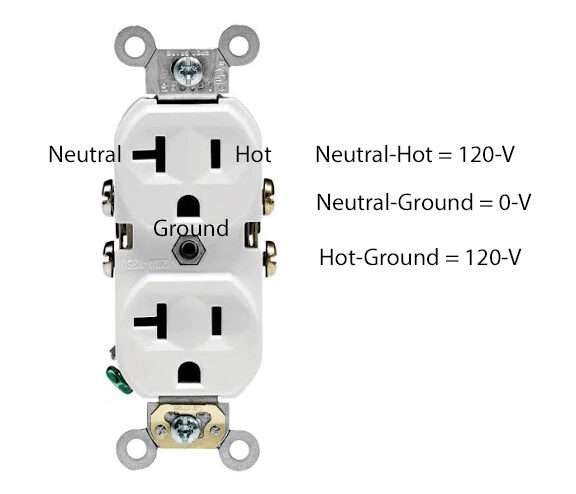
Most likely your outlet is a 20 amp, which is identified by the sideways “T” for the neutral. Test the outlet to make sure you have at least 115 volts and not more than 125 volts between the neutral-hot and the hot-ground, and nothing between neutral-ground. Anything outside this range could be the cause of your issue and needs to be addressed.
Check the extension cord
If the outlet tests good, plug in your extension cord and test the female end in the same manner before hooking up the shoreline cord and the adapter. Again, any readings outside the safe range means your extension cord is no good.
If that tests good, connect your adapter and test that without the shoreline cord. This will help eliminate the outlet, extension cord, and adapter, as we know the shoreline cord is good because it works at the campground.
Could be overloading circuit
If all these steps test within range, it could be that you are overloading the circuit by having a roof air conditioner or other components on. Even if you have a 20-amp outlet at home, it may be ganged to other outlets that have a refrigerator, freezer, or air compressor connected and drawing power.
Even if nothing else is running, your RV absorption refrigerator will draw about 8-10 amps depending on the size, and the converter will be running continuously and drawing 6-9 amps. If you have the air conditioner on, that will draw up to 14 amps and you do not have enough power for all of that.
Low voltage could cause increased amp draw at the module board and be the issue. Try turning off all the circuit breakers at the distribution panel other than the main and the refrigerator. Even with the converter breaker off, the house batteries will still power the 12 volt required by the refrigerator—see if that works. Otherwise, I would suggest getting an electrician in to conduct the specific tests to ensure there is enough power.
Level the RV
One last thought: If your rig is in the driveway and not level 3 degrees side to side, 6 degrees front to back, the rich liquid cannot zigzag it’s way back down the cooling unit in the RV absorption fridge. It will pool in a corner, causing extreme heat and eventually blocking the tube. This excess heat will also increase the amp draw and could be the issue.
You might also enjoy this from Dave
Why does the RV refrigerator work on LP but not on 120-volt power?
Dear Dave,
The RV’s fridge (Norcold 7) will not cool on electric, but works fine on gas. —Rodney, 2019 Thor Chateau 22B
MORE FROM DAVE ON RV REFRIGERATORS
- My RV’s absorption refrigerator died. What replacement would be best for dry camping?
- I want to install a 12-volt-powered fan in my RV refrigerator. What are my options?
- How long will an RV 12-volt refrigerator run with two batteries?
- Why does RV 12-volt refrigerator noisily cycle hourly?
- Replaced RV’s absorption refrigerator with a 12-volt; remove vents?
Dave Solberg is a leading expert in the RV industry and the author of the “RV Handbook.”
Read more from Dave here.
HAVE A QUESTION FOR DAVE?
Send your inquiries to him using the form below.
##RVDT2588

Thanks for your fact based article. It is very refreshing in today’s environment. It is hard to understand why people try and run their rv off of a 20 amp outlet and a household extension cord.
Let me help you understand, Prior to leaving on a trip I park the MH on the street in front of the garage, level it and start and run the generator for 2 hours to start the refrigerator cool down and to exercise the generator for the required 2 hours run time each month. After 2 hours, shut down generator, and use extension cord from garage to RV so refrigerator can finish cooling down. I do this the day before we leave and the refrigerator is the only thing running in the RV. Been doing it this way for 12 years and have had no problems with our Dometic absorption refrigerator. I do level the rig prior to doing this procedure.
Thank you for the discussion, particularly the test and decision tree for working through the problem, Dave! Have a great day and safe travels!
Another issue – what gauge is that outdoor extension cord? The outlet might be rated for 20A but many of those cords are only rated for 13A. And Dave says the voltage converter plus the refrigerator heating element typically draw 14-19A. Drawing more than 13A through the cord will just generate heat in the cord. You need a cord equal or greater than the expected current draw.
I routinely hook our 30A camper to a dedicated 20A house circuit to either prep or shutdown the camper prior to or following travel. But I also invested in a 50′ cord rated for a full 20A. A lot of stores don’t stock this level of extension cord.
I did not see extension cord wire gauge mentioned. If you’re going 40-50 feet a 16 gauge cord is only good for using a trouble light. You should have at least a 12 gauge cord to run that distance. Even with that cord only run the refrigerator and the converter. Shut off all else. It would be better to run the fridge on propane.