


Dear Dave,
On our first trip with this new-to-us travel trailer, the 12-volt refrigerator cycled on and off every hour or so, with a whirring, whiny noise and a soft thud, all night long. We finally had to turn it off so we could sleep. This was on battery power. Is this typical, or is something wrong? We’ve never had a 12v before, so we aren’t sure. Also don’t know how it behaves on shore power. Thanks! —Rebecca, 2022 Sun Lite Sport
Dear Rebecca,
A refrigerator will turn on and off quite often, which is called a cycle, as they do not run 100% of the time. As the temperature rises, the temperature sensor, known as the thermistor, calls for cold and the refrigerator starts and then shuts down when it reaches the set temperature. This is known as a cycle.
I don’t believe the thumping and whirring is normal. I would suggest connecting to a 120-volt source to see if the issue continues. When you are plugged in, the converter or battery charger provides a consistent 13.2 volts, so you know there is sufficient 12-volt power. If the issue continues while you are plugged in, then it would be something in the refrigerator such as the temperature sensor. This could be positioned wrong, frosted over, or weak.
Could be a battery power issue
My guess is that it is a battery power issue, and there are several variables here. Most trailers do not come from the factory with a battery, as they leave it to the dealer to decide what would be best for the new owner. Most dealers are going to install the most inexpensive flooded lead acid (FLA) battery rather than an expensive, high amp hour one if the new owners aren’t doing much dry camping.
Therefore, I would assume your rig has a FLA Group 24 with a low amp hour rating and you can only use 50%. If you are going to do a lot of dry camping, I would recommend doing some research on your amp draw of the refrigerator as well as other components and upgrade accordingly.
Keep in mind that most refrigerators will not run continuously for an hour. So I do believe that the refrigerator runs through a cycle, shuts down normally without the whirring and thump a few times, but when the battery gets low, it goes through an emergency shutdown? You should install a wireless thermometer inside the refrigerator and record temperatures. I would believe the unit may be shutting down more often than hourly but you just don’t hear it.
Type of refrigerator
The next variable is the type of refrigerator. You indicated it was a 12-volt but not the make and model. The market has been flooded with 12-volt refrigerators, and it’s hard to find an absorption model that runs off LP or 120 volt. From some of the forums I have been following, there are also a ton of junk 12-volt refrigerators coming into the market.
I have heard good things about units with the Danfoss 12-volt compressor, such as the Everchill model. This model seems to cool very well and is the most energy efficient when it comes to 12-volt power.
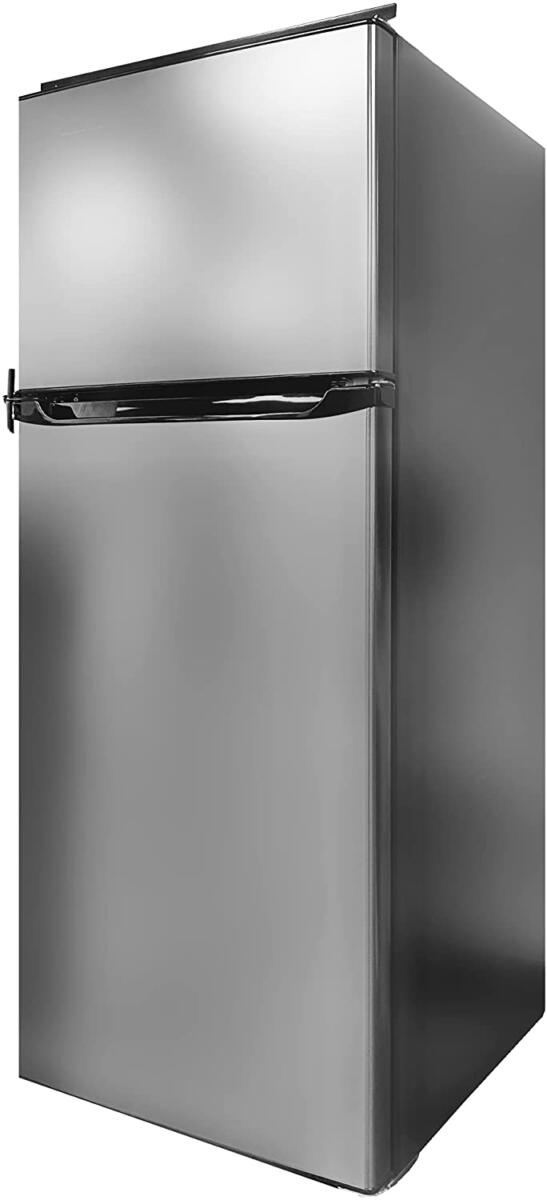
Mike Sokol did a comparison of refrigerators and a residential model running on 120-volt power through an inverter and 100 Ah lithium battery ran for 10 hours at 70-degree ambient temperature. This was an isolated test with nothing else running, so it would be even less in a real camping situation.
A 12-volt compressor refrigerator running on the 120-volt mode through an inverter with the same battery and temperature ran for almost 20 hours. However, a 12-volt compressor refrigerator running directly through a 12-volt connection ran for almost 40 hours. The variable in your situation is what type of refrigerator and how it is connected.
Why the refrigerator shuts down
I would assume you are running off a low amp hour FLA battery and the refrigerator is a high-draw model. As it drains power and something else comes on, like the water heater or furnace, the battery drops below the power threshold and the refrigerator shuts down. Then, as the other components shut off and the battery rejuvenates somewhat, the refrigerator kicks back on and continues this cycle. This could be verified with a multi-meter checking voltage at the battery when the unit shuts down.
Once again, plug the unit in to verify if it is a refrigerator issue or a battery issue. Then get the amp draw of the refrigerator, which will be on the data plate, and calculate what battery capacity you have, and then you can upgrade accordingly.
You might also enjoy this from Dave
I want to install a 12-volt-powered fan in my RV refrigerator. What are my options?
Dear Dave,
My question is about refrigerator fans. The RV’s fridge, gas-electric, works good and always has. I put an extra fan above the top of the fridge outside to help. I would like to put one inside for better air circulation. I’ve had the battery ones but would like to have one that hooks up once to a 12-volt power source and not have to think about it. Any suggestions? —Alan, 2018 Winnebago 29VE
Dave Solberg is a leading expert in the RV industry and the author of the “RV Handbook.”
Read more from Dave here.
HAVE A QUESTION FOR DAVE?
Send your inquiries to him using the form below.
##RVDT2468


Thank you, Dave! 🙂 This strikes me as one of the potential downsides of buying used; lack of information on the unit received by the new owner. Hopefully, Rebecca, et. al., can easily gain the necessary information about the rig’s configuration to address this problem and any future surprises. Thanks again for putting a bit more knowledge before me. My understanding of RVs certainly is growing through this column. 🙂 Have a great day, safe travels, and safe stays! 🙂
Hey Dave thats sounds like a very annoying situation with the refrigerator whirring, whiny noise and a soft thud when it stops’! To me that sounds more like a mechanical issue than a voltage one! I would like to see a follow up on this.
Snoop
PS: Hey Dave hope your enjoying the Hershey RV show!
Our new trailer came with a Furrion 12V compressor fridge. It is quite noisy almost sounds like a generator spinning up when the load increases. We seemed to have gotten used to it though.
What I really do not like about it is that the 165W solar panel is not enough to keep up with 2 12v group 24 batteries unless we have absolutely full sun. It is quite power hungry.
I installed a 12 volt refrigerator and noted the same type of noise Rebecca describes.
As a retired HVAC/R instructor I’ve experienced this before and observed the compressor side of the unit during a cycle. When the compressor stopped running it’s internal torque would cause it to jerk to one side. So, I checked its mounts and found one to be loose.
After tightening the mount I added a bit of offsetting tension with a zip tie pulling the compressor case against the torque.
The fridge is much quieter now, but I still hear the circulating fan in the freezer compartment.
My wife’s solution is to remove her hearing aids.