

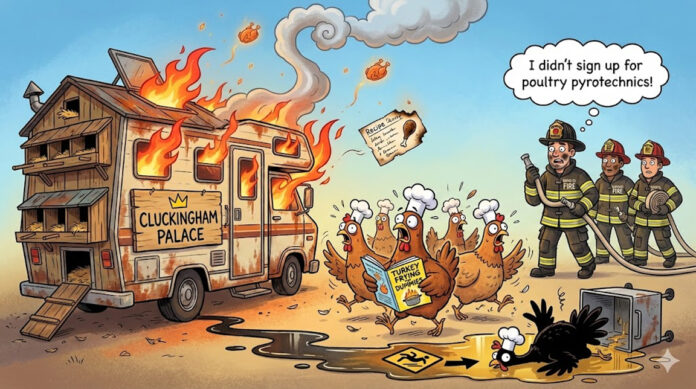
BENTON COUNTY, Wash. — Firefighters in Benton County had an unusual start to the week: a fire in an RV that doubled as a chicken coop. Thankfully, the feathery residents were safely evacuated, but the incident serves as a sharp reminder about turkey deep frying safety this Thanksgiving.
Somebody turned a retired RV into a luxurious hen house—what one might call a Cluckingham Palace. But fowl play turned disastrous when the coop caught fire. While the cause hasn’t been officially confirmed, we can speculate: Maybe the hens saw an old Rachel Ray episode featuring the classic “dip your turkey in hot oil” trick and decided to try it themselves. Either way, the fire department’s call was a wake-up cluck for anyone planning a Thanksgiving deep fry.
Egg-cellent turkey deep frying safety tips

Here are the top turkey frying safety tips to keep your holiday meal delicious and your kitchen—or backyard—intact:
1. Fry outdoors in a safe, open space
- Use a flat, stable surface far from buildings, decks, trees, or other flammable materials. No chicken coops, no stables.
- Never fry indoors, in a garage, or under a covered patio.
2. Use the correct equipment
- Use a fryer specifically designed for turkeys, ideally with a basket or hook for safely lowering the bird.
- Ensure your propane tank and burner are in good working order.
- Wear heat-resistant gloves, goggles, and long sleeves to protect against splashes.
3. Thaw and dry your turkey completely
- Ice, frost, or excess water can cause oil to splatter or explode.
- Pat the turkey dry with paper towels before frying.
4. Don’t overfill the pot with oil
- Use water to measure the proper oil level: place the turkey in the pot, fill with water, then remove the bird.
- Refill with oil to the “safe fill” line before heating.
5. Heat oil safely
- Maintain oil temperature between 325–350°F (163–177°C). Too hot can ignite the oil.
- Use a thermometer designed for deep-frying; don’t rely solely on the fryer’s preset.
6. Lower the turkey carefully
- Turn off the burner while lowering the bird to prevent splashes from igniting.
- Lower slowly and steadily to avoid overflow and oil splattering.
7. Monitor constantly
- Never leave a hot fryer unattended.
- Keep a fire extinguisher rated for grease fires (Class K) nearby—never use water on an oil fire.
8. Keep children and pets away
- Maintain a safe perimeter of at least 10–15 feet.
- Explain that hot oil is extremely dangerous.
9. After cooking
- Turn off the burner before removing the turkey.
- Allow oil to cool completely before moving or disposing of it.
- Dispose of oil properly—never pour it down the drain.
10. Be ready for emergencies
- Know your local emergency number.
- Keep a metal lid nearby to smother small oil fires if needed.
Keep these tips in mind to ensure your Thanksgiving turkey is a hit—and not a hazard. After all, you don’t want to hen-ter the inferno.
Sources include NBC Right Now
RELATED
- When it comes to cooking Thanksgiving turkey, don’t do this… or this… or this…
- Ask Dave: What is the best RV fire extinguisher?
- How to cook Thanksgiving turkey in an RV oven
- RV Thanksgiving: How to cook a whole turkey over a campfire
RVT1237b

We take our pet parakeets with us on every trip. Due to insurance reasons we no longer let them drive. Won’t make that mistake again.
Thanks, David. We all need a laugh every so often Laughter cures many ills The potential fire problem is 1 reason I chose my all electric LilSnoozy after a little over a decade with the Boy Scouts I’ve seen almost every way LP propane and butane could be misused