


By Tony Barthel
Is your RV dangerously overweight? Do you know its real cargo-carrying capacity? One of the things I’ve noticed in the RV Reviews column here on RVtravel.com is that a lot of RVs can be significantly overweight without much effort. Whether that be a motorized rig or a towable, overloading has been a big problem. Unfortunately, the manufacturers seem to do more to avoid the problem than to correct it.
In fact, sometimes I wonder if it’s being purposely hidden.
The bad thing is that your life can be in danger and you may not even know about the risks.
What’s the issue?
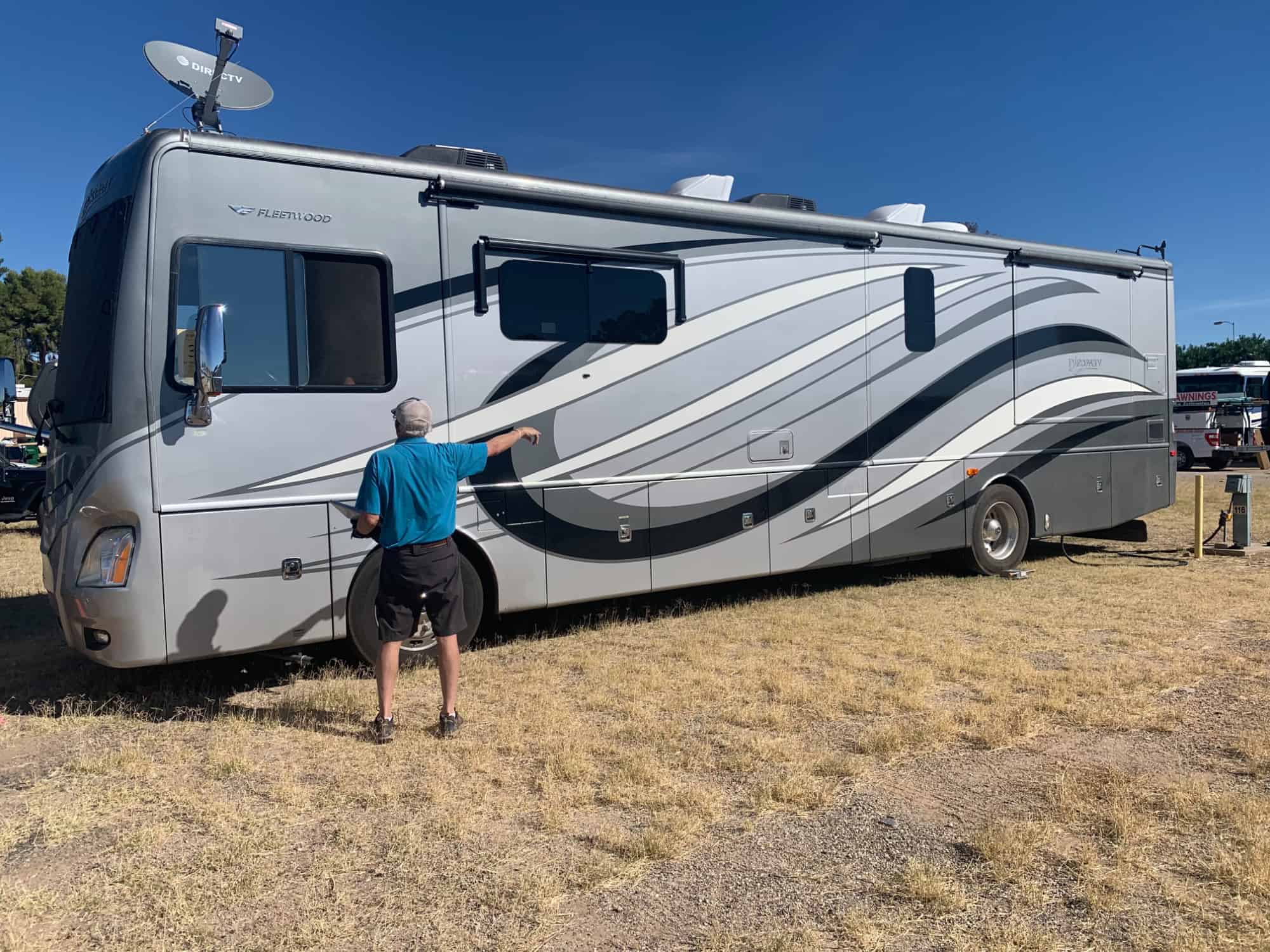
The problem is that some RVs have so little cargo-carrying capacity that just a couple of passengers and a week’s worth of clothing will overload them. For example, look at my review of the Coachmen Prism motorhome, which has less than 800 pounds of available cargo-carrying capacity.
But by no means is Coachmen alone. That review just really sparked my attention. Once I became more aware of the issue, I started digging into reviews I had done in the past. Universally, many of the larger Class C rigs didn’t have the cargo-carrying capacity data. I realized that it was a pattern—the information just wasn’t available.
Further, many of the RV companies just don’t bother to return my emails. I also called a few dealers, but that proved to be not very fruitful either.
I wasn’t able to get the cargo-carrying capacity of rigs including the Thor Quantum Sprinter, the Airstream Atlas and the Leisure Travel Vans Unity FX. These all have the Mercedes-Benz Sprinter chassis in common.
The hidden truth behind cargo-carrying capacity
I have been reviewing fewer motorized rigs for the simple reason that I think you deserve this important information. There are few of these rigs where the companies specify the cargo-carrying capacity. In many cases, as part of serving you better, I start digging and contact the manufacturers. When I don’t hear back from them after a reasonable amount of time, sometimes I look for these rigs on dealer lots and contact the people at the dealerships.
I have yet to speak with someone at a dealership that understands the question I ask. I’ve been hung up on several times and, more often than not, the salespeople who will try to answer my question will often say something like, “Oh, it’s capable of more than what it reads on the sticker.”
Even if that were true—and it’s not—there is still more to it than that.
Furthermore, I know folks at dealerships who are very intelligent and fully understand this. But all of those are people who sell travel trailers and the information for them is much more readily available.
No wonder only about 12 percent of all RVs sold are motorized.
Where is the information about cargo-carrying capacity?
All modern vehicles have to have weight information available to the owners.

On motorized rigs, if there is a driver door, then it’s there in the door jamb. Otherwise, it’s somewhere close to the driver’s seat. It may also be in the main entry door on some motorized RVs.
On towables, it’s close to the front of the towable on the road side. Typically these rigs are weighed at the end of the assembly line and the sticker that’s there reflects what the rig actually weighs. The manufacturer already knows what the maximum capacity of the chassis is, so it’s simple enough to create that sticker.

You can also find this information inside the door jamb of newer towables, as well—essentially those built after 2000.
What’s wrong with a few extra pounds?
Yeah, this is something I tell my doctor too. Being overweight isn’t as big a deal as she makes it out to be, but I know that’s not true in RVs or humans.
The components that keep our hind ends from scraping on the ground as we go down the road are all designed with certain specifications in mind. The steel in the chassis, the springs, axles, bearings, tires, and brakes are among the very critical components that all have capacities that are factored into what any vehicle can carry, whether it be a trailer or a motorized vehicle.
Like any chain, the greatest measure of its strength is the weakest link. So whatever component in that collection that is the weakest part, and potential point of failure, is the most important aspect of coming up with that weight rating.
I know some folks choose to put more capable tires on their vehicles or add helper springs to their suspension, but that may not have resolved the weakest link. That link may be a suspension component or the brakes or even the steel in the chassis.
In fact, recently there have been more than a few videos on YouTube faulting certain travel trailer chassis for failing on the road.
The cargo-carrying capacity stickers are underrated
 As mentioned, many of the salespeople I’ve spoken with often have told me flat out that the chassis is designed for much more than the sticker says, but they put that number on there for legal reasons.
Let’s assume that’s true, even if it is a ridiculous statement.
Let’s say you get into an accident and the local law enforcement or the insurance adjuster suspects that your rig is overweight. They can literally collect the pieces and weigh them and then figure out what that weight sticker said was the maximum.
According to one insurance adjuster, “Yes, I have denied claims because the vehicle was grossly overweight.” While that same adjuster said the practice is uncommon, he has had to do it.
Further, a few law enforcement officers I spoke with said that they can cite you for being overweight. That means you’re unloading stuff and leaving it behind, depending on the circumstances.
So, while you may feel that that weight rating is overzealous, the fact that your insurance company and, potentially, law enforcement believe that number is factual is really what it’s all about.
Weighing in
I had the privilege of interviewing Steve Kass from RV Weigh about what he has experienced as part of weighing rigs all over at places like FMCA rallies. He has seen some interesting things with rigs that were drastically overweight.
But he has also seen rigs that were considerably overweight on one side while underweight on the other. The podcast episode (link in prior paragraph) is really interesting and I do encourage you to listen.
 Not a new story
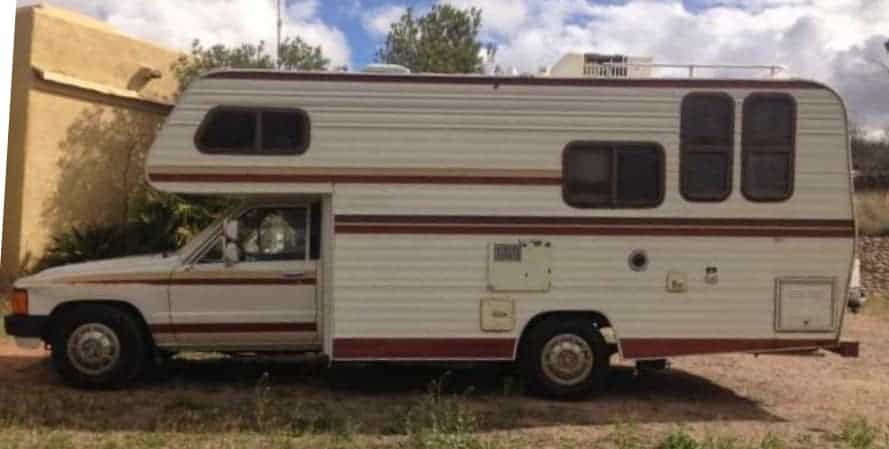
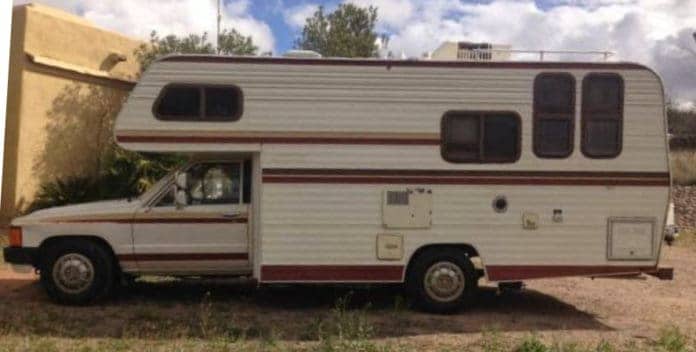
In the 1970s, Toyota, a bastion of ultra-reliable vehicles, especially so in those days, started selling their pickup chassis as a cab and chassis to motorhome companies. This all started with the Chinook, a small motorhome. But as the popularity of that grew, so did the motorhomes themselves.
By the 1980s these things were really popular and also considerably larger than the original models. A lot of companies had jumped onto the Toyota motorhome bandwagon, some of which established their names with these little beauties. They made a lot of sense. They were easy to drive and park, and they got fuel mileage that wasn’t cringe-worthy. Sound familiar?
By the late 1980s, the length of the camper bodies for many of these mini motorhomes had expanded to 22 feet. This caused a severe overload problem on the original half-ton pickup axle. A national safety recall was issued to correct the problem. Under the recall, most of the models were then given a new one-ton axle which was less prone to failure, but the other components of the chassis were left intact.
In 1989, Toyota began offering a V6 in the chassis. This increased horsepower became very popular with the camper owners and production continued. Until 1994.
At that point, there had been so many axle failures and the damage to Toyota’s reputation had started to set in. So Toyota just stopped selling cab and chassis models altogether in the U.S. These little motorhomes weren’t so little anymore, and the axle failures were significant.
What should consumers do?
The decision to buy one of these rigs rests with the people who are shopping. In my RV reviews, I often cite suspension and tire systems that I think are second-rate. But being close to capacity on cargo carrying, particularly in a motorized rig, is also a big safety concern.
One way of mitigating a small cargo-carrying capacity is to simply reduce the weight of what’s in your rig. But, as cited in the example above, just a driver and passenger and a few necessities may put some of these campers over capacity.
Once again, this goes back to something I strongly urge you to do if you’re shopping for a new RV of any sort, whether towable or motorized. I would first look at what’s underneath the rig that keeps you from scraping on the highway—long before you ever step foot inside and examine those pretty cabinets.
##RVT1145

We turned down purchasing a beautiful Tiffen Wayfarer because of it’s limited load capacity. Once you added driver, passenger and fuel, there was little left of load capacity. Our Ford E-450 Chassis has a yellow sticker showing load capacity North of 3,300 pounds.
I believe that once you exceed the stated load capacity or modify the designed Chassis, you are totally libel in an accident. Your insurance company could abandon you in your hour of need. Never mind law enforcement.
You can bank on that! That’s the first thing any good lawyer will pursue.
Another area where sales personnel seem confused is towing capacity of motorhomes, especially on B vans and class C’s. Most when I ask “how much can it tow?” look to see what size hitch is (how many pounds it is rated for) on the vehicle and then proclaim that number as the towing capacity. Same thing when you ask about towing capacity of a truck, few of the sales people seem to know about the importance of hitch or pin weight.
The other half is to be very careful about the real cargo carrying capacity of your tow vehicle! Toyota’s web site shows the cargo capacity of a 2023 Tacoma TRD Sport as 1105 lb. When we took delivery, the door sticker and the owners manual say 940 lb. Our trailer is somewhat hitch heavy (makes for good stable towing). The net result is that we can’t carry anything in the truck bed, and have to be very careful where we pack things in the trailer, even though we have lots of CCC in the trailer.
You forgot to add all the optional equipment you had installed over the base truck that had the 1105 rating. Everything installed above the standard cab truck detracts from the cargo carrying capacity. Crew cab vs std.cab, automatic transmission vs std. transmission, etc.
The proof in this pudding is that many weight distribution hitches can weigh 100 pounds or so. So that 940 pounds is not 840 pounds. You can exceed that very, very easily.
2 comments-
Load capacity has to include everything in or attached to the RV as it rolls down the road. So for example, passenger weight is not included for towables. But is included for class A/B/C.
Sure wish there was an easy way to get per-wheel weights at or very near home. The nearest scale to our home is a 60 mile round trip and only capable of whole vehicle weighing (it’s a trash transfer facility and only cares how much you weigh before and after dumping).
09 Cedar Creek 34 TSA. Upgraded from 6K spring to 7K Torflex axels. Couldn’t be happier. Smoother ride and better braking.
Thanks, Tony. We had our rig weighed at a rally, possibly by Steve Kass, with our usual complement of stuff. We were at about 37,000 pounds fully loaded with DW, our dog, and me aboard. The max weight for our RV is 38,600 pounds. Our manufacturer lists the empty weight (full fuel but no water or passengers) of our RV as 31,100 pounds and the CCC (including water) as 5,500 pounds. Thank you for reminding us all of the importance of not overloading our RV. Safe travels! 🙂
The same goes for tow vehicles. Our big 400 HP, 6000+ pound SUV has a J2807 tow rating of 7500#…but the SUV’s GVWR only allows about 1500 pounds of weight in the SUV. Well, with my wife and I pushing 400# plus 750-800# for the tongue weight, that leaves ZIP for passengers and ANY cargo in the SUV! So, really, my maximum trailer weight is really only about 5000#, if I want to bring along the kids, dog, and some basic cargo in the SUV. The SUV has plenty of power to pull…but insufficient weight carrying capacity. And even biggest pickups have insufficient interior room for a big family even though they can handle the weight. Its a conundrum!
Sometimes it is not about the pulling, it is about the slowing or stopping going down long, steep, mountain grades or taking a shortcut to the deep canyon below. A vehicle is only as strong as its weakest component.
That’s the reason many Sprinter Class B and C RVs have small tank sizes, tankless water heaters, and even flexible solar panels. Every pound of house weight reduces that minimal CCC. So, 30 gallons of fresh water instead of 50 gallons, water heaters with a one-liter tank instead of a 6-gallon tank, 5# flexible 100w solar panels instead 15# framed 100w solar panels, overcab bed as an option, not as standard equipment, etc. Switching two AGM house batteries for two 105Ah LiFePO4 batteries not only doubles the usable amp-hours, but also adds 75# to the available CCC. Baby steps, yes, but that extra 75# weight savings can offset the increased safety of a heavier Helwig antisway bar!
Our previous 27′ Class C coach on an E450 chassis was weighed at an FMCA Rally and overall was found to be within the rated GVW.. However the rear axle was 700 lbs. overweight. We resorted to changing where we stored things but always worried about that weight. Whenever I see a 30 plus feet Class C going down the road I always wonder how they can be under the CCC for that vehicle. Especially when I see them carrying a couple of e-bikes on the back hitch.
Could not agree more with your on your article! In my research on 5th wheels I decided on a 35′ Montana. CCC is 3,700 lbs. I usually max out at 2,000 – 2,500 which includes water, aftermarket washer/dryer combo and 4 x 6v AGM batteries, plus everything else. I never want to push the maximum as towing this at 55 mph on some of the roads we travel on is enough!
Also please don’t forget tow vehicles need to be matched (or overmatched) to your particular trailer. We tow with a Chevy 3500 dually diesel longbox, so we have quite a bit extra on that end as well. We have talked to enough people who have horror stories pulling a 5th wheel with a 1/2 ton. YIKES!
You mentioned not being able to get the cargo-carrying capacity of certain rigs. How, then, would the insurance adjuster or law enforcement hold you accountable if the info isn’t available?
They would go by the Gross Vehicle Weight Rating, which must be shown on the sticker.