

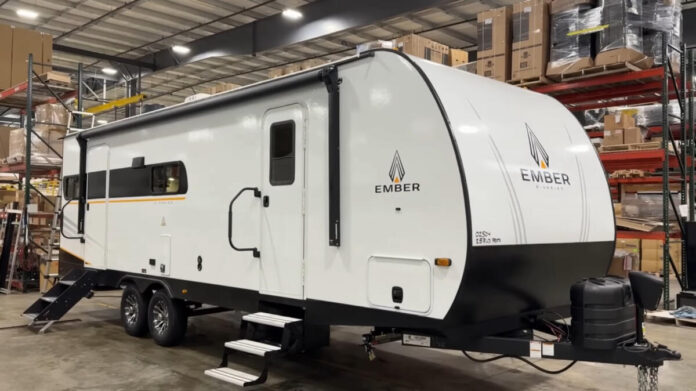
Today’s RV review is of the Ember RV E-Series 25RUD travel trailer. It was just a week ago that we looked at another Ember—the Touring Edition 26MRB. I was pretty impressed with the lengths to which Ember RV goes to make that a quality product despite the fact that a lot of the differences are under the skin of that rig—where some customers and probably most RV salespeople will never notice.
I can see the conversation at the dealership: “It’s expensive.” To which the salesperson replies, “Yeah, but it’s an Ember.” They really don’t know what they’re talking about. Of course, that’s what makes these RV reviews so very popular. I’ll tell you things the RV salespeople don’t know. Or won’t tell you.
Ember RV E-Series
Something that has been a theme this year has been “decontenting.” Many of the RVs that sold well previously are selling less well now. So you’ll see companies taking out more and more of the features that they deem unnecessary or that make a big difference in the price of the rigs that they figure you didn’t want anyway.
I keep picking on that Jayco 25RB as a prime example of this—but it’s such an easy mark.
Ember RV’s E-Series is labeled as the Essential Series. There are a variety of ways that Ember has created the E-Series so that it’s more affordable than some of their other lines. For example, the custom metal edging along the perimeter of the RV isn’t there.
There’s no Stargazer window, unfortunately. I really like that feature, but it’s not an inexpensive one.
Wall construction still uses Azdel as the substrate of the exterior wall, but the interior wall substrate is a wood product. Also, you’ll find the fancy metal locker on the tongue for the batteries and propane gone, as well.
These have no solar as standard, but that makes sense to me. You either want solar or you don’t. Those that do want it will find a nice solar package available.
Really thoughtful touches in the Ember RV E-Series 25RUD
Honestly, much of what it takes to create the E-Series is no different than some other RVs. There are some really thoughtful touches in this trailer that I haven’t seen before.
There are still Goodyear Endurance tires, but the tire pressure monitoring system is an option. Get it. Seriously. This offering still has a good number of upscale features, but the suspension isn’t one of them—being a very basic leaf spring design. This’ll work fine for you who don’t tow much. However, if you plan to, upgrade with something like a MORryde CRE 3,000 shackle system.




What’s inside the Ember RV E-Series 25RUD
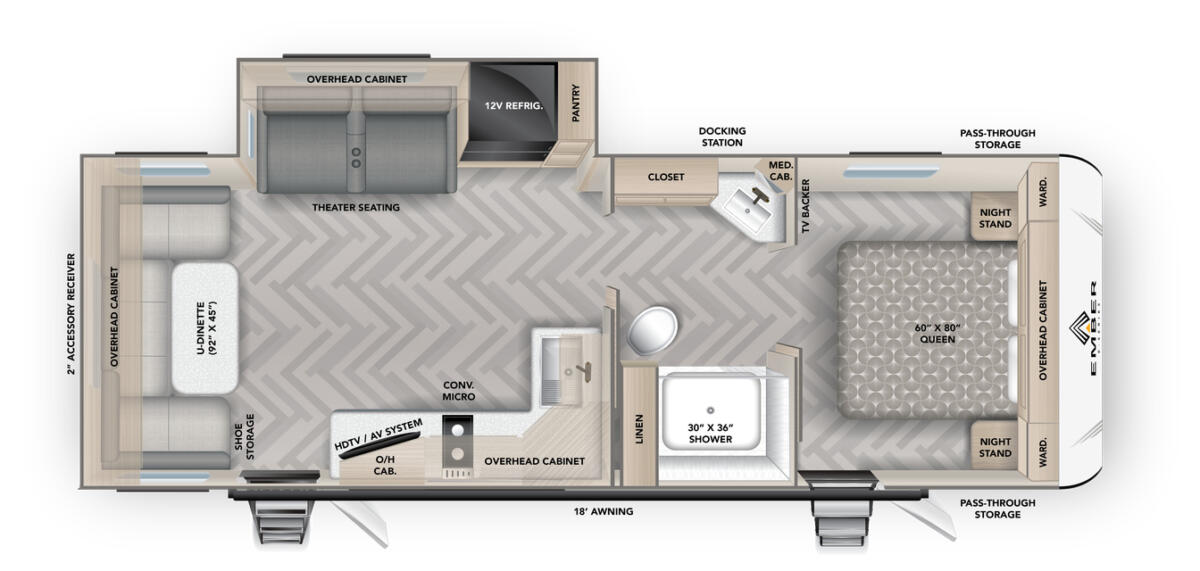
Of course, there are a number of floor plans in the E-Series. The one we’re looking at today, the 25RUD, starts with a big rear U-shaped dinette. The prototype in the video here uses a single pole mount for the table, but what’s your take on this?
Regular readers will know that I would love to see this as a free-standing table with collapsible legs that sported various height adjustments including one for counter height. This would mean even more counter space than is already there. But you could also take this free-standing table outside or use it for the dual recliners in the slide room.
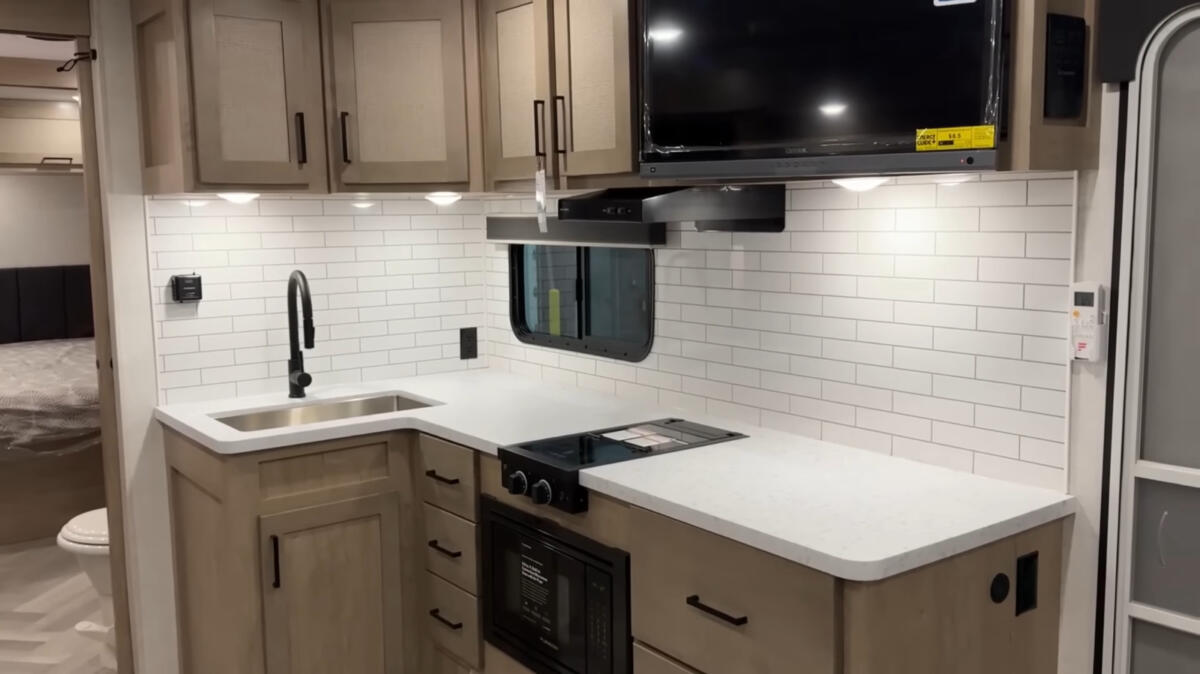
In a lot of RVs you’d really want additional counter space, but I don’t think owners of this are going to complain. This model has a bathroom that bisects the trailer. The kitchen counter extends from the entry door allllllllll the way to the bathroom wall and then makes a left turn and extends even farther.
The kitchen sports a two-burner cooktop and then a convection microwave, along with a larger sink. I’m someone who cooks a lot in my RV and have never used more than two burners, so this would work fine for me. But I’ve seen a few comments that two burners aren’t enough. What all are you cooking?
Another thing that makes this space pretty great is the 82” ceiling height. That also means a bit more cabinet space in the overhead cabinets. Over in the slide, the doors flip up and actually have struts to hold them. Why has this suddenly become difficult for some in the RV industry to comprehend?
More spaces
I like the fact that the bathroom splits this camper in half. But I am here writing this at around 5:15 in the morning while my dear wife is still dreaming about making our awesome travel plans. She’s so good at it! So, the fact that there would be two doors—one to the bedroom and one to the main living space—separating us at this time of day means I’d also have a nice cup of coffee. I don’t like running the coffee grinder this early and didn’t think to grind coffee last night.
Now you know if there’s something unusually stupid in this article it’s due to lack of coffee.
I had mentioned a good amount of storage out in the main body of this camper. There’s even more in the bathroom, though it’s the type that is a cubby more than anything. But still—it’s a good place for towels.
From here we check out the bedroom which, on this prototype, has its own outside entry door. In typical Ember RV fashion, there are the usual wardrobes on either side of the bed for hanging storage, storage over the bed, and then space behind the wardrobes with household and USB power outlets. I also like the nice touch of the amber night lights that Ember uses—word is that these don’t mess with your circadian rhythm. I’m sure we’ve all read that we’re not supposed to be looking at our little electronic friends before bed. That’s partially due to blue light spectrum. So, see? Ember’s been reading those same things.
More to like in the Ember RV E-Series 25RUD
Even though this is labeled the “Essential” series, which means it’s the entry-level in the Ember RV world, it’s by no means devoid of good features. For example, the overhead ceiling vent fans (note that that’s a plural!) are of the high-performance variety.
But something else I really like is that this features a turn signal system where the upper marker lights flash with the blinkers. This used to be a great feature in the Jayco that they took away. Perhaps it just changed addresses, because Ember RV has it even on their E-Series. So, you see, you can make a more affordable RV and still not ignore a great safety feature.
My absolute favorite feature in here might be that this is the first RV with the Furrion Chill Cube air conditioner as standard equipment. Essentially, this is the first truly modern RV air conditioner, besides the Truma Aventa, that I have come across.
It’s essentially heat pump technology and is so quiet you can barely hear it operate. It provides 18,000 BTU of cooling performance. This is the AC unit we RVers have been waiting for. It is efficient and quiet, and it has some great features.
Another nice feature on these rigs are the Lippert Quick Drop stabilizer jacks. These are a dramatic improvement over the typical stabilizers in that they provide more stability plus they are approved to be used with a power drill.
Boondocking and travel access
I was shocked to see that, with the slide room in, you can still access the bathroom. Normally in this somewhat common floor plan you’d just get to the bathroom through the bedroom door, but here you can do whatever you want.
Speaking of which, I was told that one of the advantages of the Norco BAL® Accu-Slide mechanism used in this trailer is that you can occupy the slide room with it in. In most cases, you shouldn’t occupy the slide of a towable RV unless it’s fully extended.
As mentioned, solar isn’t included in this model. However, there are solar options with up to 400 watts of solar panels and a 2,000-watt inverter. With being as efficient as that Furrion Chill Cube is, I wonder if a 2,000-watt inverter could run it?
I am going to be testing one of these in the future, so I’ll get back to you.
Conclusions
It’s funny what happens when an RV company actually listens and even has decision-makers who go RVing. This is a more affordable trailer, but doesn’t feel cheap by any means.
I’m not thrilled with the suspension on this, so that’s my biggest gripe. But for many people who don’t do a lot of long-distance towing, it’s fine. In fact, in the latest report from KOA® (Kampgrounds of America), it seems that most RVers travel fewer than 100 miles from home, on average.
As I write this, I’m about 1,700 miles from home. So this is another instance where I’m out of the ordinary. [I.e., Tony is “extraordinary.” —Editor]
One last thing that I like is that Ember puts a port in the newest RVs for Starlink or whatever cable you want to run. I had to drill a hole in my RV—Ember has this figured out.
I think you have a lot of value here, including a good warranty and a company that really listens to customers. What we have here is a prototype, so a few details are still being finalized on this unit. But I like what I see.
More about these RV reviews
These RV reviews are written based on information provided by the manufacturers along with our writer’s own research. They are based on information from a single unit and may not reflect your actual experience. Shop your RV and dealership carefully before making a buying decision. We receive no money or other financial benefits from these reviews. They are intended only as a brief overview of the vehicle, not a comprehensive critique, which would require a thorough inspection and/or test drive.
Tony comes to RVtravel.com having worked at an RV dealership and been a life long RV enthusiast. He also has written the syndicated Curbside column about cars. He also works closely with a number of RV manufacturers to get an inside look at how things are done and is a brand ambassador for Rockwood Mini Lite with his wife, Peggy.
You can also check out his RV podcast with his wife, Peggy.
##RVT1157


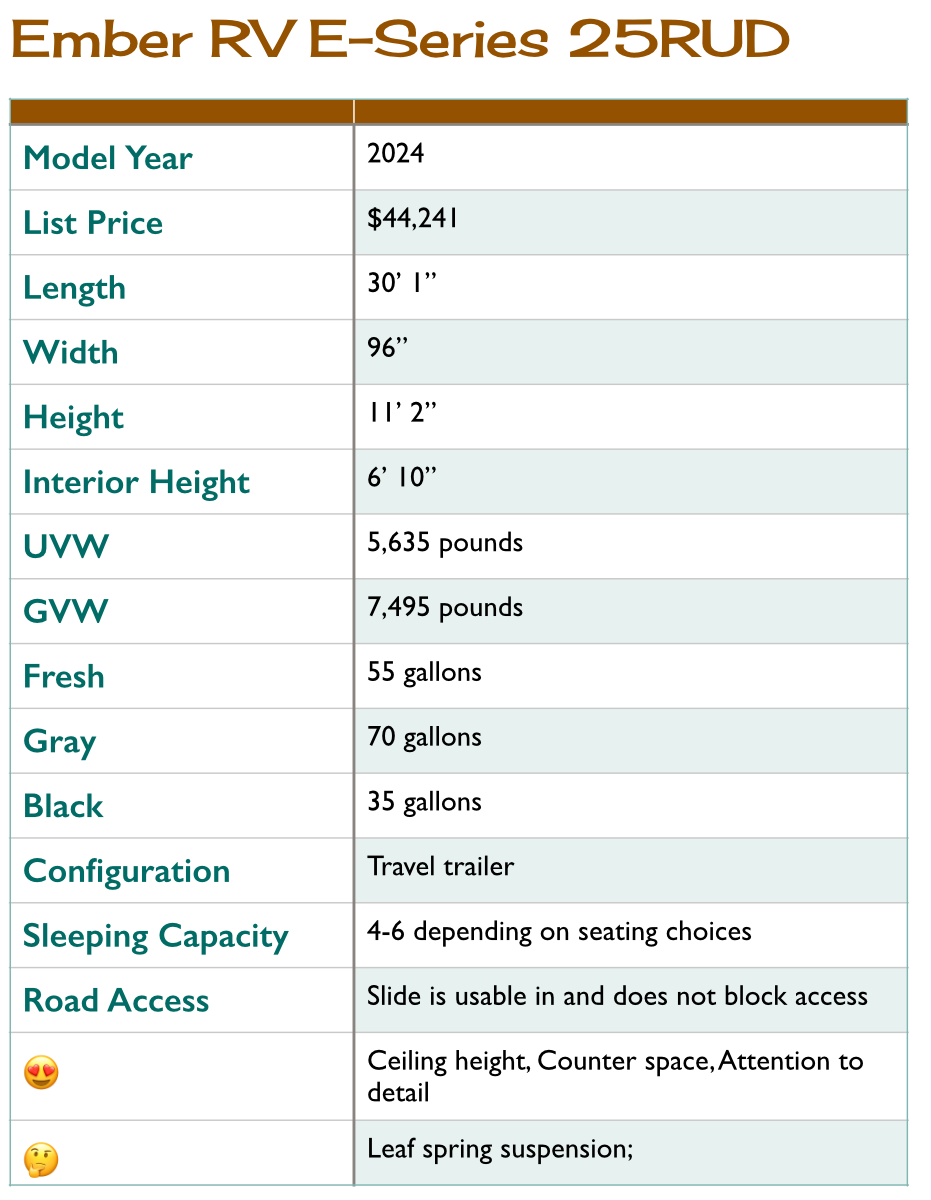
Is there a typo on the fresh/gray/black capacities? Doesn’t look right.
These are the specifications according to Ember’s website at the time this was published.
I wonder if there are 2 gray tanks. We have similar specs for our GD 260 RD (Fresh Water Capacity: 55gal. Gray Water Capacity: 71gal. Black Water Capacity: 39gal.) and we have 2 gray tanks.
I would suspect that there are with this number.
The windows around the dinette need to be bigger. Would also like a range with large oven with 3 burners. Would be nice if it had the Stargazer window. Being able to use the slide when in is a big plus. Should also have the same steps by the dinette as the steps by the bedroom. I like the steps. I believe this is a prototype TT
I like that they use two different steps. I’m no fan of those solid steps, especially for mid-journey access to a trailer. You can deploy the traditional steps that are at the bedroom much more quickly than you can the solid steps and you don’t have to worry about the ground being level.
But that’s why there are 31 flavors of ice cream – something for everybody.
Tony, this caught my eye, “they are approved to be used with a power drill.” Do many manufacturers say not to? Thanks!
Yes!! According to the manufacturer you’re not supposed to use a power drill with the stabilizers on most towable RVs. In fact when I was at Rockwood and whipped out my power drill they were aghast. I still do it, of course.
Thank you, Tony! 🙂 Looks like a great RV. Thank you for reviewing the prototype. I look forward to seeing where the production version is, once there is one. Thanks again and safe travels! 🙂
I would really like to know the actual price difference between the torsion axles in the Ember Touring Edition and the leaf spring suspension in this trailer. Is it $500, $1000, $2500? After having a 2012 Rockwood Mini Lite that had torsion axles and a new cost of only $14,000, they couldn’t have been much more expensive than leaf springs back then!
What a great question – I will see if any of my industry friends will answer this from the standpoint of an RV manufacturer.
Oddly enough I know the difference between the 17″ oven and 22″ oven is about $38 which is one of the reasons I’m such a nut about hoping to see either the larger oven or no oven.