

Has an RV vacation become a luxury only the wealthy can afford? Or is an RV vacation one of the most affordable forms of travel? A recent issue of RVtravel.com posed the question, “Is RVing today just for the wealthy?” However, an RVIA study claims an RV vacation is the most affordable form of travel. This spurred me to share my most recent RV vacation costs, comparing them to what the RVIA study claims.
Click here to learn more. Then let us know if you think the RVIA study confirming an RV vacation is the most affordable way to travel is a myth, plausible or something you can confirm via your own experience.
What our two-week RV vacation really cost
My wife and I recently returned from a two-week RV vacation with friends. I have been reflecting on how enjoyable the trip was and how little we spent.
Then I read the headline, “Is RVing today just for the wealthy?” in the Campground Crowding column of the RVtravel.com newsletter. In that column, RVtravel.com reader Brianna H. said high prices have ended her RVing. She writes, “Like everything else, price gouging has made enjoying my RV experience impossible. I’m selling my Keystone Premier and will just take the loss. RVing now is for the wealthy. It’s become the American way.”
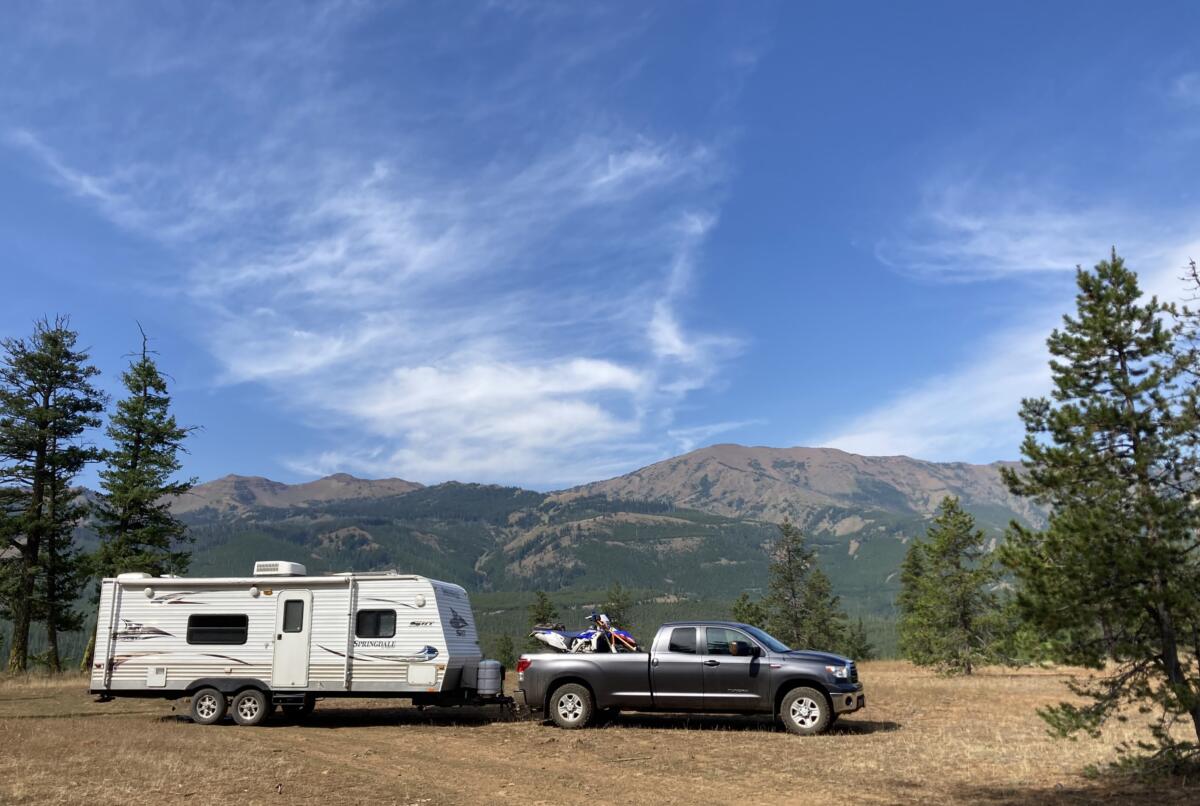
I then questioned what our two-week RV vacation really cost and came up with the following for our trip from Renton, Washington, to the Wallowa Mountains in Oregon and back.
- Fuel: Tow vehicle, off-road toys and generator: $499.75
- Dump holding tanks and fill potable water at the Lions Club Park: $5 donation
- Propane: $23
- Food: $0 – We didn’t stop at any restaurants, only eating what we would have cooked at home, anyway, so I didn’t add any expense for groceries. I could argue that we saved money as my wife and I typically eat out once or twice a week as part of our regular routine when home.
- Camping fees: $0. We boondocked on National Forest land every night in some very scenic locations.
- Attractions/admission fees: $0. My wife and our friends both have federal Lifetime Senior Passes that paid/covered trailhead fees.
Two weeks of our RV vacation cost total: $527.75, or $38 per day.
Tow vehicle and travel trailer expenses
I then began to consider the expense of my tow vehicle and travel trailer, even though I am actively trying to replace my truck and travel trailer. (So far, I can’t find a new Toyota Tundra with an 8-foot bed or a travel trailer without a slide or 12-volt compressor refrigerator among other negatives.)
I consider my current tow vehicle (12 years old) and travel trailer (14 years old) depreciated. The few hundred miles we put on both during our trip did nothing to impact the resale value. I also paid cash for my current truck and travel trailer, so there is no interest expense to consider. I am able to store my travel trailer at home negating storage fees. And I do my own service, saving the hundreds of dollars per hour an RV shop would charge.

About this point, I remembered some statistics (listed at the bottom of this article) from an RVIA study touting the affordability of an RV vacation. What stood out the most was the RVIA statistic that 63.8 percent of RVs are bought used and held until they are 19.5 years old. This age statistic pretty well aligns with my situation, especially since I don’t see a new RV on my horizon anytime soon.
Note: This study spawned an article entitled “RV industry again falsely claims RVing is cheapest way to travel” from RVtravel.com founder Chuck Woodbury
So, is an RV vacation the most affordable option?
In conclusion, I believe parts of the RVIA study are very slanted but, in the spirit of the show MythBusters, from my experience ($38/day), I am going to consider the RVIA study confirming an RV vacation is the most affordable way to travel as “Plausible” for those that buy used RVs, while Chuck Woodbury and reader Brianna H consider it “Busted”.
How about you? In your opinion, is RVing the most affordable way to take a vacation or is it a myth? Please let us know with a “Confirmed”, Plausible” or “Busted” in the comment box below.
While you are commenting, please let us know how closely your RV experience aligns with RVIA’s study regarding the following:
- Did 63.8 % of you really buy an approximately 12.5-year-old used RV?
- Did the vast majority of you finance your RV and deduct the interest as a second home?
- How many of you are traveling with an RV approaching 19.5 years old? Given the 10-year-old rule of many RV parks, where are you staying?
- I suspect the average use of 25 days per year is about right for the average RVing family. However, I believe the readers of this newsletter use their RVs much more. What is your average use per year?

Finally, if you don’t believe that boondocking (aka dispersed camping on public land for free or the cost of a permit) options exist in your neck of the woods, I encourage you to attend my daily seminar “Boondocking 101 – Finding a place to camp” at the upcoming America’s Largest RV Show in Hershey, PA, September 11–15, 2024. I hope to see you there!
RVIA study findings
“In order to determine the cost of owning an RV, CBRE Hotels Advisory utilized data provided by Statistical Surveys Inc. We used the percentage of used versus newly purchased vehicles in order to develop a weighted average cost of ownership. According to Statistical Surveys Inc, for the period 2016 through 2022, approximately 36.2 percent of recreation vehicles are purchased new and 63.8 percent are purchased used.”
“We estimated that a used RV was, on average, 12.5 years old when purchased.”
“Loans to purchase the vast majority of RVs are treated like second-home mortgages – the interest is tax-deductible.”
“The average reported holding period for all RVs was assumed to be seven years, per a 2011 University of Michigan report. After seven years, we assumed that RVs would be sold.”
“CBRE Hotels Advisory determined today’s residual value of seven-year-old RVs (based on new RV being sold in seven years) and 19.5-year-old RVs (based on 12.5-year old RV being sold in seven years) and applied those ratios to today’s new and used costs.”
“After calculating the cost of each vehicle, plus seven years of interest payments,
we subtracted the vehicle’s residual value, or what the owner would receive upon sale of the vehicle. This resulted in a total cost of ownership, which was then divided by the average holding period to determine the average cost per year.”
“An RV is used an average of 25 days per year.”
Again, please leave your comments below.
##RVT1172

RVs are not just a pretty lawn ornament. Our current Class C is 7 years old. Purchased used. Paid cash for it.
Travel usage is averaging 10 days a month.
We have just returned from a month long cross country trip. The oppressive heat prevented boon docking, limited use of harvest host, and cooking evening meals in the RV. Heat and horrendous road conditions caused extreme stress on the RV and was also a big concern. We purchased all premium gas and even octane booster. The cost of fixing the refrig door which fell off on I 40. Our rig has been paid for years and we store the RV on our property so the only monthly cost we incur is the skyrocketing insurance. When I got home, I calculated we could have flown to CA, spent 10 days in a rented RV at Laguna Seca for 1/2 of what we spent. Every trip and every family needs different
In the fall of 2023 we towed our 21′ TT roughly 1700 miles from Michigan’s Upper Peninsula (home) to Texas Hill Country. It was a 3-night, 4-day drive. We packed our breakfast & dinners, and picked up lunch on the road. Less than a month later my wife’s mother died. It was now winter in Michigan. Because of pets, we had to drive. For simplicity, we took the same route north stopping at mid-priced, pet-friendly (there is often a surcharge) hotels located near our RV stops. We had to procure all meals on the road. The per gallon cost of fuel was about the same. Not counting our investment in the TT, we saved about $200 by towing our bedroom. And it was FAR more convenient.
We agree with Dave’s assessment on travel costs. Since retirement we travel about 150 days each year. We are on a fixed budget but even with a $400 per month loan payment, we’ve calculated ( and tried) flying, hotels, car rental costs , meals, etc.
5 years over 42 states, 100,000 miles, in our rig, we tracked costs for each individual trip and stay. We also plan/compared each to driving/flying, hotels, having to eat meals out, etc.
When all costs were calculated ,including maintenance and loan payment, RV’ing was far less expensive. Some complain campgrounds are expensive but hotels are worse
Plus: We love RV’ing. Thank you
I’ve run the numbers numerous times over 20 years. I have found it’s about the same as any other form of travel with all things considered.
Like everything else, the answer is “It depends.”
If you are a big time boondocker with an older and simple travel trailer or pickup camper, then it’s probably cheaper. If you have a newer motorhome and stay at “full service” type parks, it’s probably more expensive, ALL costs included. Every individual case is going to be different, and Dave, your example is probably not typical for the normal family RVing anymore than the person with a new high-end bus is.
The RVIA study is always going to be biased because that’s their mission…support selling RVs!
Net…each person needs to do their own study to see their result. For us, cost or not isn’t why we RV anyway.
We have been RVing with our kids since 2005. It has allowed us to see many parts of the country that we just could not have seen without the RV. It is also our preferred way to travel. We occasionally have to stay in a hotel or fly for work purposes and each time, we realize how much we prefer to travel in our RV with our own beds and being able to cook our own food. As for the cost factor, some trips are huge savings while others maybe not so much. But I tell everyone this, if it sits in your driveway and you don’t use then it’s definitely not worth it!
You can make the numbers tell any story you want. If you like traveling/staying in an RV you will find a way to make it affordable.
We bought our current RV new in 2011 & it’s paid off. We did don’t vacation as lot these days because got involved in dog sports. We do travel in the RV to events too far for a daily commute. With motels using $200night in many cases, then charging up to $50/night/dog on top of that, with 2 lage dogs we don’t want the restrictions that come with lodging facilities. At $60-70/night staying in the RV makes sense. Àt some venues, we stay on site for $10-20/night, saving alot of money.
Our last 2 vacations were less expensive traveling by RV – Montana to Grand Canyon for 3 people & 2 big dogs.
We stopped staying in vacation rentals and hotels when finding a place that accepted dogs without a huge surcharge (sometimes $100/night for two dogs) became impossible. But, even without that expense, driving our own RV, sleeping in our own bed, camping in beautiful places, stopping to “smell the roses” along the way? Priceless!
Cash…it’s the only way to fly.
Really? I assume you are talking cash vs finance in purchasing. Using “cash” depends on what that cash could do for you in an appreciating investment vs plowing it into a depreciating asset. Or what if that cash has to come from a 401K or similar retirement savings and the marginal tax rate, impacts to Medicare costs, impact to SS taxability, etc. is far greater than the interest?
No cash is not ALWAYS the best way to pay…one has to analyze their own financial situation to know for sure.
I don’t really believe one way or the other is cheaper for me. What it is in the RV I can do what I want don’t have to haul all my stuff inside to a room and then get dressed each time I want to get something to eat. I guess you call it peace of mind.
When we started camping the start up costs were very low. Tent, sleeping bags etc. We then decided we wanted to sleep off the ground and bought a used pop up for very little. We only had to format an existing car for towing and the costs were minimal. We then decided after a decade we wanted a hard side for more convenience. That was a more significant purchase as it required a newer tow vehicle. We’ve since upgraded further at significant cost. The long and short of it: the costs were organic to our particular economic states at each stage of our life. Not once did we consider whether it was an affordable option to other vacations. It’s just something we love to do and we made it happen.
We used to take our motorhome (now almost 20 years old) from Chicago to the east coast and stay for a week or two on Chincoteague Island in Virginia. But since the pandemic, the costs of a campsite have gotten out of control, Big real estate private equity has bought up the few campgrounds on the island and along with gas costs, tolls, and the crowded conditions it’s just not worth it. I’m not paying $150/night for a postage stamp site with my neighbor’s sewer hose 3 feet from our picnic table. We now just rent a cottage there for a week or so and do most of our camping near our home at COE, State and Federal parks.
I long for the old days but they’re not ever coming back.
This article didn’t mention the cost of tags, title, taxes, or insurance on the RV, and even if you do your own maintenance there is the cost of materials, supplies, and maybe tools. For a two-week vacation I don’t see any way an RV can be cheaper. I have been keeping accurate records for our diesel pusher for years, including depreciation and interest as well as camping and bedding, and it has consistently been in the range of $30,000 per year or about $82 as day for us as full-timers.
We’ve had our 21′ travel trailer for 11 camping seasons now and have used it an average of 26 days a year (from my spreadsheet). When it comes to destination travel and after accounting for campground costs and gasoline for the Ranger at 300 miles per day, it probably costs us about the same as staying in the typical hotel/motel but when I add the cost of buying it ($15000…a relatively inexpensive one in 2014), it costs much more. We didn’t get it to save money. We got it for the comfort, fun and enjoyment, then discovered the pleasure of having “a home away from home” while we traveled.
My experience with a 2001 National Islander purchased in the fall of 2000 and sold in the fall of 2015. Four and a half year full time the remaining years about three to five months per year. When considering fuel, RV parks/Campground/Boon-docking, maintenance/service, Insurance, Storage and all expenses I found my averages costs were somewhere in the range of about $10,000 per year. So the last five year with 90 days use per year that is about $110 per day. Plus the rig was due for some major refurbishing, mechanical and physical.
There are too many variables to make any useful conclusions. People use thier trailer or rv’s differently. We have used ours at least 32 nights for each of the last 4 years but don’t drive as many miles as some people. Our total annual mileage is around 1000. We store our camper in the mountains in the summer so we have hundreds of great places to boondock within a short distance. Camping around Telluride and Crested Butte is amazing and the cost for a hotel in those areas is over $300 a night if you can get one.
My math may not work for everyone but RVing for us is priceless. I figure RVing has given us immeasurable benefits including time with my beautiful wife so when I factor in quality of life, RVing is priceless. I have achieved millions of dollars of value from RVing. I am way up and will receive for another 20 if I can.
I don’t think it’s an either/or question of cost but rather a question of value. Sleeping in a tent is cheap but of diminished value in a windy, soaking downpour.
If you value boondocking where hotels and airports don’t exist, the cost is mute as there’s no alternatives to compare. Even an AirBnB puts your bed where it stands, not where you can really stay.
An RV vacation is a different kind of vacation so even if the destination is the same, the journey and lifestyle isn’t. Especially if you have a family and pets.
Cheaper? Rarely. Better? Sometimes. Easier? Not always. Of value? Absolutely.
I don’t know if traveling in my Class B is cheaper or not, but basically I don’t care. I like my rig, it is home to me while on the road. It is how I prefer to travel. Comparative cost don’t even cross my mind.
I don’t think there is any comparison between RV vacations vs going by daily driver or fly-in. Two years ago my wife and I completed a NY to CA trip over 59 days for a combined cost of less than $10K. Fuel, Campground average paid $47/Night, food, souvenirs, Entertainment, 4 National Parks, Napa, and wine purchase, and daily cost of RV ownership. There is no way you can travel for 2 months paying for hotels or AirBnBs that you would meet that price by car, and forget airfares if that route. I believe our daily average was $169, and on our 2-month trip this past Spring it got down to $158 with lower diesel prices.
Hi, saving money by RVing can be true in upfront costs such as campsite fees versus motel or hotels room costs. However, the savings by using using campsites could be off set by fuel costs if you use a large tow vehicle, eg., pickup truck or drive a class A motor home. And don’t forget time as part of savings; for long distance travel, flying would be the most time efficient placed against driving. We bought our trailer new in 2020 via a loan. Half of our camping has been in private grounds, half in state parks for about 28 days each year. It’s a compromise; this is how we want to see things and people on our trips while being cost smart as possible to make it affordable for our budget.
Thank you, Dave! 🙂 Plausible, depending on who, when, and where. I doubt that it is true for us. We bought new twice, both DPs and paid cash (foregoing interest earnings). Kept #1 for 6 years. Have had #2 for 2 years. Took #1 to Alaska at 3 years. Plan to do as well with #2. We have traveled a bit less than usual in the last 12 months and have spent 44 nights in the RV traveling. I haven’t any cost information beyond fuel. We spent $2,712 on diesel and DEF in the last 12 months. We usually spend 2 or 3 nights/year “boondocking,” but none in the last 12 months. I have the lifetime senior national park pass, which we overwhelmingly use to stay at Army Corps of Engineers campgrounds. …
Thanks again, have a great week, safe travels, and safe stays! 🙂
I have owned 8 different RVs over the past 35 yrs. Bought my first one at 23.
I have paid cash and bought used for all of my vehicles and RVs plus have never had to pay storage fees so it has never been a financial burden to own. I have done most of my own maintenance with a few big jobs sent to the mechanics shop. My current DP is a 1998 and going on 2 yrs w her.
Even factoring wear and tear expenses, yearly insurance and licensing fees and currently getting 8mpg with my diesel pusher, it pencils out cheaper every time than car/hotel or fly in rent car trips. We boondock alot and are able to eat same as at home plus bring dogs so no house sitter fees .
We had a Micro Lite for 5 years. I kept track of every cost I could think of. We camped 322 nights over the course of 5 years. I kept track of every cost I could think of. The cost of owning the travel trailer was $69.81 per night. Our average campsite fee was $37.53. Total cost for each night of camping was $107.34. Note: We paid cash for the travel trailer. I didn’t include the cost of gas or the cost of food. Very roughly, these may have cancelled out each other. We traded that travel trailer in for a newer one, also paying cash. I’m keeping track of the numbers, but it’s a lifestyle we love.
We borrowed money to purchase both our 2020 Colorado truck and 2021 Little Guy Max new. Both are holding up well.
We haven’t boondocked yet; we’ve stayed at KOAs, COE campgrounds, state parks, and privately owned campgrounds. We haven’t stayed in a National Park yet.
We’re both retired and camp around 45 nights per year, mostly 4 – 5 nights per trip, and usually during the week. This is our fourth year and we definitely have felt the impact of increased costs but so far haven’t backed down too much.
We haven’t factored in the cost of our 13 year old coach that we paid cash for 7 years ago. We have about 25K in it. We store and maintain it ourselves. When I compute fuel and campgrounds (we avoid resorts and seek out free or low cost options, and fix most of our own meals), it compares favorably to flying, rental cars, motel/resorts, and eating out. Traveling this way takes more time, but we see more. When we stay at a state park in the Northwest for 10-14 days, it’s really cost effective. We’ve taken several coast to coast trips that we likely wouldn’t have done in the car, schlepping bags into/out of motels, wondering about cleanliness, etc.
We just completed one year of ownership of our now 16 year old DP. It looks like new and I spend heavily on maintenance to keep it in top shape. I kept detailed records in a spreadsheet of all costs. Excluding initial purchase and costs we would have incurred without the MH, the cost was $250 a night for 75 nights. Soon we will be buying a toad.
We did it for the freedom and adventure, not because we thought it would save money. I have flown across this country hundreds of times. Now I want to see it.
I have had my TT for 7 years and put over 25k miles on it. I spend the summers in MT where I visit one son with side trips to rallies, property in WA and visiting the oldest son in Portland. I camp at an AFB for most of the trip and pay to park the RV in a campground when visiting in Portland. Every other year I spend Jan to April traveling to and from GA where I spend about three months with my sister (no costs parking on their property or a friends property and staying with them).
I take my two dogs with me everywhere which is the main reason I bought the RV. Extra fees for dogs in hotels or boarding them would negate any savings by not traveling in the RV.
Our 1st trailer was 13 yrs old when we bought it. The next 3 were new. Current RV is 1-1/2 yrs old. We are retired so we camp a lot. This year has been a light year and we have 54 days in already and another 21 planned. Our biggest cost is diesel as we tend to travel far away. We usually boondock or stay in state and federal campgrounds. Still, considering all costs, the RV isn’t much cheaper than driving and hotels. However we would much rather stay in our camper than a hotel so that’s how we roll.
We purchased our RV used, a 2017 model purchased in 2020. We do not have space to store it at home, and we are not equipped or inclined to perform all of the service ourselves. We also do not boondock much. We are NOT wealthy, and we could probably save money by selling our RV and traveling other ways. However, we enjoy the comfort and convenience of our RV. We have owned it for 4 years and will likely keep it at least another year or two.
Our 5th wheel (’13) and tow vehicle(’15) were purchased new and have been paid off for some time. They’re stored at home and we do 95% of the maintenance ourselves. We are generally gone 6-8 months at a time and pay for about 30 nights of camping. We mitigate expenses by staying at son’s church and in exchange for our hookups we do volunteer work around their facility. Plus some camping trips in our home state for another 30-40 nights we pay for. RVing allows us to spend extended periods of time with our “on the other side of the country” son’s family!
Here’s the quick and dirty, the way I see it: Average nightly cost for a campground/RV park in the US = $30-60. Average motel cost per night in the US = $255. You’ll have fuel costs either way, though higher for a larger motorhome than a car. You’ll have food costs either way, though less costly if you eat via grocery in your RV versus restaurant food when staying in a motel. On the surface, it’s less expensive to travel via RV.
That the author boondocks on free land and does his own maintenance makes a huge difference in RVing expenses, and isn’t a true comparison for many people.