


If you have ever taken an exit ramp or maneuvered a sharp curve, you’ve probably spotted a yellow sign with a lower speed posted on it.
These yellow speed signs became the topic of discussion at a recent campfire. RVers clearly didn’t agree on the meaning of these signs or how RVers should react to them.
It’s the law!
Arnie began, “My wife and I disagree. You know those yellow speed signs posted near sharp curves and exits? I say those speed signs require drivers to slow down to the posted speed.”
“Well, if it’s on a highway sign, it’s the law. Right?” Bryce joined in. “If the sign says 25 mph, you’d better slow down or risk getting a ticket.”
It’s a suggestion
Megan disagreed. “No, no, no. Didn’t you take driver’s ed? Yellow speed signs are merely a suggested speed. It’s probably best to follow the recommended speed, especially if you’re driving a big RV. Not because you’ll otherwise earn a ticket, but simply because that’s the suggested speed for safely maneuvering the curve.”
Arnie’s wife chimed in, “See, Arnie. I told you it was only a suggestion.”
“Tell that to the patrol officer.” Arnie huffed. “And plan to pay a fine.”
What’s right?
According to the Manual on Uniform Traffic Control Devices (MUTCD), the short answer is this: The number on a yellow speed sign is a recommended safe speed, not a posted speed limit.
Under the MUTCD, advisory speed plaques are part of the warning-sign system. Warning signs exist to alert drivers to conditions that might not be obvious ahead and may call for a speed reduction.
What’s the difference?
The MUTCD says yellow warning signs give notice of situations that might not be readily apparent. White regulatory signs are the ones that give notice of traffic laws or regulations.
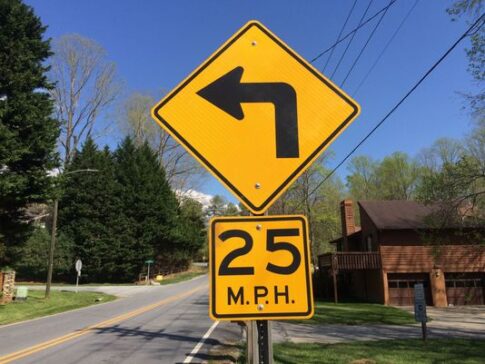
The yellow advisory speed plaque is specifically described as something that supplements a warning sign. It’s not supposed to be installed as a standalone sign. In other words, the yellow number is there to guide you, not to function as a white regulatory speed limit sign.
Who sets the advisory speed?
For exit ramps and highway curves, the MUTCD says the advisory speed should come from an engineering study and be based on recommended engineering practices.
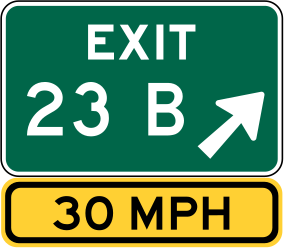
The Federal Highway Administration also notes that advisory exit speed signs are meant to appear far enough ahead for drivers to slow down and make the maneuver safely. That’s why these signs often show up on curves, interchanges, and deceleration lanes rather than as general speed limits for the entire roadway.
Ticketed offense
Can you be ticketed for going faster than the yellow advisory sign’s noted speed? No. Not just for ignoring the plaque by itself. The enforceable part comes from the broader traffic laws in that state or locality. Not from the advisory plaque acting as a speed-limit sign.
NHTSA (National Highway Traffic Safety Administration) says speed still affects safety even when a driver is at or under the posted limit. FMCSA (Federal Motor Carrier Safety Administration) lists curves, intersections, wet roads, reduced visibility, and heavy traffic as examples. So, if an RV or tow vehicle enters a curve too fast and loses control, the issue can become unsafe driving, reckless driving, or another condition-based violation depending on the state and the facts. For that, you can be ticketed.
Bottom line
For RVers, the smart move is to treat the yellow advisory number as a real safety cue, even though it is not a standalone legal speed limit.
Your rig is less forgiving than a passenger car when the road tightens up, the pavement changes, or the exit ramp banks harder than it looks from the freeway. The yellow speed sign is basically telling you what speed you should have before the turn starts, not after you’re already in it.
Yellow advisory speed signs on exits and curves are generally not legally enforceable as posted speed limits. However, they can still matter a lot if you drive too fast for the conditions. The safest rule is simple: Slow down before the curve.
How do you react to yellow advisory speed signs when driving your RV? Tell us in the comments below.
RELATED
- How aging affects our driving
- Do you legally have to use your signal in a turn-only lane? RVer finds out the hard way
- Navigating diverging diamond interchanges in your RV
- Why mile markers still matter on today’s highways
- When it’s not OK to use cruise control
RV2T126

I always slow down to the suggested speed. I don’t want to risk a roll over! I’ve seen a mini van full of kids roll over on an exit ramp!
While i’m on the highway, the white signs seem to be information only.
Until the LEO pulls you over for speeding.
If I’m not pulling my RV, the yellow signs are suggestions that can be exceeded under perfect conditions. If I am pulling, or if conditions are poor, I treat them seriously.
The yellow signs are just warnings of conditions, not an enforceable action. At the same time, ignore the warning and lose control of your vehicle, you can expect to be charged with reckless driving – and hefty repairs – and higher insurance premiums. Your choice.
I usually stay with what is posted. I may go 3 or 4 mph over from time to time.
I slow to the advisory speed as anything faster gets “uncomfortable” for my 34-foot Class-A. Anyone going faster runs a risk of losing control, especially if a blowout happens in the corner.
Those cautionary signs are determined by using a least stable vehicle as a sports car will be able to navigate the situation better than a large panel truck. If the situation requires more information to navigate, additional cautionary signs are warranted, such as chevron (black > on a yellow background) to delineate the curve, a narrow bridge sign etc. If you are curious, you can download the latest version here:
https://mutcd.fhwa.dot.gov/kno_11th_Editionr1.htm
When I’m driving my car, those signs are just a suggestion. However, when we travel in our 34 foot Class A motorhome…I follow them to the letter. It keeps things from shifting inside the cupboards, drawers, and fridge!
Well, let’s add something different to the story: what is the rule when a school zone speed limit sign states 25 MPH (with lights flashing)….and it is also yellow?
When I was a young foolish teenager (and sometimes still act like one), I would experiment with how much I could exceed the recommended “curve speed” on the yellow signs. I generally found that in a competent-handling sedan with good suspension and tires, and clean dry pavement, I could hit double the limit before things got dicey.
Later, as an engineer, I tentatively decided that highway engineers used a 100% safety margin to set those limits. I still don’t know if it’s exactly true.
MUCH later, as a retired RV-er with a rolling house nearly two stories high, I’ve found that those limits are excellent guidelines, almost never to be exceeded.
I still shoot for 15-20 faster….in my car, not my motorhome.
As a career Law Enforcement Professional, I faced this question hundreds of times over my decades of service. Simple to remember that White, Black and Red are regulatory – Yellow, Orange and now Fluorescent Green are precautionary.
When driving a large, heavy vehicle, it’s a good idea to at least recognize the recommended speed and slow down. (in my Class A, I usually need to slow to “at least” the recommended or precautionary speed, if not more!)
Be safe out there!
I agree with everything that was said. But there is one big question that was not answered. Are the suggested speeds set for “regular” passenger vehicles or oversized rigs?
Sorry to disagree, but in TX, the yellow speed limit signs are the law, not suggestions, and we have seen people being pulled over. Of course, many people here interpret the regular speed limit signs as just suggestions.
Wrong.
Thank you for the discussion, Gail. If I am sitting on the nose of 38,000 pounds while towing 5,200 pounds (i.e., driving RV #2 while towing), then I treat the speeds posted on yellow signs as my maximum speed. If I am driving my car in an unfamiliar area, then I do similarly. Only if driving my car in a familiar area do I do differently. Have a great day and safe travels!
DH is a traffic attorney in Florida and confirms that at least in Florida yellow means a suggested speed limit
I’m not sure this is true, but in some cases those signs may also be based on the sight distance, that is if you are going faster and there is something in the road you may not be able to see it in time to stop.