

By Gail Marsh
Winter brings cold temperatures, biting winds, and even snow or sleet. Will your RV furnace keep you toasty? How much will it cost to maintain a comfortable temperature inside your rig? Perhaps a space heater can supplement your furnace heat and save you money on costly propane, too. Before you get started, it’s important to know critical safety tips for using portable heaters.
Types of portable heaters
Here are some popular kinds of space heaters.
- Portable electric heaters. Usually small in size, these heaters can be easily moved from your RV bedroom to galley to the living room. Electricity powers a heating filament inside the unit. A fan pushes the warmed air out into the surrounding space.
- Radiant space heaters. These heaters also run off electricity, but they function a bit differently. Instead of heating the air, radiant heaters are engineered to warm you and other objects directly. Radiant heaters come in a variety of sizes and configurations and are best suited to heating smaller spaces with poor insulation.
- Oil-filled heaters. This type of heating unit often resembles a residential radiator, though smaller in size. The heating system is filled with oil, which is then heated by electricity. You won’t need to refill the oil. It’s sealed inside the system and continues to circulate through the heater, transferring heat through the metal fins. The heat circulates throughout the room by natural convection, rather than a fan.
- Ceramic heaters. In this type of heater, electricity heats a ceramic plate rather than a filament. A fan blows the warmed air out into the room.
What portable heater is best for RVs?
Electric heaters and oil-filled space heaters are typically recommended for use inside a home or RV. Other heaters are available, like propane-burning units. These are generally best used in wide-open spaces like a large garage or outside patio space. A fuel-burning unit can be problematic because they emit harmful fumes.
Things to look for when purchasing
- Get recommendations. Look at posted reviews online, inquire at a local hardware store, or ask other RVers about the heaters they use or recommend.
- Consider your space. A large RV will require a space heater that’s manufactured to produce a larger amount of heat. Look at the space heater’s packaging. You should find the heater’s warming capacity or the square footage it will heat. Compare that information with your RV’s square footage and buy the heater that’s recommended for your rig’s size. A general rule of thumb is to purchase a heater that provides ten watts per square foot of your space.
- Check wattage. Look at the packaging again to make sure the space heater won’t overload your RV’s electrical system.
- Safety logo. Look for a safety logo (ETL or UL certification) before purchasing the unit.
Helpful heater features
- Tip over shut-off. This button or sensor is usually mounted to the bottom of the heater. If the heater is bumped over, the unit will automatically turn itself off.
- Temperature limitation. Many space heaters also feature an automatic turn-off function that will activate if the heater becomes too hot.
- Timers. You can purchase portable heating units that can be set to only run during the time you choose. At bedtime, use alternative methods of staying warm. Blankets, flannel sheets, and thicker pajamas will keep you warm overnight. They are much safer than an unattended heater.
Safety tips for portable heaters
Heating equipment is the second leading cause of home fires, according to the National Fire Protection Association. Follow their recommendations to stay safe.
- Plug the heater directly into an outlet. Do not use an electrical power strip or extension cords.
- Place your heater a minimum of three feet away from all flammable objects like furniture, curtains, cabinetry, blankets, and more.
- Frequently check the heater electrical cord to ensure it’s securely plugged into the outlet.
- Keep children and pets away from the heater. This can help to prevent accidental burns and bump-over mishaps.
- Make sure to keep your heater positioned flat on the floor, not on top of the RV dinette table or countertops.
- Double-check to see that your smoke and carbon monoxide detectors are working.
- Show everyone traveling with you how to safely operate the heater.
- Position your heater away from all water sources.
- Never run the heater’s power cord under rugs, ottomans, or other furniture.
- Do not leave a heater unattended, especially with pets or young children in the RV.
- Unplug the heater when you’re not using it.
Do you use a portable heater to supplement your RV’s furnace? What type of heater do you like best? Why? Please respond in the comments below.
RELATED
- Tiny space heater comes in handy in an RV
- Lasko vertical portable space heater is perfect for RVers: Small but mighty!
##RVDT2289
I haven’t used my furnace ever since I installed a catalytic heater. My Big Buddy Heater uses propane,has a low oxygen sensor that automatically shuts it off if necessary it also shuts off if knocked over. In 10+ years of using it I have never had a problem.
The Mr Heater Big Buddy is NOT a catalytic heater.
True, but it’s a far better solution than any electric heater if you are not on shore power, most places have time restrictions on generators that forbid their use when needed most.
Been using a 900/1500 watt ceramic heater on the 900 watt setting for years, in conjunction with a plug-in between the heater and the outlet which is thermostatically controlled by a remote controller. It cycles on and off as necessary. In my 21-foot trailer, it provides adequate heat. And I set it on the dinette table in the middle. I have had zero problems doing so. If it were on the floor, it might get kicked.
I use the oil filled radiator heater, it is super quiet and puts out steady heat.
I had one of those types of heaters about 35 years ago. The electrical box caught fire right in front of me. Lucky thing I was home! There was a “snap” sound and fire started burning at the control box. Needless to say, it went right into the trash. Everyone that I know has had good luck with these heaters but I’m gunshy now.
I’ve used mine for five years now. Best heat ever.
Portable electric heaters are limited to a maximum of 1,500 watts which is a little over 5,000 BTU. All electric heaters are virtually 100% efficient whether you spend $10 or $500 so the only real considerations are physical size, safety features, and quality of the thermostatic controls.
I have a Pelonis ceramic heater, it measures approximately 8” cubed, is very quiet, and very easy to store. The heat and fan are controlled by one control on the back where a washable foam filter also is located.
We love our oil filled heater and have used it for years. The only problem we have with it is that it makes a “tick tick tick” noise as it heats up. Our dog has always been unnerved by it until recently. He’s 16 years old now and can’t hear it anymore.
It has been my experience that the oil filled units are the safest portable electric heaters, as their surface temperature does not exceed the ignition point of common materials found in an RV. I have used propane catalytic heaters, but have a phobia of possible CO2 poisoning/asphyxiation in the event of a malfunction. Although not portable, if I were to ever replace the flooring in my RV I would install an in-floor electric radiant heat mat. They take up no space, can’t tip over, emit no fumes, and warm a larger area. The cons are; higher initial costs. This is a very desirable option on high-end RVs. We have heated flooring in our bathrooms, and love’um!
A factor that wasn’t mentioned in the article is the cost of operating an electric heater. Mike Sokol has done the testing, and propane heating is cheaper per btu than electric heat. If your paying the electric bill. it’s cheaper to use the furnace. If you aren’t paying for how much electricity you use, than a small space heater won’t cost you for propane.
This really depends on the highly volatile price of propane. In the last 3 months of travel we’ve paid from $3.30 to $5.75 per gal between Nev, Utah, NM and now Arizona.🫤
Agreed! I use my trailer for work and on the road 6mo of the year. Have only wintered in my trailer once and that was enough to learn that I don’t want to do it again if I have other options. At that time, I had the factory furnace, 2 electric space heaters, a diesel heater, and a Wave 6 installed by the previous owners. 2 space heaters were the most effective in heating the entire 36ft trailer and, surprisingly, also the cheapest to purchase and in monthly running costs.
We have a small space heater. It won’t heat a multi-room RV, but does well for a single room or a small camper. We use a remote thermostat for accurate consistent heat where we want it. Works great – set the temp on the heater to max and let the thermostat start/stop the heater.
Especially in our 21′ camper, floor space is a premium. A space heater on the floor is a trip hazard; and even with a tip switch, who wants a hot space heater to tip over? We use counter/table space.
We’ve used a few space heaters over the years, both in the campers and in the house. Ceramic heaters, with a fan, worked OK, but could be very annoying with the on/off cycles. The camper furnaces have never bothered us, but the small fan-heaters were crazy-making at times. One with a digital setting was better, but we finally bought an oil-filled radiator for our current 17′ TT. It gives much more even heat than the other heaters, is quiet, and we can roll it to whichever end of the trailer we’re using, or out of the way as we cook, etc.
We use a portable electric fireplace. It gets used a lot in the winter time and looks nice when it’s on.
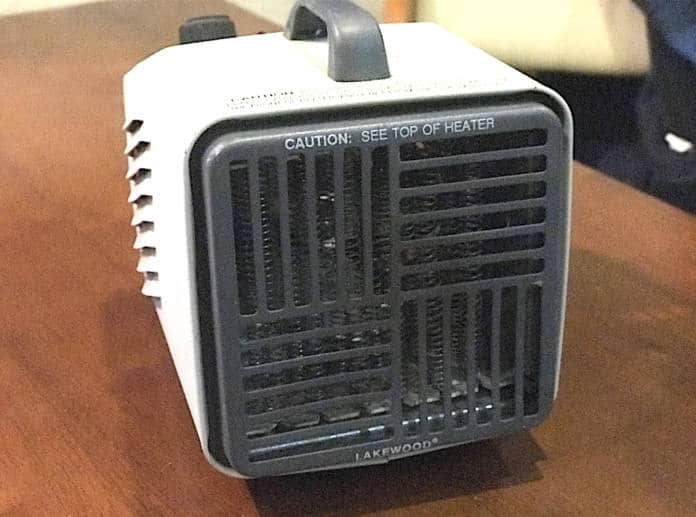
RV size tends to dictate portable heater size. Although very small portable heaters like the one pictured can be hard to find. When having electricity, we do heat with a small cube heater plugged into a portable thermostat at the electrical outlet. The remote thermostat provides a nice even temperature without the wide temperature swings of the heater’s thermostat. And whenever possible, given our heating needs, we use the lower 750-watt setting. Everything operates cooler and safer when drawing less power.
We have a well insulated fiver (guaranteed to -10 degrees) but it’s necessary to use the propane furnace to heat the underbelly and the basement where all the plumbing’s is. There’s even a vent in the exterior water panel. Last year we spent a week at Eagle Nest, NM with nighttime lows of -4–8F. In order to heat the lower areas and save propane I turned off the heat and ran the blower using 2 120 volt electric space heaters. Each one on a separate circuit to keep from blowing breakers. We had to turn off one heater and lower the temperature on the other heater because heat rises and the bedroom overheated.
What model is guaranteed to -10? C or F? What are they guaranteeing not to freeze?
We set our small electric heater on a pizza pie pan to help with keeping flammable materials away. Cheap enough at Dollar Tree.
Helps take the chill out of the early morning.
Nobody mentioned infrared electric heaters. They CANNOT catch anything on fire and use very little electricity. I am a retired electrician
Infrared!! That is what I have in my house and MH!!
Thank you, Gail! Even if ones OEM heating features work well, they may fail at some point. So, it is a great idea to have one or more of these portable heaters as a backup. 🙂