


Here are comments from Dave on an RV forum, regarding tire sidewall bulge:
Do not get bullied by either the RV manufacturer or the tire manufacturer. We had a McKenzie trailer. When new, every place that the cords overlapped was a depression. We stopped for gas in Needles, CA. The gas station attendant had this horrified look on his face and showed us bulges on 3 of the 4 tires. He also showed us a pile of blown tires out back. We bought 4 tires with the next higher load rating. We took the bad tires with us on our whole vacation.
After we got home, I tried to get warranty from Monaco Coach (parent company) shortly before they folded. They do not do warranty on the tires. Contacted the tire manufacturer. The U.S. customer service manager stated that where the cords overlapped was the strongest part of the tire (BS). I told him that he was wrong.
Per my years of experience with custom industrial lamination equipment at HP, the rubber surface where the cords overlapped looked like very fine sandpaper. This is what rubber looks like when it is repeatedly compressed and stretched. By the time the rubber surface looks like this, the rubber gets soft and will pull away from the cords, form the bulge, and then blow up.
I wrote up what happened, who I talked with, and researched the management of the company. With my person’s email, I looked on the website under investor relations, sent what happened and technical description to North American and International heads of Customer Service.
I got no reply, but the guy I talked to called me two days later and told me he called a local dealer to get pricing and they were sending me a check for full retail on the four tires. And no, no one else had contacted him.
Difference between tire bulge and tire depression
I found Dave’s comments interesting but rather confusing and misleading. Pictures of the tires would be a big help as many times people, even gas station attendants, have a hard time telling the difference between a bulge and a depression. Tires are a pressure vessel and not an “industrial laminate,” so his experience seems to have misled him
There is a big difference between a “bulge”, that sticks outward from the rest of the tire sidewall, and a “depression”, that goes inward toward the air chamber.
Most radial tires will have one or more sidewall depressions. These occur due to the small overlap of the body cord ply that occurs when the tire is being “built”. These depressions would actually be at the location of more cords, which prevent the inflation air pressure from bulging a tire outward when inflated.
A bulge, as seen in these pictures, would be the result of an impact where the body cords were broken.
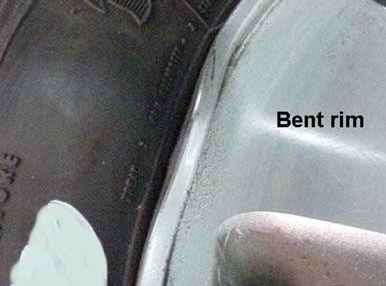

In these cases the tire clearly hit something and the body cords are broken. This condition is not warranted unless a “Road Hazard” warranty was purchased.
I have covered impact breaks, with pictures, that I discovered on my personal car and on my wife’s car. I posted the results of the forensic tire inspection with pictures on my RV Tire Safety.net blog.
Sometimes, dismounting a tire and inspecting the interior can provide the extra evidence to confirm impact or body splice.
Side comment: Any “tire store” that can’t properly identify the impact or splice should be avoided as they apparently have zero training in inspecting tires, such as the “gas station attendant” mentioned above.
Roger Marble
If you have tire questions, check out Roger’s Blog as well as his posts on RVtravel.com. There are hundreds of posts covering everything to do with tires.
If you still have a question for Roger after searching the above posts, send your inquiries to him using the form below.
MORE ON TIRE SIDEWALL BULGES
- When is a tire bulge evidence of external damage and not a defect?
- Is that a tire sidewall bulge? All about sidewall undulations
- Tire bulges and depressions: Do not drive on a tire with ‘this’ condition
RVT1215

Had a woman that we know who was told by a local big name tire shop that her tires were ‘dry rotted’ and needed replacement. I checked their age, which was less than 4 years old.
Saw no evidence of any damage.
He just wanted to sell tires.
OK It looks like I wasn’t clear enough. If you have an outward bulge. the tire needs to be inspected for structural damage, which would require a dismount unless you are lucky enough to have the manager of the tire dealership to do the inspection and put in writing the tire is OK for use. If you have an inward depression it is most likely just the location of a “Body Ply Splice” and should be OK. Again, have the tire store manager do the inspection as the “new guy” who primarily does oil changes and mounts tires may not have the experience.
Thank you, Roger! Have a great day and safe travels!