


Dear Dave,
I bought this unit used. There’s a soft spot on the RV’s roof where a seal around a vent was broken. Can I leave it, and will it stay “as is” if I keep it all sealed now? —Shawn, 2004 Newmar Mountain Aire
Dear Shawn,
I would not leave it, as a soft spot indicates there was moisture penetration and ultimately damage to the wood and it could still be leaking. If that is the case, it will just get worse and beyond repair. You did not indicate if the seal around the vent had been replaced. Also, what seal are you referring to?
RV roof vent
If you are referring to a roof vent such as the FanTastic Vent, the “seal” is actually the butyl tape underneath the flange and self-leveling lap sealant covering it. The RV manufacturer cuts a square hole in the roof and the roof vent is inserted into the hole with a 1” flange on the outside. Screws are inserted to hold the entire unit to the roof, and self-leveling lap sealant covers the flange and screws. This is a photo of a vent we worked on recently Notice the horrible sealant around the flange!
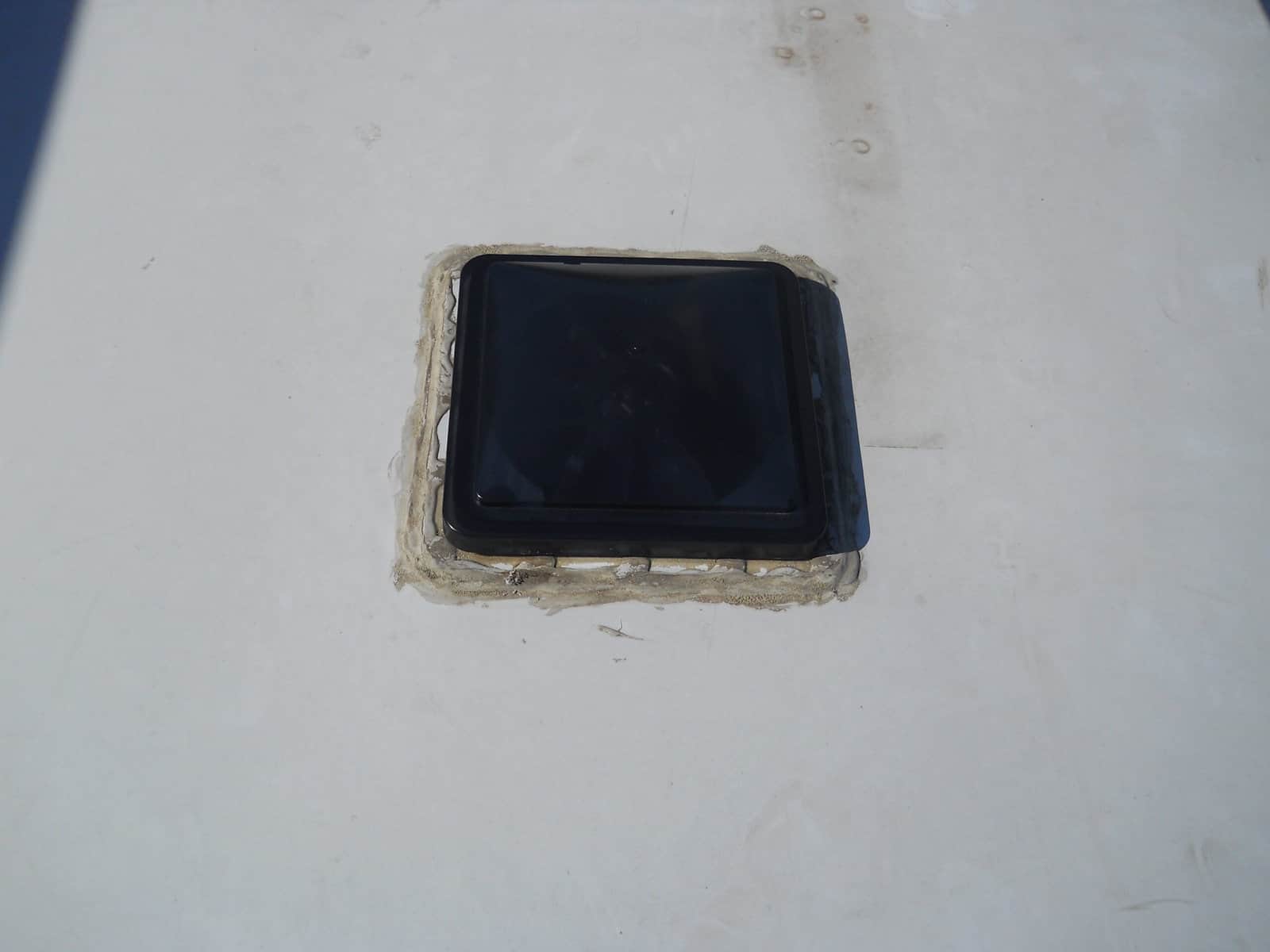
So the “seal” would not actually break. Maybe it’s the flange or housing, which is plastic and would not be easy to fix or reseal. It’s possible, but I have not had much luck in the past due to the vibration of traveling down the road and temperature changes. So I would take the old one off and replace it with a new one.
Inspect the damage to the RV roof
Even if you do not replace it, I would recommend taking it off and inspecting the damage to the RV roof. Your unit most likely has a fiberglass top skin, luan backing board, block foam insulation, and interior paneling with either a vinyl cover or hair cell fabric. Taking the vent out will show what the soft spot looks like and if the foam has deteriorated.

Take the interior flange off first, and look at the roof structure. See if you can determine what is soft and what might be an issue before taking the top side of the vent off. This is a photo of a demonstration model for the Winnebago, which is very similar to your Newmar. You want to check out the integrity of the block foam and the thin wood and verify that no more moisture can get inside and cause more damage.
You might also enjoy this from Dave
Should I condition my rubber roof or recoat it?
Dear Dave,
We have a 2018 Sunset Trail 33-ft. RK291 travel trailer with a rubber roof. Would it be best to use a conditioner or recoating product on it? I plan on doing it myself, whichever product I use. Thank you. —Robert
Dave Solberg is a leading expert in the RV industry and the author of the “RV Handbook.”
Read more from Dave here.
HAVE A QUESTION FOR DAVE?
We have a popular forum for Ask Dave. Please be as brief as possible. Attach a photo or two if it might help Dave with his response. Click to visit Dave’s forum. Or send your inquiries to him using the form below.
##RVDT2146


Newmar doesn’t build the same way as Winnebago. They don’t do laminated walls or block foam.
What Shawn will find is aluminum trusses, a plywood roof under the fiberglass skin, and thick bat insulation. In 2004 Newmar made the Mountain Aire, the bottom of it’s luxury offerings, in both gas and DP models. Shawn didn’t mention which he has, but he can go to
https://www.newmarcorp.com/owner-tools/brochures-archive/
to pull up the appropriate brochure and look at the construction breakdown shown to verify how his model was built.
I agree he should ultimately remove the vent, but for a quick check he can remove the inside bezel, push the bat insulation aside a little and/or feel for dampness. He will be able to see if there is dampness & mold or if it is dry in the immediate area and proceed from there.
Hi Spike, Dave, and everyone else-
Question: Could Shawn remove the inside bezel and insert a borescope and take a look around?
Thanks Dave, for the reminders to do more thorough inspections on what might even be thought of as minor repairs
Thank you for the reminder of how important maintaining the roof seals are, Dave!