


Dear Dave,
How about a simple discussion on how to determine actual RV load capacity? We turned down a beautiful Class C because of its small load capacity. It was very difficult to find a correct answer. —Thomas, 2012 Phoenix Cruiser 2552
Dear Thomas,
Thanks for the comment and the discussion point. This is a big issue, in my opinion, with many of the Class C and B van units. And as you stated, it is hard to find the correct answer. Most people selling RVs today do not do their homework and, frankly, just want to sell something no matter what.
The issue is Cargo Carrying Capacity (CCC) or the amount of weight you can add to an Unloaded Vehicle Weight (UVW) before it gets to the maximum weight the unit can weigh, which is Gross Vehicle Weight Rating (GVWR). The UVW or “Dry Weight” listed on the weight sticker is the unit as it sits with no passengers, water, propane, or “stuff” (cargo).
Some RV manufacturers don’t list the CCC in their literature
I don’t know of any RV manufacturer that lists the CCC in their literature of the smaller Class B van and Class C units that are built on the Mercedes Cutaway chassis. Typically you just see the GVWR, Gross Axle Weight Ratings (GAWR), and Gross Combined Weight Rating (GCWR). For example, a 2020 Winnebago View has a GVWR of 11,030 pounds listed in the brochure but nothing about dry weight or CCC.
This was a huge issue back in the late 1980s and early ‘90s, when there was no requirement for listing dry weight or CCC. RV manufacturers were building units that were over GVWR before anyone stepped inside or added cargo.
Weighing RVs at events
We have John Anderson of the RV Safety & Education Foundation (RVSEF) to thank for bird-dogging the industry and exposing the problem. John retired from the military, bought a 5th wheel and large hauler, then started blowing tires on the trailer. He finally got it weighed and found it was severely overloaded, thus the reason for the tire issues. He formed “Weigh We Go,” and with sponsorship from Michelin, Goodyear, and the Tire & Rim Association, started weighing RVs at rallies and events.
It was found that more than 75% of the rigs were overloaded in either GVWR or GAWR, and the same amount had underinflated tires. This prompted the RV Industry Association (RVIA) to mandate weight stickers that showed what the unit weighed dry and the CCC. Most RV manufactures were not happy with this, as it uncovered the fact that just because you have huge storage compartments all along the bottom doesn’t mean you can fill them up!
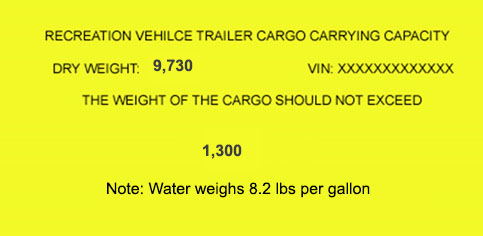
So, now all RVs have a weight sticker; however, it is a little short on information. Here is an example of the typical weight sticker with our example of a 2020 Winnebago View: The Dry Weight is 9,730 lbs. Since the GVWR is 11,030, as we noted above, the CCC is 1,300 lbs. This is actually one of the better Class C models on the Mercedes Cutaway chassis. I have found some units that only have a CCC of 600 lbs.
Dry Weight is without passengers
What they don’t tell you is the Dry Weight is without passengers. So most people shopping for these smaller units don’t realize you must subtract the weight of a driver and all passengers before calculating what cargo you can shove into every nook and cranny. And if you fill up the 40-gallon water tank, that adds almost 328 lbs. That puts you right at or over GVWR with a 600 lb. CCC!
The problem, in my opinion, is RV shoppers want everything in these small units and are not educating themselves on weight ratings. And the competition in this market is fierce. So RV manufacturers will give them what they want, while hoping the buyers don’t do the math. This is a point I make in my RV Buyers Seminar for buyers looking for the smaller units.
And don’t forget options that can be added later, such as a generator that would add another 200+ lbs. However, full fuel and engine lubricants is factored into the Dry Weight.
Glad you did your math!
You might also enjoy this from Dave
Why is the GVWR higher than the combined GAWR?
Dear Dave,
I have this question regarding just about every 5th wheel RV manufacturer sticker I see. Why is the gross vehicle weight rating (GVWR) allowed to exceed the combined weight rating of the axles supporting the 5th wheel? For example, my GVWR is 12,600, but my two axles are rated at 6,000 lbs. each. I can only surmise that the tongue weight of the 5er is always going to be supported by either the front jacks or the tow vehicle. If true, I’m curious how they arrived at the GVWR of 600 lbs. over the combined axle rating. —Ray
Dave Solberg is a leading expert in the RV industry and the author of the “RV Handbook.”
Read more from Dave here.
HAVE A QUESTION FOR DAVE?
Send your inquiries to him using the form below.
##xxxx

I got my first lesson on weights in 1999 when I bought my 1st Class A, a new 34′ Fleetwood Bounder. This unit had all the heavy stuff behind the rear axle (except the engine/transmission). A 100 gal water tank was at the very back. Think about 833# of water about 13′ behind the axle and the leveraged weight that creates! Add a generator and the fuel tank and the rear axle was overloaded. They should have put that water tank between the axles: plenty of space, front axle CC & GVWR, just not well distributed.
At purchase I wasn’t savvy about this stuff. I assumed the RV industry engineered correctly. Lesson learned.
I have encountered sales staff who believe that the hitch rating is what determines how much you can tow. You really need to know how to do the calculation yourself.
I believe there’s CAT scales for truckers that can and allow you to weigh your RV for a small fee ($10- $15). Here’s a link to find them and they also have an app.
Thanks, Gary. There’s no link in your comment, but here’s a link to the CAT Scales website, which includes a tab at the top for the apps as well as a locator tab: https://catscale.com/about/ Have a good night and a terrific Thanksgiving.🦃 😀 –Diane at RVtravel.com
That’s just one of the reasons we love our Winnebago Travato Class B. Our OCCC (occupant and cargo carrying capacity) on the official sticker is 1889 pounds!
Yah, I vas overweight so I left the wife at a truckstop on the interstate. Gùt now, ya.
🤣 And now she’s probably with a trucker who appreciates her more than you do.🤣 Have a great Thanksgiving, Baron. 😀 –Diane at RVtravel.com
We weigh our motorhome at our local gravel company. Their scales are never closed even when the office is not open
It’s still the case that RVs are often not balanced side to side, so it is best to get 4 corner (wheel position) weights. For RVs on ST, LT or TBR tires, you need to know the weight on each tire on the heavier side to set the inflation pressure for each axle.