

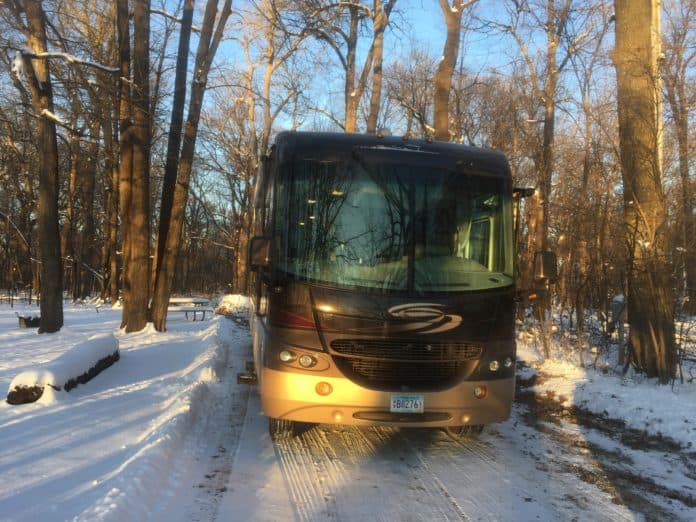
By Nanci Dixon
Successful winter camping? Yes! It’s easy to enjoy the solitude and beauty of winter camping—you just have to know how to do it safely.
The end of the season when it’s time to pack up the RV, winterize it, and put it in storage has always been a rather sad time. That is, until I was able to convince my husband that we could still RV—we just needed to do a little more prep and do without some of the fancy luxuries that an RV provides.
Let me tell you one thing about winter camping: There is no campground crowding! While the majority of private campgrounds close down in the winter, a lot of state and regional parks keep campgrounds open. They even plow a few select sites and have power on.
Our first winter camping adventure
Our first outing was not well-planned but we still made it memorable. The best birthday present I could have had was a weekend in our truck camper in March. March in Minnesota is still cold and complete with six feet of snow. It was an epic present, but it took shoveling out a way into the backyard to retrieve the truck camper and three burly guys to release it from the frozen tundra.
Success! We traveled to a state campsite and had the pick of more than 100 sites! The campground was in a tourist area and I didn’t realize that the town would be closed up tight in the dead of winter. My anticipated birthday steak dinner was reduced to a gas station frozen meal defrosted over the propane stove. But it was an adventure! We stayed warm and snuggled up. In the morning, I looked out the windows with such joy and gratitude over the frosty, pristine snowscape.
Camping at -10° F
Next came a more demanding trip in our 34-foot motorhome. The temp was -10° F. We had just sold our house and all our belongings and were traveling south. Truthfully, I had thought we would stay in a motel, but my husband was all in favor of camping. We found a casino campground that stays open all winter with 50-amp power and showers.
The next morning, the motorhome didn’t start and there was a good 1/2″–thick coating of ice on the inside of the windshield. We used a small, portable electric heater to defrost it, and the casino had a car start service. However, it became apparent we needed a new battery and absolutely no shop would go out in the cold to change it. We finally gave up and bought a battery and my husband changed it out. I supervised from inside the motorhome.
We found campsites along the way that catered to winter camping. As I was filling up a five-gallon jug inside a ranger station, they informed me that they left a few faucets on at the campsite for those traveling back and forth to the Mayo Clinic and hospitals.
While we did put water and antifreeze down the sink and toilet, we did not dewinterize until the blissful warmth of Alabama.
While we’re not experts in winter camping, we know it can be done and that an RV does not need to sit forlornly throughout a long and dismal winter.
A few helpful winter camping tips
Winter travel
- Check weather reports. Driving in snow and ice in an RV requires patience and forethought. Waiting out a storm is usually the best idea.
- Let family or friends know your travel plans and route. Stay in touch and keep them posted on your location along the way, if possible.
- Go slow! Required chains is not an RV-friendly route.
- Carefully sweep off snow from slide-outs before pulling them in.
- Have a portable car starter available and charged up.
- Carry ice and snow scrapers.
- Make sure vehicles are winter-ready.
- Stuck or slipping? Removable rugs and car mats can provide some traction under tires.
Using the sinks and toilet when winterized
- You can use the toilet and sinks even if winterized.
- Carry water in jugs and use the water in your sinks and toilet very sparingly.
- “Flush” with RV antifreeze.
- Pour RV antifreeze into sink traps and down the toilet. This is particularly important if leaving the RV for any amount of time.
Not winterized? Keep pipes from freezing
- Make sure the furnace warms fresh water and holding tanks. If your RV has multiple furnaces, know which one is heating the tanks.
- Keep sink cupboard doors ajar to allow interior heat to get to interior lines.
- Even at a full-hookup site, do not hook up the sewer hose until needed to dump… and dump with caution! If there is the potential of freezing mid-dump, wait!
- If your RV is not winterized and is in an area that freezes overnight, you can use a heated water hose or unhook and store the water hose. Note: Putting a water filter at the faucet will freeze if it’s not done after heating the water hose. (I know that from experience!)
Staying warm
- Make sure batteries in smoke and LP detectors are working.
- Monitor propane levels.
- Do NOT use a propane stove top for heat. This can prove deadly!
- Portable electric heaters can supplement heat but do not use overnight or leave them unattended.
- Big Buddy portable propane heaters can provide auxiliary heat, but make sure you crack a window when using one. Do not run it overnight!
- Pull shades or curtains to retain heat. Cover the windshield if in a motorhome.
- Install insulated vent covers.
- Insulate windows and cabinets.
Dress appropriately, and enjoy!
- Have doubles of all warm clothing.
- Know that once gloves, socks and clothes are wet they can take a long time to dry out—always have two pairs handy.
- Protect against hypothermia. Get inside if you’re chilled. Watch the kids—who may not realize they are too cold and just want to keep playing.
- Enjoy the solitude and beauty of a winter camping trip. You’re guaranteed to make amazing memories.
RELATED
- How to stay warm in an RV in winter: Insulate, heat, and protect
- Two fast and easy winter RV mods to help you stay warmer
- 7 common RV winterization mistakes you should avoid
- Yikes! There’s a freeze warning. Tips to keep the water flowing.
- Commercial heated RV hoses vs. DIY heated hose for winter camping
RVDT2830
Wonder how the slides work with the cold harder rubber seals?
I haven’t had an issue. Had a 1999 Fleetwood Bounder with a single slideout I winter camped in it for years no problems. Also, a year ago in February we traded our 43′ Newmar Mountain Aire for a 36′ New Aire at Midway RV in Grand Rapids, MI. It was supposed to be “nice” for end of February, but a storm blew in across Lake Michigan dropping temps into the low single digits. In those temps we transferred our stuff between both rigs, all slides out on both. Then we stayed onsite for three days in the New Aire ensuring all systems were a go. When we left, we closed up the slides on both rigs…no issues.
Always a fresh perspective, Nanci. Thank you!
Many people are frozen in place at 50 degrees, let alone freezing and below. True Minnesotans know the beauty of continuing on, with prudent preparation!
A friend and I went tent camping a couple times in mid winter in central MA in our teens. We packed the snow down to make it level for our tents. Very chilly.
Used to camp frequently in Nov/Dec in Minnesota on hunting trips.
Coldest was right after the mega Halloween blizzard of 1991 that dumped over 3 ft of snow and had winds up to 50 mph. After the snow passed and winds shifted coming from the North, temps plummeted to -20°F for a week. Nanci, I’m sure you remember that one, being a Minnesotan.
It took me three days just to get across the state from the Mississippi in SE MN to the camp in SW MN near the S.D. border for a planned week long hunting trip. Despite the weather, our group had a great time and it’s one trip I’ll never forget!
Nanci,
Not sure l follow: “ If there is the potential of freezing mid-dump, wait!”
I guess I’ll find out. We’re in Sopchoppy, FL with 20’s over nights. I put away the water hose but left the sewer hookup. Gate valves closed. We’ll see..
We’ve found using an electric radiator heater helps supplement furnace heating and isn’t nearly as dangerous as those other heaters. The furnace still runs so the underbelly gets some heat.