

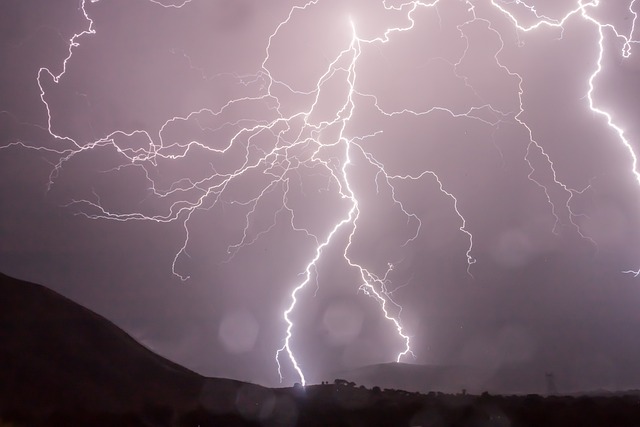
My husband and I enjoy traveling south for the winter months. I’m happy to escape the cold Midwest winter, but I’m not excited to relive the lightning storm we experienced a few years back. Florida is known as the Lightning Capital of the U.S. (July is usually its busiest month.) However, lightning can strike at any time of the year. This year, I want to be prepared! I need some tips for surviving lightning while RVing.
Storms
Storms can be frightening. Growing up in the Midwest, I know and respect the power of a thunderstorm, with its potential for excessive wind, rain, and hail. I also know the power of lightning that often accompanies these storms. What I didn’t know a few years ago was how to deal with thunderstorms while RVing.
Any port in a storm?
- Building. Usually, I feel safe and secure inside our fifth wheel RV. However, when a storm threatens, it’s best to move to an actual building. That’s why we try to walk the campground immediately after setting up our rig. This quick walkaround gives us a sense of what buildings could be used in an emergency. We also learn where the buildings are in relation to our RV site. (If a storm hits during the night, we may not be able to see the shelter in the darkness.) The campground store or shower house can provide shelter from lightning and other storm events. Some campgrounds have actual storm shelters, too. Know where they are located!
- Vehicle. A secondary place to find shelter is inside your car or truck. If you cannot access a building, your vehicle is the next best option. The Faraday Shield will protect you. No, it’s not an accessory—it’s the theory behind the idea that your vehicle can protect you from lightning. It turns out that it’s not the rubber tires that protect you in a lightning storm. It’s the metal “cage” or chassis of the vehicle. This metal shield or cage will channel the lightning around you—not through you. Note that your vehicle will not provide much protection in high winds or tornadoes.
- RV. If your RV has an aluminum shell or metal frame, the same Faraday Shield will protect you. If, however, your rig is composed mostly of wood and fiberglass, you’ll be safer inside a building or your vehicle.
Antennas
If you have a television antenna, Wi-Fi booster, or other equipment on your RV roof, it’s best to lower them before the storm, if possible. Electricity can travel through coaxial and other cables and potentially damage your equipment.
Shore power
Before moving to a campground building for shelter from the storm, disconnect your shore power. That’s right, unplug your rig’s electrical cord from your site’s power supply.
Why do this? Because in many campgrounds, the power cords are buried relatively close to the surface of the ground. If lightning strikes nearby, its electricity can travel through the wires, into your shore supply post, and into your RV—potentially frying your RV’s electrical system or causing a fire! Yipes!
I feel much more prepared with these tips for surviving lightning while RVing, and hope you do, as well!
Have you ever experienced a dangerous storm while RVing? Tell us about it in the comments below.
RELATED
- RV hurricane preparedness tips: What to do in big storms
- RVing in severe storms? Do this, and definitely don’t do that!
##RVDT2356

You haven’t lived until you have been on a chairlift going up the side of a mountain, in the summer time, and an electrical storm comes over the top of the mountain….
No storm warning of any kind forecasted in the area? Did you have a mini-lite trailer on the lift, lol.
Lightning struck our RV while parked beside the sticks and bricks. Destroyed every single electrical appliance and engine electronics in the RV.
Ouch!
Thank you, Gail! 🙂 No, never gone tbrough a thunderstorm in the RV. At least I do not recall doing it. Thank you for the tips on dealing with lightning and thunderstorms! Safe travels! 🙂
On a related note: It is best if your RV has only one earth ground source (or none). On a properly installed park electric system, that will be at the power pedestal through your shore power cord. Rubber tires of course, but I use plastic pads under all stabilizers and jacks. Having more than one earth ground source may create an electric potential (in other words electrons flowing where they shouldn’t) through the RV frame.
Boy, growing up in Chicago, I remember some epic thunderstorms! My folks home, built in the late 1800s, would rock to the core with the first CRACK of thunder! The old sash-weighted windows would rattle back and forth with every following crack. Here in northern NV we rarely get any thunder OR lightning.
The most lightning we ever saw was on a night time trip going up I-39 in Central and Northern Illinois. We were in severe thunderstorms with tornado potential. Heavy wind & rains. We thought about pulling in somewhere but if you know this area, there’s not really good protection anywhere. There was so much lightning that it had the sky lit up continuously. We got into a convoy of semis going 30 mph (you know its bad when semis go that slow) and stuck it out, my wife scanning for tornados in the brightness all the lightning provided. Finally drove out of it around Rockford.
Have been in many others while camped in the Central Plains & Midwest.
Lightning in Florida once appeared to hit our house with two bangs almost at once. Not sure what happened but it hit the incoming phone on the south side of the house and the electrical mast on the north side. Another storm strike hit right above my barn shop and I went deaf for just a minute or two and the RF evidently fried my radio/CD player. A small tornado lifted my daughter’s playhouse and moved it three feet without disturbing anything inside but lifted the roof off a house across the street (could look down like into a doll house) and took down two live oaks in the neighbor’s yard. And I thought I escaped the Mid-West storms. LOL All happened before world was to end today.
We were in a 5 minute hail storm one week ago in Fredericksburg, Texas. It came out of nowhere, no rain, no wind. It really did a lot of damage to our tow jeep. Don’t know about the LondonAire yet. We just got home and will look.