


Dear Dave,
My 12-volt system has quit working. I have 120 that still runs the A/C and microwave, but lights and fans don’t work. I’ve pulled the inverter out but am wondering how to check it. It still has power going to it. I’m pretty good on electrical tracing but this has me stumped. Should I just replace it? Thank you. —Jeff, 2015 Livin’ Lite 28FBD
Dear Jeff,
To start with, we need to provide a little clarity in how the system works and what components you are actually looking at. When the rig is plugged into shoreline power, 120-volt power goes to the distribution center and to the circuit breakers for 120-volt appliances such as the roof air conditioner or conditioners, and any appliance that is plugged into an outlet such as the microwave, refrigerator on 120-volt mode, and TV. The distribution center also has a converter, which is a battery charger providing a 12-volt DC charge to the house battery or batteries. They run items such as interior lights, vent fans, and any appliance that runs on LP such as the furnace, water heater, and refrigerator on LP mode.
Inverters
An inverter takes 12-volt power from the house battery system and provides 120-volt AC power to select outlets to be able to use the TV, CPAP machines, or other 120-volt components when not connected to shoreline power or dry camping. Most inverters have a 120-volt outlet on the inverter that you could test to verify if 120-volt power is being provided. However, this does nothing to power the 12-volt DC components.
Converters
There are two different converter configurations. There is the all-in-one that is part of the distribution center such as this one which has the converter on the right side of the unit behind the vents.
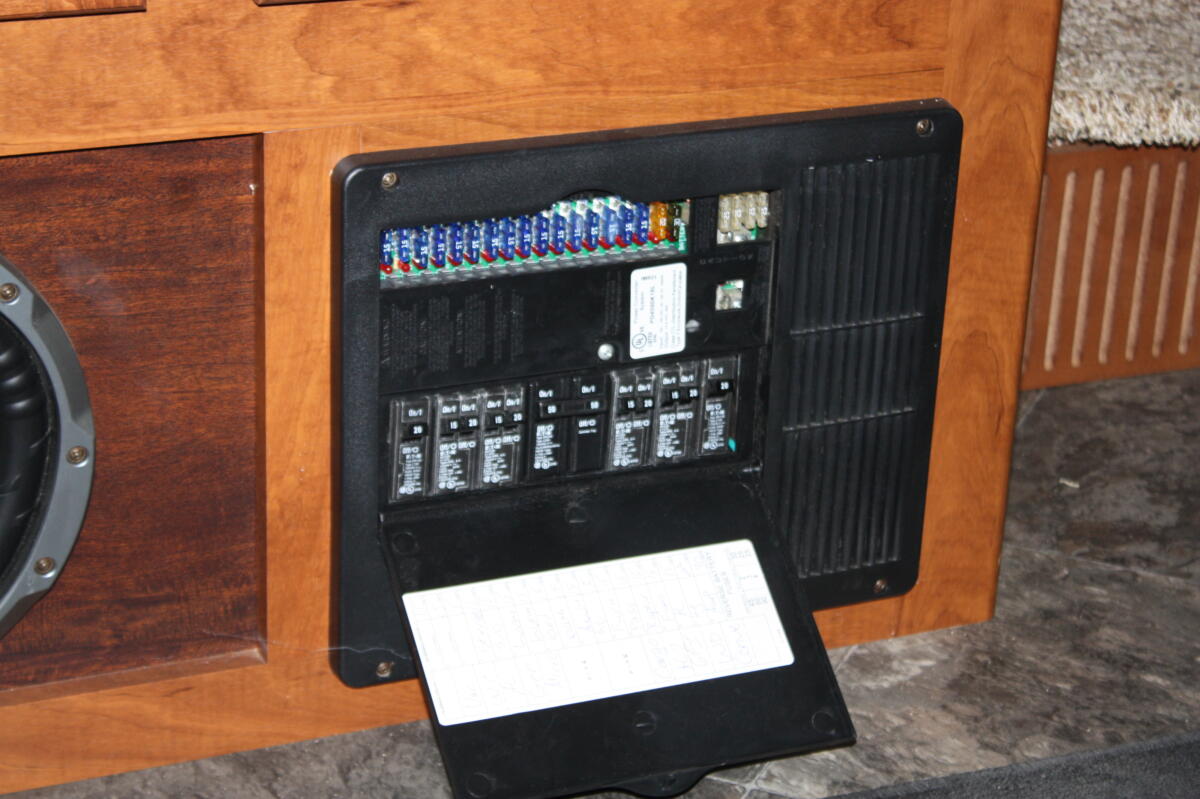
Other units have the converter at the bottom of the distribution center, such as this Salem we have been working on for the past few years. This unit had no 12-volt power coming out to the house batteries when connected to shoreline power, so the battery was dead all the time when not connected to shoreline power.

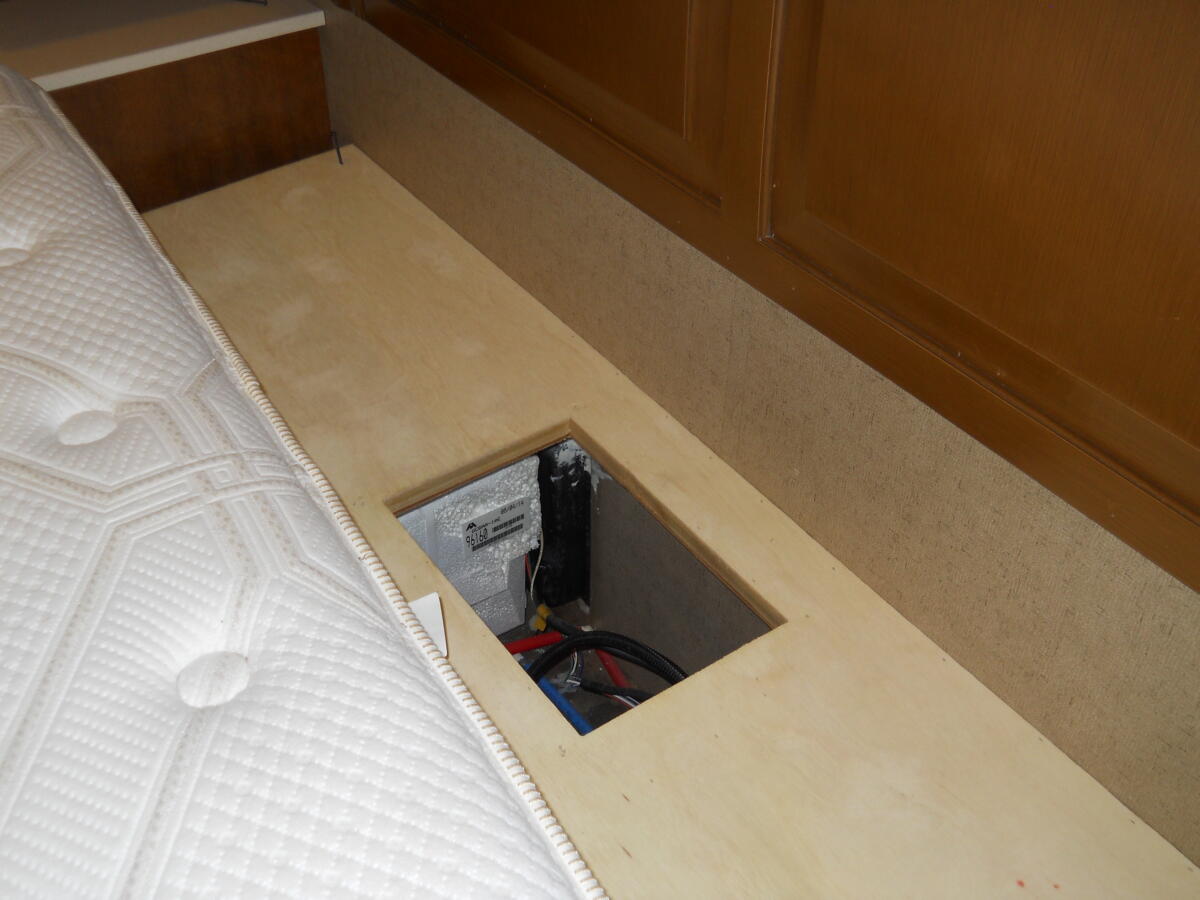
Some RV manufacturers use a distribution center located in the living room or kitchen and a standalone converter located under cabinetry or in the bedroom, as they are noisy and produce heat. Here is one that was located under the bed in a unit we worked on last year.

Is it the inverter or converter?
You stated you removed the inverter, and I question if it was an inverter or converter. An inverter would have 12-volt DC wires coming in and either 120-volt Romex wires coming out or an outlet. Here is an 1800-watt version from the Thor we worked on that was in an outside compartment.
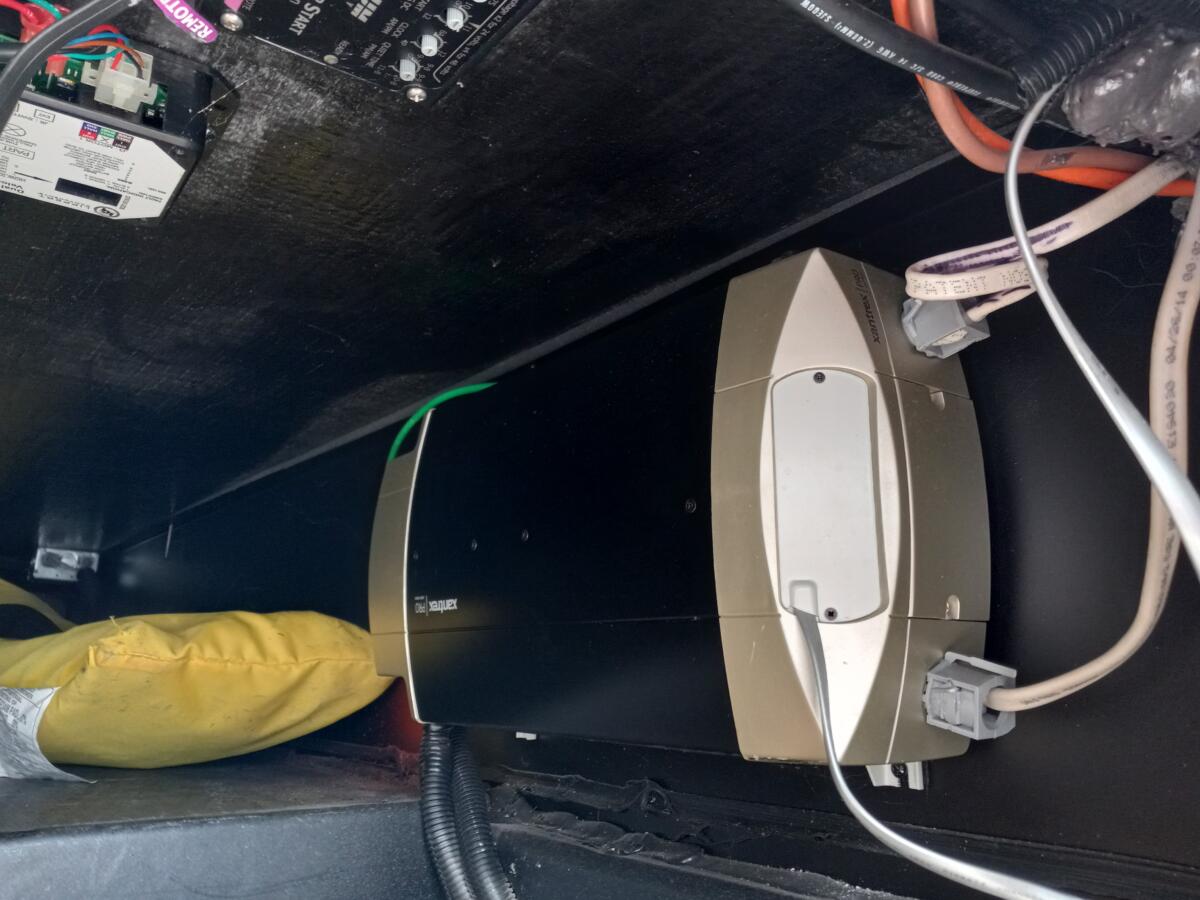
Note the 120-volt AC Romex at the top and bottom as well as the 12-volt DC cables at the back that are in automotive conduit. This model has what is called a “pass through” feature. That means if the rig is connected to shoreline power and has 120 volts available, it will allow the 120 volts to pass through rather than drawing from the house battery system. That is why there is an incoming and outgoing Romex on this model. This would not supply any 12-volt DC power to the lights or roof vents.
To pull the inverter would be easy as it is a standalone item and can be tested by connecting 12-volt DC supply from the batteries and verifying there is 120-volts AC coming out. To pull out the converter is much more technical as it could be part of the distribution center. That would require a certified technician to pull it out and then test it.
If it is a standalone like the WFCO, you can pull it out and test it by plugging it into a good 120-volt outlet and using a multimeter to test for 12-volt power. It should have a 13.6-volt charge coming from the unit. If it is lower than 13.2 volts, it will not charge the battery.
“My 12-volt system has quit working”
Technically, if the lights are not coming on and other 12-volt operations are not working, you are not getting 12-volt power from the house battery system or the converter. The first test I would suggest is to use a multi-meter and test the batteries for 12-volt power without the unit plugged into shoreline power. Fully charged batteries should read 12.6 volts and 50% depleted will be around 10.5 volts. Even at 10.5 volts, most lights will come on but will be very dim. My guess is your batteries have been depleted much lower than this.
Next, plug the unit into shoreline power and measure the voltage at the batteries again. The converter should be putting out at least 13.2 volts and most likely 13.6 volts if the batteries are very low. If there is no voltage or it is extremely low, your converter is no longer working and the system drained the batteries completely dead with no charge going back in. This would mean a new converter and most likely a new battery or batteries.
Before doing all that, check to make sure the battery disconnect switch is not engaged, which would be like removing the negative cable so no power would be available. Also check to make sure the battery cables are cleaned and have a solid connection.
One last item to check if there is a charge at the batteries or coming from the converter is to look for a resettable fuse downstream of the batteries. Just a few months ago we had a reader that found his rig had what looked like a junction box and a spade-like fuse that had tripped and shut off all 12-volt power from that point on.
You might also enjoy this from Dave
My batteries don’t charge when connected to shoreline power. How can I test my converter?
Dear Dave,
My converter does not appear to be working. My batteries are not being charged when plugged into shoreline power. How can I test/check to verify an inoperative converter on my Airstream? —Jay, 2020 Airstream Classic 33
Dave Solberg is a leading expert in the RV industry and the author of the “RV Handbook.”
Read more from Dave here.
HAVE A QUESTION FOR DAVE?
Send your inquiries to him using the form below.
##RVDT2356

Check your figures again. A 12v lead acid battery reading 10.5 volts is totally dead. Around 12.1 volts is 50% charged.
Plus a battery can read over 12 volts at idle (surface charge), and die when a load is applied.
A shorted cell in the battery can cause it to draw enough current that it appears the converter is bad.
This happened in my wife’s car. Even trying to jump the battery with a known good one would not start the car.
One reason there is no 12 volt supply from converter…WFCO…that dreaded piece of scrap that gives so many the fits. Replace the 12 volt side of the converter with a PD 12 volt supply and away goes your troubles down the drain.
Thank you, Dave! 🙂 I recently saved a listing of the battery readings and the associated state of charge. Anything below 11.9 volts was considered fully depleted. When you typed/wrote “10.5” was it supposed to be “12.5?” Thanks again and safe travels! 🙂
Update And Correction
Sorry, below 12.5-volts is 50% and 10.5 is totally depleted. And here is an update from Jeff;
Afternoon Dave. After reading your response which is great. I feel that I have left out a few items. My fault. If I have my battery disconnected and plug into shore power I still don’t have any 12 volt power supply. So I think maybe I was using the wrong term . Maybe should have been converter, instead of inverter. Hope I’m not making a bigger mess for YOU. Looking at your pictures my unit looks like the first two. You have definitely helped clear a few things for me. Thank you Jeff
And since the battery was disconnected, the converter would have been running at full charge and most likely why it failed.