

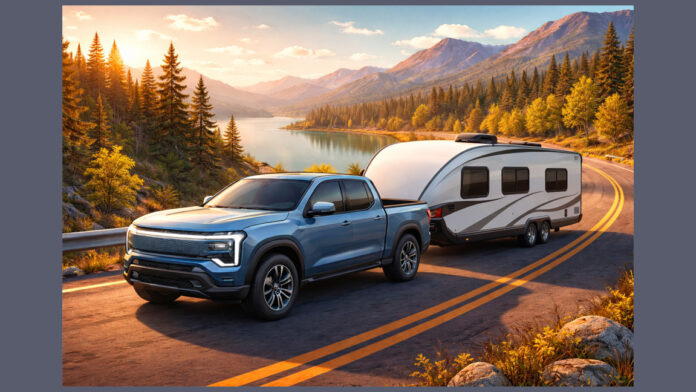
Walk through any major RV show this winter and you’ll notice something new. It’s not just electric trucks on display—it’s the growing talk about the challenges of towing an RV with an EV and what they say about the way RVers tow today.
That doesn’t mean most RVers are about to trade in their gas or diesel pickups. Far from it. But as electric vehicles slowly enter the towing conversation, the limitations they face are beginning to influence how RVs themselves are designed. And those influences reach well beyond electric vehicle owners.
A recent piece in CleanTechnica explored how RV manufacturers are starting to think about electric tow vehicles as show season gets underway. While the piece focused on EV users, the issues it raised will sound familiar to anyone who has spent time towing a trailer.
In many ways, EV towing doesn’t introduce new problems. It amplifies the ones RVers have been dealing with for decades.
Manufacturers are rethinking weight—and not just for EVs
Electric vehicles make one thing immediately obvious when towing: weight matters. A lot.
Because batteries store far less usable energy than a tank of diesel, EV range drops sharply when pulling a heavy, boxy trailer. That reality is forcing manufacturers to pay closer attention to trailer weight, materials, and how mass is distributed.
For traditional RVers, the lesson isn’t new. Heavier trailers reduce fuel economy, shorten range between stops, increase braking distances, and add wear and tear to suspension and driveline components. EVs simply remove the cushion. What gas and diesel rigs absorb gradually shows up immediately when an electric vehicle is towing.
As a result, lighter construction is no longer a niche talking point. It’s becoming a design priority.
Aerodynamics are getting overdue attention
At highway speeds, wind resistance matters as much as weight—and sometimes more.
Flat fronts, tall profiles, and rooftop accessories all work against towing efficiency. EV towing has pushed that issue into sharper focus, because a blunt-nose travel trailer can dramatically reduce electric range.
That’s why manufacturers are paying more attention to rounded or sloped front caps, lower overall heights, cleaner rooflines, and reduced frontal area.
Those changes don’t just benefit EVs. They improve mileage, stability, and handling for gas and diesel rigs as well, especially in crosswinds and long interstate pulls.
Towing exposes infrastructure gaps RVers already know well
One of the biggest EV-specific challenges highlighted in the CleanTechnica report has little to do with batteries. It’s infrastructure.
Most fast-charging stations were designed for cars, not long vehicles towing trailers. Pull-through access is rare, and many setups require unhitching a trailer to charge.
That problem will sound familiar to RVers who have dealt with tight fuel stations, low canopies, awkward turns, and crowded truck stops. EV charging doesn’t create the issue—it just makes an old problem harder to ignore.
As more complex tow vehicles enter the picture, those shortcomings are becoming harder to work around.
Range anxiety isn’t new—just more visible
RVers have always planned trips around range. How far to the next fuel stop. Whether diesel is available. How grades, wind, and weather affect fuel consumption.
With EVs, there’s less wiggle room and the feedback is immediate. When you’re towing, range loss is impossible to ignore. But planning ahead and knowing your limits is already second nature to experienced RVers.
In that sense, EV towing doesn’t change the fundamentals. It reinforces them.
Skill still matters more than specs
Another issue raised by EV towing discussions is experience. Many new EV buyers have little or no towing background, even if their vehicles are rated for it.
Instant torque doesn’t replace proper hitch setup, understanding tongue weight, managing braking distances, or handling crosswinds and grades. Those skills remain essential regardless of what powers the tow vehicle.
As new towing combinations enter the RV world, education and experience become even more important—not less.
Why this matters to RVers today
Most RVers won’t be towing with electric vehicles anytime soon. But the pressure EVs place on towing highlights long-standing truths about RV travel:
- Lighter trailers tow better.
- Aerodynamics matter more than marketing claims.
- Infrastructure hasn’t kept pace with RV growth.
- Planning beats pushing limits.
Whether EV towing becomes more common or not, its influence is already visible. Trailer weights are coming down, efficiency is getting more attention, and design choices once considered optional are becoming essential.
EVs aren’t changing the fundamentals of towing. They’re just making the limits more obvious. As manufacturers respond, those changes may end up improving RV travel for a lot of people who never plan to tow with an EV.
Even if electric tow vehicles never become common in campgrounds, the design and infrastructure pressures they expose may quietly reshape RVs—and the roads they travel—for years to come.
RELATED
- Experiment shows roads themselves could charge electric RVs
- Would you consider buying an electric car or tow vehicle as your next car?
- Ford says e-pickups aren’t suited for towing; moves toward hybrid vehicles
RVT1245b

One significant omission: you talk about flat trailer fronts, but flat trailer BACKS are as bad or worse. That’s why teardrop trailers work so well. A flat back produces air turbulence (suction) that seriously kills your gas mileage.
Great point. An open tailgate on a pick up truck makes mileage worse than having it closed for the exact same reason, contrary to what many people think when they remove or open a tailgate.
✌️😎
It will be interesting to see how the new Honda TT plays with the EV challenge. Hope to actually see it at FRVA Perry Rally in Feb.
In addition to range and charging availability, will be connecting a charger at a campground site and the increased load to the campground electrical infrastructure.
Hopefully streamlining will cause more RV companies to consider removing current very heavy, inefficient AC units from the roof. Then mini-splits might be given more serious considation for moderate- to high-priced fifth wheels and Class As and conventional window AC units for low-priced trailers and Class Bs and Cs. Several low-priced “large” teardrops and travel trailer companies are already using inexpensive window units placed through the side of the trailer and sitting above the fridge. Some companies might even begin to consider 12v-24v DC automotive or truck cab AC units. What a concept: 21st century RV air conditioning!
They already have 12v A/C that use less power.
I towed a brand new small travel trailer from Salt Lake City to Phoenix 750 miles with a Tesla model Y. I average between 50-75 miles of battery power until I had to charge up. I probably 2/3rds of the time I was able to charge at a Tesla Super Charger in and out quickly. The other 1/3 of the time I was stuck using a 15-20amp charger at a hotel waiting for hours to just get enough of a charge to get me to the next Tesla Charger station. I was force to use a RV camp ground for a few hours to use their 30amp pedestal and I had to pay for the whole night $50. Had 5% battery power and was force to stop at Love’s, drop the trailer and drive to Las Vegas 25 miles way. Bought a Ram diesel later.
Charging stations are going to be a problem with towables. Few high-speed charging stations accommodate vehicles with trailers, and few people are going to tolerate unhooking and rehooking every time they stop for a charge. Stations accommodating trailers will require a lot more real estate which will make them even more expensive.