


My first experience with a TPMS (tire pressuring monitoring system) was as a Tire Design and Forensic Engineer in 2001. I received some questions from a car company on some problems they were having with the proper installation of a system in some new 2002 model cars.
Tire pressure monitoring system history
In 1998, due to reports of some fatalities on one model vehicle, the National Traffic Safety Administration aka NHTSA (part of the U.S. Department of Transportation [DOT]) started to collect data. I was asked to assist in data collection on vehicle crashes in North, Central and South America. Basically, it was determined that significant underinflation was the root cause of the tire failures. That, coupled with basic vehicular instability, contributed to the subsequent crashes and fatalities.
This data led to the realization that very few people bothered to check their tire inflation, as many tires were found to be underinflated by 10 to 20 psi.
The result of this investigation was a new Motor Vehicle Safety Requirement of a warning to the driver that one or more tires were underinflated.
Different systems to report underinflated tires
As background, I think that people need to know that there are a few different “systems” out there. I’m not talking about different companies, but different methods of reporting and notifying the driver that there is a tire with less air pressure than what is needed for long-term safe operation.
NHTSA had issued notices in 2000 of requirements for highway vehicles with Max GVWR under 10,000 pounds to alert drivers that one or more tires were underinflated.
There are two basic types of tire underinflation notification systems: “Direct” and “Indirect”.
Direct system
The Direct type of system measures the actual inflation pressure in the tire air chamber. If the PSI drops below some set value, a warning is sent to the driver by way of an indication light on the dash, like this.

Most car companies use a “Direct” measurement system.
Indirect system
An alternative is the Indirect type of system, which basically compares the RPM of each wheel. If a wheel is lower in RPM (revolutions per minute) than the other wheels, that could indicate that that tire has a lower inflation level.
This system has the advantage of not needing new PSI sensors in each wheel. It can use the existing RPM sensor system that is part of the existing anti-lock braking system (ABS).
I believe that a disadvantage of that system is that if you are low on both tires on an axle, it is possible for the system to misinterpret the RPM levels and to not issue a warning to the driver.
The warning indicator light, however, is the same for both Direct and Indirect systems.
Most RVS are exempt from this requirement
Since most RVs have a GVWR (gross vehicle weight rating) greater than 10,000 lbs., they are exempt from this legal requirement. Also, trailers are not “motor vehicles,” so they are also exempt from the legal requirement.
Direct inflation measurement involves a PSI sensor, with most cars having a sensor that replaces the basic rubber valve that you can see in your wheel. The original equipment (OE) sensors look similar to this:
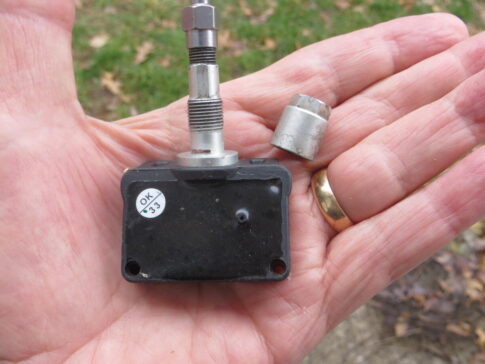
Here is an OE sensor as installed:
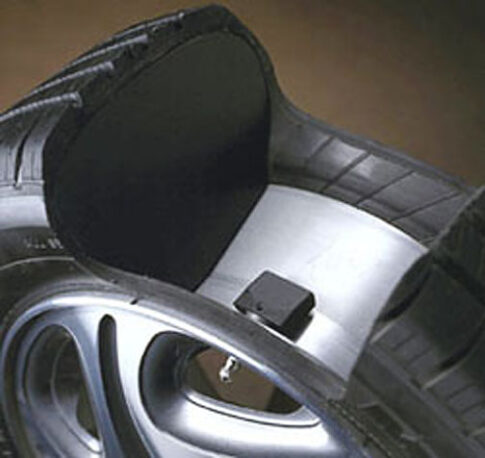
There is a battery under the black silicone sealant. The stem and nut are aluminum.
If possible, I suggest the threads be coated with “Never-Seez®” or a similar anti-seize product if the vehicle is ever driven on roads treated with salt.
You can replace this sensor, if needed, but you must get a sensor identical to the OE part, as not all car companies use the same radio frequency. Some auto parts stores can get the appropriate replacement sensor. However, it may be best to have a tire store replace the sensor if or when the battery dies.
While I have been discussing original equipment car tire pressure monitoring systems, we need to consider the RV market.
Almost no RVs, except for possibly some small Class B units, come with original equipment tire pressure monitoring systems. Therefore, RV owners, for the most part, will be using “aftermarket” systems, which I will cover next week.
Roger Marble
RELATED
- What type of tire valve stems should you use with external TPMS sensors?
- Learn the basics of setting tire pressure and testing TPMS
- TPMS settings may not be right
- Many more posts on TPMS on RVtravel.com
If you have tire questions, check out Roger’s posts on RVtravel.com. There are hundreds of posts covering everything to do with tires.
If you still have a question for Roger after searching the above posts, send your inquiries to him using the form below.
RVT1244

“Almost no RVs, except for possibly some small Class B units, come with original equipment tire pressure monitoring systems.”
Fortunately, this is changing. On diesels, both Freightliner and Spartan are installing systems. Tony’s reviews have also highlighted a number of towables with OEM systems available as well. 👍