

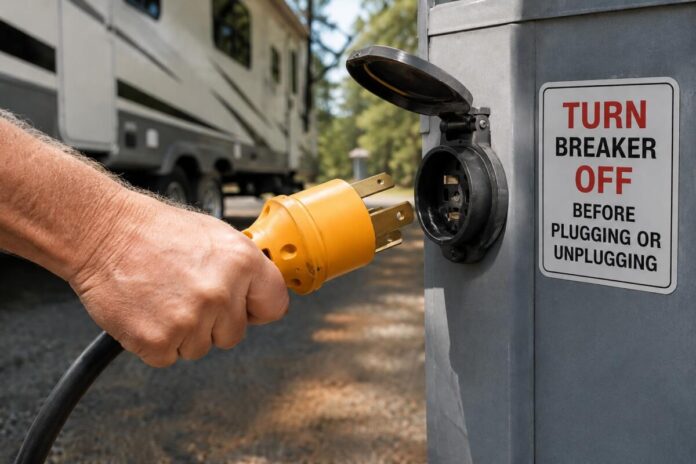
Those bright sparks you may see when plugging in or unplugging an RV power cord under load are actually tiny bits of superheated metal burning in the air. Each spark removes a little metal from the plug contacts, eventually causing pits that can lead to overheating, melted plugs, or even fire.
To prevent this, always turn off the circuit breaker at the campsite pedestal before plugging in or unplugging your shore power cord. Once securely connected, turn the breaker back on.
It only takes a few extra seconds, but it’s one of the easiest ways to extend the life of your shore power cord and campground pedestal connection. Many experienced RVers make it a habit every single time they hook up.
While you’re there, take a quick look inside the campground outlet. If it appears burned, loose, cracked, or damaged in any way, notify campground staff and ask for another site or pedestal rather than risking damage to your RV’s electrical system.
If your plug contacts are already deeply pitted, replace the cord. Light corrosion can sometimes be cleaned with emery paper, but significant damage can’t be repaired safely.
If replacing a shore power cord, make sure it’s wired correctly. Improper wiring can create a dangerous RV “hot-skin” condition. If you’re unsure, have a certified RV technician do the work.
RELATED
- How to test for a dangerous RV hot-skin condition before it’s too late
- Deadly ‘RV hot-skin condition’ can spread from your neighbor’s RV
- Are EVs bringing an end to free campsite electricity?
RVDT2957
Although most electricians will tell you breakers are not really supposed to be used as a switch, if that’s all you got to protect your RV, use it as a switch. I have a tip that’s worth adding to that advice but it’s on the other end.
Before you disconnect, turn off the heavy electrical loads like the A/C and hot water heater. Although tolerant, those devices don’t like frequent voltage drops, especially when they’re busy at work. Worse, if still on when you go to connect, the minute you throw that breaker, the inrush will be huge and that can damage the control cards. Other appliances that get their 120VAC off the inverter like the fridge, microwave and outlets are less affected.
Timely! As a CG manager I see this on almost a daily basis – sites are vacated and every breaker in the pedestal is “ON.” Two things: 1st, as the article pointed out, turn off the breaker before unplugging and 2nd, you only need to turn on breakers for power you are using.
I made it a habit to make sure all breakers are off.
My TT has a 30 amp service. I have a 30amp to 20amp adapter and receptacle tester that also has a voltmeter.
I use this before plugging in the cord. Not only does it let me know if the power is good and what breaker controls it. It also lets me feel the physical integrity of the receptacle.
Another tip is for those with cord reels the RV power cord winds up on in storage. Never move/turn the cord reel when plugged in with power on. Those reels use contact brushes to transmit the incoming power to the RV. Moving the reel while under power does the same thing within the reel contacts as plugging in under power does to the plug.
Thank you for the warning and explanation, RV Travel. My additional step is to spray the receptacle contacts in the power pedestal with Deoxit (https://a.co/d/02qO9PG9). I also spray the prongs and receptacle contacts of my surge protector before plugging into the power pedestal. If the surge protector shows the pedestal wired correctly, then I spray the prongs of the power cord and attach it to the surge protector. Have a great day and safe travels!