


By Cheri Sicard
What follows is my recent experience doing a lithium battery upgrade on my RV. Consider it a “lithium battery for newbies” article because that is what I was when I began this process.
While I had used lithium batteries in my portable power stations, I had never used them to power my RV.
I will be referencing LiTime batteries in this article as that is what I used for my upgrade. However, the process and extra equipment you will need to do an RV lithium battery upgrade will be the same regardless of which battery brand you choose.
How my RV lithium battery upgrade began
It all started when RVtravel.com’s resident repair guru Dave Solberg had been graciously trying to help me diagnose an electrical issue. It didn’t take Dave long to come to the conclusion that the problem was my worn-down lead acid batteries.
The batteries, of questionable quality when new, had long since surpassed their usefulness.
Dave suggested if I was going to replace my batteries anyway, I should look into a lithium battery upgrade.
“I can’t afford lithium batteries,” I whined.
I just had to completely replace my RV’s refrigerator and get a bunch of other smaller repairs done. My repair and maintenance budget was going to be in the red for a few months to come. In addition, since the shop I had an appointment with charged an extra 3 percent on top of their expensive repairs to use a credit card, something I resentfully refused to do, my bank account was dangerously low too.
LiTime lithium battery company
Dave suggested I look into a lower-priced lithium battery company, LiTime. He said he had been hearing really good things about them and they were far lower priced than the bigger brands.
LiTime has been around for about 15 years, so it was confidence-building to know that they do have a long and decent track record in this industry.
With nothing to lose, I got in touch with the folks at LiTime and told them that I was looking for a 12-volt 100Ah battery—actually two of them. Instead of the one Dave had emailed me, they suggested I instead use this upgraded battery that operates at a wider temperature spectrum.
That sounded good to me, as the weather during my travels these past few years has been nothing if not unpredictable.
I added a lithium battery install to the list of upcoming repairs I had scheduled.
Dave was right: The LiTime batteries are indeed far less expensive than, say, a better-known brand like Battle Born.
Amazon’s prices change all the time, but as I write this, the LiTime batteries I installed are on sale for $210 each. (Check today’s prices here.)
By contrast, Amazon lists a similarly powered Battle Born lithium battery for $700 today (hence, my initial whining to Dave about not being able to afford lithium batteries).
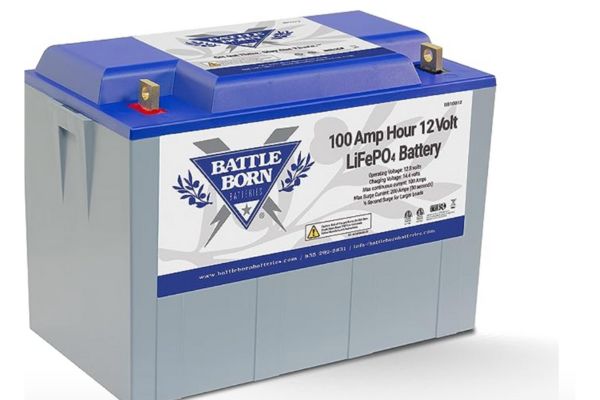
The LiTime, like the Battle Born, battery has a built-in Battery Management System (BMS) that performs a number of functions that are critical in protecting the health and longevity of the battery.
Nonetheless, the price of a LiTime battery was not too much more than a decent-quality lead acid battery, especially when I balanced it against all the benefits of an RV lithium battery upgrade.
With their longer lives and greater energy efficiency, lithium batteries actually are less expensive than lead acid batteries. And they perform better. But there is undoubtedly a bigger initial cash outlay.
In my mind, the extra cost of the LiTime batteries is well worth it, although, at $700 times two for Battle Borns, I would have had to think twice.
Stay tuned for a full review of my LiTime lithium batteries coming up. As I write this they have only been installed a few weeks. So far, so great. But I want to use them a while before doing a review. (UPDATE: Find that review of LiTime batteries here.)
RV lithium battery upgrade: More than just swapping out batteries
OK, my new lithium batteries were on the way and I had a service appointment to have them installed. I needed to get educated quickly as I knew nothing about this topic.
It did not take long to discover I needed more than just the batteries, especially as I was installing the new lithium batteries on an older travel trailer.
One of the first things that needed replacing was my trailer’s converter, as the one I had was not optimally compatible with the new batteries. At first, as I was wading through the oceans of information about lithium battery upgrades, I mistakenly thought I needed a separate battery charger. But it is the RV’s converter that does this task, so no lithium battery charger is needed.
Note that newer RVs are often already wired for lithium battery upgrades from the factory, so your converter may or may not need changing depending on the RV you have.

I also had to install a DC-to-DC charger, as the current amount of power delivered to charge the batteries while driving would be insufficient. I ordered one from LiTime.
The specialist who installed the new equipment for me mentioned that this was his first time working with LiTime products and he was impressed. He especially loved how easy LiTime made their DC-to-DC charger to install and use. In fact, he said it was all “plug and play”!
That’s because the LiTime DC-to-DC charger comes equipped with an ACC wire, a solar input terminal, a DC input terminal, and an output terminal to enhance the operational efficiency of the solar, alternator, starting battery, and service battery.
 In addition, I purchased a battery monitor with shunt. I LOVE this upgrade. Previously all I had to check for battery levels were the monitors that came with my RV. Those provided only 4 choices, charging/full, medium, low, and dead.
By contrast, LiTime’s battery monitor tells me exactly how much battery power I have on a scale of 1 to 100. The display includes battery voltage/current/power/capacity, remaining charge/discharge time, charge/discharge indicator, and capacity percent. It even has a backlight for easy use at night.
No rooftop solar? No problem!
 Most RVers installing an RV lithium battery upgrade have solar panels installed on the roof. If you have this, celebrate—as your batteries will be continually charging whenever there is sunlight.
My older travel trailer does not have rooftop solar. I wondered if I could charge my new lithium batteries through portable solar panels. Yes, indeed! The 200-watt panels that came with my Ugreen PowerRoam 1200 portable power station work just fine for this purpose!
If I did not already own portable solar panels, I would have added some to my lithium battery upgrade budget. Or if I had an RV I thought I would be keeping for a long time, I would consider getting rooftop solar installed.
Also note, while my Ugreen portable solar panels work fine, my Jackery solar panels do not as they are made to work only with Jackery products. (Another point for Ugreen over Jackery, in my opinion.)
Want to keep your lithium batteries when you sell your RV? No problem!
One of my initial hesitations in doing an RV lithium battery upgrade is the fact that I do own an older RV and I don’t intend to keep it for more than a season or two more.
Dave Solberg’s advice was, “Take the lithium batteries with you for your next rig and just replace them with lower-cost lead acid batteries when you go to sell it.”
But what about the converter and DC-to-DC charger changes? Would everything still function properly if I switched my RV back to lead acid batteries?
Yes! Apparently, these are all backwards compatible, meaning it is easier to switch from lithium back to lead acid than the other way around.
Benefits of upgrading to lithium batteries in your RV
- Less weight. In the case of the LiTime batteries I had installed in my travel trailer, they are 1/5 the weight but the same power as a 12V 200Ah lead acid battery.
- They offer far higher energy efficiency than lead acid batteries, resulting in significantly less charging time, better overall energy retention, and a longer battery lifecycle.
- Lithium batteries have far fewer self-discharge issues than their lead acid counterparts, which results in a longer lifespan.
- While you can damage a lead acid battery’s life by depleting it below 50 percent, that does not happen with lithium batteries. They can discharge to zero, although this is not recommended. But discharging down to 20 percent presents no issues whatsoever. The bottom line is you can actually use more of the lithium battery’s energy than you can the lead acid’s.
- Lithium batteries don’t require much maintenance overall. For instance, there are no water levels to check or corroded posts to clean. Even while your RV is being stored, all you need to do is simply engage your RV’s battery disconnect switch and that’s it.
Is an RV lithium battery upgrade worth it?
All this may seem like a lot, but it really wasn’t bad. What took me the most time was learning.
Like everything else when it comes to RVing, it depends on how you use your RV. If you spend most of your time at RV parks with full hookups, you probably do not need a lithium battery upgrade. But if you like to boondock, to my mind it’s the only thing that makes sense.
RELATED
- Review of LiTime lithium batteries after using them for four months.
- Want to upgrade your RV to lithium batteries? Read this first.
- RV lithium batteries: Fact versus fiction
##RVT1129;##RVDT2585

We went from 400 Ah of AGM wet cells to 800 Ah of LifePo4 and will never go back. The deeper discharge capability in itself provides more capacity but the higher amperage rate which reduces charging time was the huge plus for me. We got more than double the battery reserve that recharges in half the time and half the cables in the same footprint as the 4 batteries. No corrosion, no gassing, no acid cable ends turning green, just power.
Yeah, your system needs to be lithium capable to maximize the benefit of your investment but it’s well worth it. I’ll never use FLA house batteries again, they’re just not worth it even if they were given to me.
Spot on Cheri,
The importance of researching and understanding the process of upgrading to lithium iron batteries cannot be stressed enough. Too often the consumer is just given a battery and told it’s plug and play. As you learned, it’s not that simple. However, with a little planning, upgrading to lithium can be a wonderful experience.
I commented about six months ago that I was replacing my 4 x Trojan AGM batteries with 2 x 230ah LiTime lithium batteries.
So far they have performed flawlessly! They appear to be very sturdy, and I even used some of the styrofoam packaging material to insulate them in my existing battery boxes. There are temperature cutoffs to prevent charging or discharging in very cold weather, but no issues for me even living in Canada. I left for the Southwest in late November when it was just below freezing.
My Montana 5th wheel converter and Redarc 50 amp DC/DC charger were easily switched over to Lithium settings for optimal charging on the road or on shore power.
Very happy.
Great article, Cheri. I’ve been looking for a realistic article with cost estimates for quite a while. It was very informative. You’ve encouraged me to do the upgrade.Thank you so much.
Thank you for recounting your experience, Cheri! Very interesting, informative, and helpful account. I hope that you continue enjoying your upgrade! Have a great weekend and safe travels!
I upgraded from two 100ah LI batteries to two 300ah LI Time batteries. Great price and they work very well. I also upgraded my inverter to 3000w. I have 1000w of solar.
What was total cost?