

By Cheri Sicard
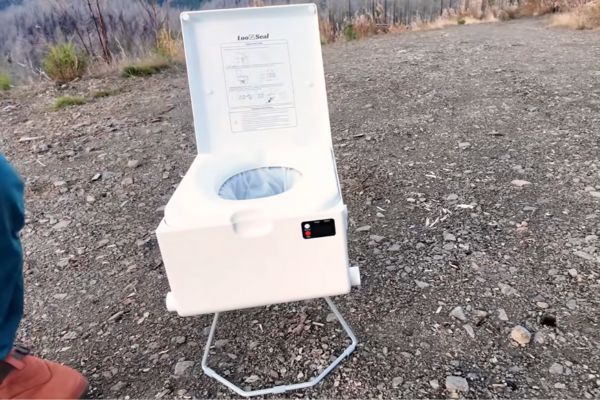
After years of using bags, a cheap bucket, and a collapsible toilet, Kelli and Greg from Explore Trek Adventure ended up reviewing something they never expected: a high-tech toilet, the Modiwell Dry Flush Toilet.
They share their thoughts in the video at the end of this post.
Quick look: What the Modiwell is and why it’s different
The Modiwell is a portable dry flush toilet that uses no water. It seals waste into individual biodegradable bags, so there’s no tying off, squeezing air out, or hoping a knot holds.
Here are the main specs:
| Spec | |
| Weight | About 17 lbs. |
| Weight capacity | Up to 350 lbs. |
| Power | Rechargeable battery, rated for up to 100 flushes |
| Flush cycle time | About 100 seconds per seal cycle |
What comes in the box
The kit includes the essentials to get started:
- Manual
- Absorbent (coagulant) packets
- Biodegradable bags (corn-based, available in black or white)
- A small tool used to feed the bag into the rollers
- Mounting brackets and hardware for hard-mount installs in a van, RV, or tiny house
They also noted that refill packs are sold separately, and the Modiwell refill bags are around $50 for 60 flushes on Amazon.
Set up and first impressions
The legs were the big question at first. They looked like they might feel flimsy, but once snapped into place, the toilet felt solid. When the legs lock, the trap door mechanism is engaged, so waste drops into the bag area below.
The body feels like heavy-duty plastic. It also has rubber feet on the base to help protect the flooring when it’s set inside a van. The leg ends are plastic, and they said rubber would’ve been nicer.
The lid stood out right away because it’s a slow-close lid, which is a real upgrade over a bucket setup.
Loading the bag system (the part that matters)
To load it, they removed the lid and center ring, then wrapped a fresh bag around the rim. The key detail is that the arrows on the bag need to point up. After pulling the bag into place, the included tool helps push the bag down into the rollers.
Once powered on, holding the start button begins the cycle. The rollers pull the bag down, and a heated sealing bar closes it off. A countdown timer shows how long is left.
Seal test: simulated “worst-case” and no leaks
For the first test, they used simulated waste and added a lot of extra water on purpose. They skipped the absorbent packet to see if the seal alone would hold liquid.
After the cycle, the bag dropped as a sealed package. The seal looked wide and firm, more like a thick band than a small pinch. They flipped it upside down, and it didn’t leak. They also mentioned white bags show everything, so black bags may be nicer day-to-day.
On a flat surface, the toilet felt steady. Greg put full weight on it (184 lbs.), and it didn’t wobble or flex in a worrying way.
Inside their Winnebago Revel, it took a noticeable chunk of space, but it still looked usable for real van life. After use, the screen goes dark, but a small flashing power indicator remains, and the instructions say to power it off between uses. It folds up easily, and it can be stored on its side, although the side “nubs” may call for a foam pad or smarter storage spot.
Comparison to a bucket toilet and a collapsible toilet
They’ve used both extremes:
- Bucket toilet: cheap and simple, but bulky, and nobody wants to pack gear inside a “poop bucket”
- Collapsible toilet: packs small and includes a carry case, but feels fragile and less stable
They also mentioned avoiding cassette toilet cleanup. (Their van has a cassette-style toilet, like the Thetford cassette toilet.)
They also tested the coagulant. The packet label warns not to eat it and to keep pets away from it. In the test, the liquid gelled up fast, and the sealed bag came out with no liquid sloshing around.
Price, who it’s for, and the main takeaway
The couple didn’t dodge the big issue: This toilet sits in a very different price range than a bucket. Between the unit and ongoing bag costs, it makes the most sense for full-time van life, boats, tiny houses, or long trips where clean handling matters.
For occasional campers, they said it’s probably overkill.
For storage, there’s also a Modiwell carry case made for it, which they planned to pick up for protection. There’s even a car kit power supply, 12V cigarette lighter adapter with 5-ft. cable.
In the end, Kelli and Greg came away impressed with the build, the seal quality, and the no-water design. The big question they left viewers with is simple: Is this what camp toilets will look like going forward?
Learn more about the Modiwell Dry Flush Toilet.
RELATED
- How to use your RV toilet even in winter
- The top three cassette toilet objections—myths busted!
- Comparing two popular composting toilets for RVers
- How to replace your RV toilet
RVDT2808
Thank you, Cheri, for the link to the video and summary. This is a reminder of how old and self-indulgent I have become. 😉 However, I am hopeful that there are many RV Travel readers (far younger?) for whom this is exciting (not merely interesting) news. 🙂 Have a great day, grand 2026, and safe travels!
I have a Modiwell toilet. Used it all summer on a trip to Alaska. Biggest reason we got it was so we could easily take it out of the wet bath to shower with more room (not possible with the original composting toilet).
Modiwell support was excellent!
We ran into only one issue: when below 50F and peed in by two people all night, the weight was too much and the white bag would stretch away from the hot seal, leaving holes. If we supported the bag by hand or advanced the bag to rest on the floor, the seal was good.
The original blue bags did not have that problem but did not block odors as well. Which is why they switched to white bags. Now they sell blue, white, and black.
Thanks for the real life experience feedback!