

By Cheri Sicard
A lot of folks have a lot of confusion over 4 seasons RVs. One of our readers’ favorite RV vloggers, Josh the RV Nerd, is here to set the record straight. Josh has been fielding a lot of questions on the topic, and he says the public is regularly being misinformed.
Josh says the RV industry throws around terms like “residential” and “4 seasons” haphazardly, which has led to a lot of consumer confusion and misinformation.
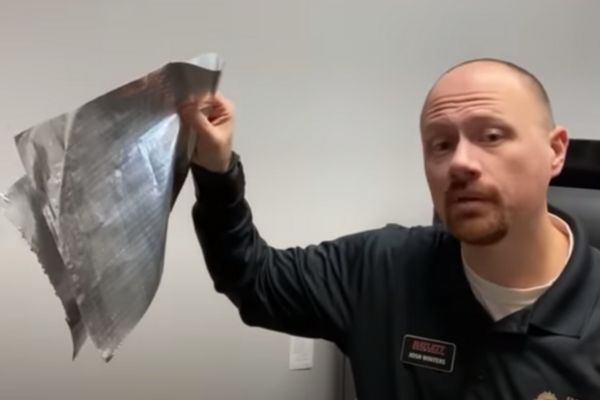
Some of this confusion starts with radiant foil insulation. There are two types: a single layer and a double layer that sort of resembles bubble wrap with air in the middle.
Josh says the RV industry is not always honest about this component and he gives an example of a single layer that was supposedly rated R-38.
Josh says it’s not, and he gives documentation in the video description on YouTube that proves it. There are independent sources that evaluate such things. Most shocking, the piece of radiant foil they claimed was an R-38 is, in reality, an R-0.
Who calculated that? Based on what? Josh says while he is not trying to start a war in the RV industry, there are no standards, and these important details and claims are never explained.
So, what is an R-value anyway?
R-value measures how well insulation can prevent the flow of heat into and out of the RV. The higher the R-value, the better the insulation performance.
However, Josh says there is a difference between what an R-value is and what a radiant barrier is. He believes a lot of the RV industry’s exaggerated R ratings are due to people, including those in the RV industry, not understanding that difference.
The radiant barrier is not insulation in the way we typically think of it. This is not to say the single-layer radiant foil doesn’t have value, it just works differently than insulation.
Yes, the single-layer radiant foil is able to reflect up to 97% to 98% of the heat from a source, but it does not work that way over time. Josh gives a great example of a baked potato wrapped in foil. Sure the foil protects the potato, especially at the start of baking, but plenty of heat still gets in and eventually the potato cooks.
Josh says the best way that he can describe the function of single-layer radiant foil is as a “burst exposure resistant.”
Be sure to watch the video as Josh completely busts through the myths the RV industry likes to spread about R ratings. Doing so can help you make more informed decisions when looking at “4 seasons RVs.”
RELATED
##RVDT2197
This is something I’ve spoken about since I got my camper last year and learned just how inflated the numbers manufacturers state are. It’s nuts that they’re allowed to claim such unrealistic R values with no testing or proof. According to Grand Design the average R value of camper (walls, ceiling and floor) is about 18. Based on A) realistic numbers for the materials and B) actually seeing how much heat it looses in different temperatures a more realistic number would 7.
Despite that, I was able to maintain 70 with an outside temperature of -12 and windchills approaching -30 over this past winter because the furnace is strong enough to overcome the poor insulation. It actually beat their claims that it could maintain 70 as low as +15 by nearly 30°. Instead of using these crazy, inflated R values I’d much rather see manufacturers competing based on measurements like that, this RV can maintain 70 inside anywhere between 100 and 0 or something like that. It would also be an easier to understand number for consumers who often don’t really understand what R values mean.
I agree. I had never heard of R values until recently and had to look it up. And what Josh says here makes a lot of sense. Although he gives the industry much more of the benefit of the doubt than I do. Maybe some are ignorant, but I would say those at the top know they are misleading.
Dan
There is no way an rv has r18. Foam insulation is about an r6.5 per in. It would take nearly 3 inches of foam. Then there is wood with an r value of 1 per inch. Any framing would reduce the overall r value. Fiberglass insulation is about r 4 per inch. Fiberglass loses a lot of its r value from air leaks. Regardless of the material its as much the assembly that determines its effectivness.
Windows are probably in the range of r 2.
Radiant barriers, think of foil, reflect radiant heat. To be effective it has to face an air space otherwise its a conductor.highly unlikey that is faces an air space.
Then there is air leakage which degrades insulation. Air leakage around a radiant barrier renders its useless.
An rv ac is about 13500 btus. A 1 ton ac is 12000 btus. You are using over a ton of ac to cool 2-300 sf. A 1200 sf home with basement in my area using 2 tons. That give you an idea of how poorly rvs are insulated.
Look into Rockwool insulation. For the small additional cost it is superior in every way, to fiberglass insulation.
Finally the truth is out!!!! reflectix claims to have a R14.5 rating, depending on installation…. hahahaaaaaa…. but the stuff works great in windows to reflect the uv rays and radiant heat. makes a huge diff in RV windows. putting it inside a wall? My own estimate is R6 per inch, keep in mind that most brands are 5/16″ thick so it will take 3 layers to achieve that. it is more cost effective to use plastic backed fiberglass and tape the seams. The problem is that the aluminum frames pass the heat and cold through the walls because both the inside and outside panels are not insulated from the framing members. 3″ thick RV walls are rated about R9, 4″ thick roofs are R12. RV insulation is awful, they are not designed for full time living. Park Models or as I call them coffin homes are insulated just like a house that has 2×4 studs R13.