

By Cheri Sicard
Many camping setups force a trade-off. Bring a trailer and deal with towing, or mount a rooftop tent and give up roof space (and sometimes the ability to quickly drive off once camp is set).
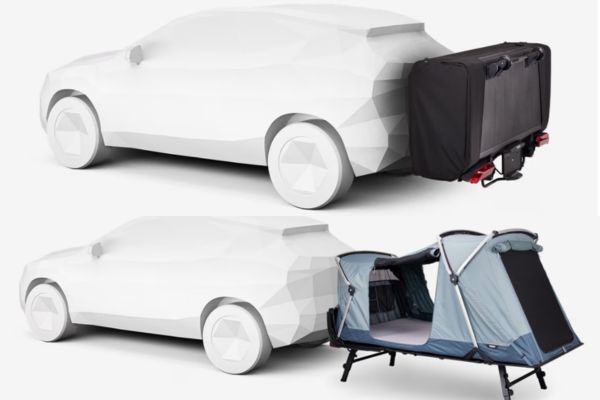
The Thule Outset takes a different route by mounting a foldable tent at the back of the vehicle on a hitch setup, not on the roof, and not behind the vehicle as a trailer. That simple change opens up a few practical wins for campground life.
In the short video at the end of this post, Patrick Botticelli of New Jersey Outdoor Adventures shows us how it works.
What makes the Thule Outset different from a rooftop tent or small trailer
The Outset is designed as a hitch-mounted camping tent. Instead of towing anything, the tent unit slides into a rear hitch receiver, then opens into a raised sleeping area.
Compared with common options, the idea is pretty straightforward:
- It isn’t a trailer, so there’s no towing.
- It isn’t a rooftop tent, so there’s no roof install.
That matters in day-to-day use. A trailer adds length and storage headaches at home, while a rooftop tent can take up the exact spot where many campers carry boats, cargo boxes, or bike racks.
The setup shown centers on a compact box on a small platform. The platform can be disassembled, then the whole unit rolls into position at the back of the vehicle. Once it’s in place, the tent opens up from that box, giving a raised sleeping area instead of a ground tent layout.
How it mounts, and what set up looks like at camp
Thule describes the Outset as the first tent on the market mounted on a hitch ball. In the clip, the main point is how the tent slides into the rear hitch receiver area and sets up without messing with the roof or pulling a trailer into a site.
The quick setup sequence looks like this:
- Slide the platform into the rear hitch receiver mount.
- Roll the tent box into position.
- Open it, and the tent is ready for the night.
The emphasis here is speed and simplicity. It’s closer to unfolding a compact unit than building a tent with poles and stakes.
Sleeping off the ground, with a campsite that can stay put
Because the tent sits on a platform, sleepers stay off the ground. That can feel like a nice middle ground between a rooftop tent and a regular ground tent, especially in wet conditions.
Just as important, the vehicle doesn’t have to stay stuck at camp. Once the Outset is set up, the tow vehicle can detach and drive into town while the tent stays standing at the site.
Thule also calls out a key benefit for camping trips: There’s no need to fold the tent down just to use the vehicle.
Keeping the roof free for boats and bikes (and skipping trailer hassles)
One of the most practical benefits is what doesn’t happen on the roof. With a rooftop tent out of the picture, the vehicle can still carry larger gear up top, like canoes, kayaks, and bikes.
On the other hand, the Outset also avoids the usual trailer problems. There’s no towing stress on tight roads, and there’s no extra trailer to store when the trip ends.
Weight is listed at around 154 lbs.
The one downside? For a tent, it’s a bit pricey with an MSRP of $4,699.95.
Final thoughts
The Thule Outset stands out because it changes where the tent lives—right on the hitch instead of the roof or a trailer frame. That opens up a flexible routine at camp, since the vehicle can drive off without tearing anything down.
For campers who want a raised sleeping setup but still need roof space for gear, the Outset is an interesting direction.
Learn more about the Thule Outset here.
RELATED
RVDT2854
Cool idea. I’d be worried about blocking the tail lights though.
It appears to have it’s own lights on the rear.
I regret I no longer use my “Air Camper” cartop tent from the mid seventies, but it makes a lot more sense than your bumper mount tent.