


Dear Dave,
I have four 6-volt deep cycle batteries that are due for a change. Could you please tell me the most economical way to switch to a lithium system? —Jeff, 2016 Tiffin Allegro Open Road 34PA
Dear Jeff,
Your Tiffin most likely came with four Trojan 6-volt batteries connected in series and then parallel like this photo:
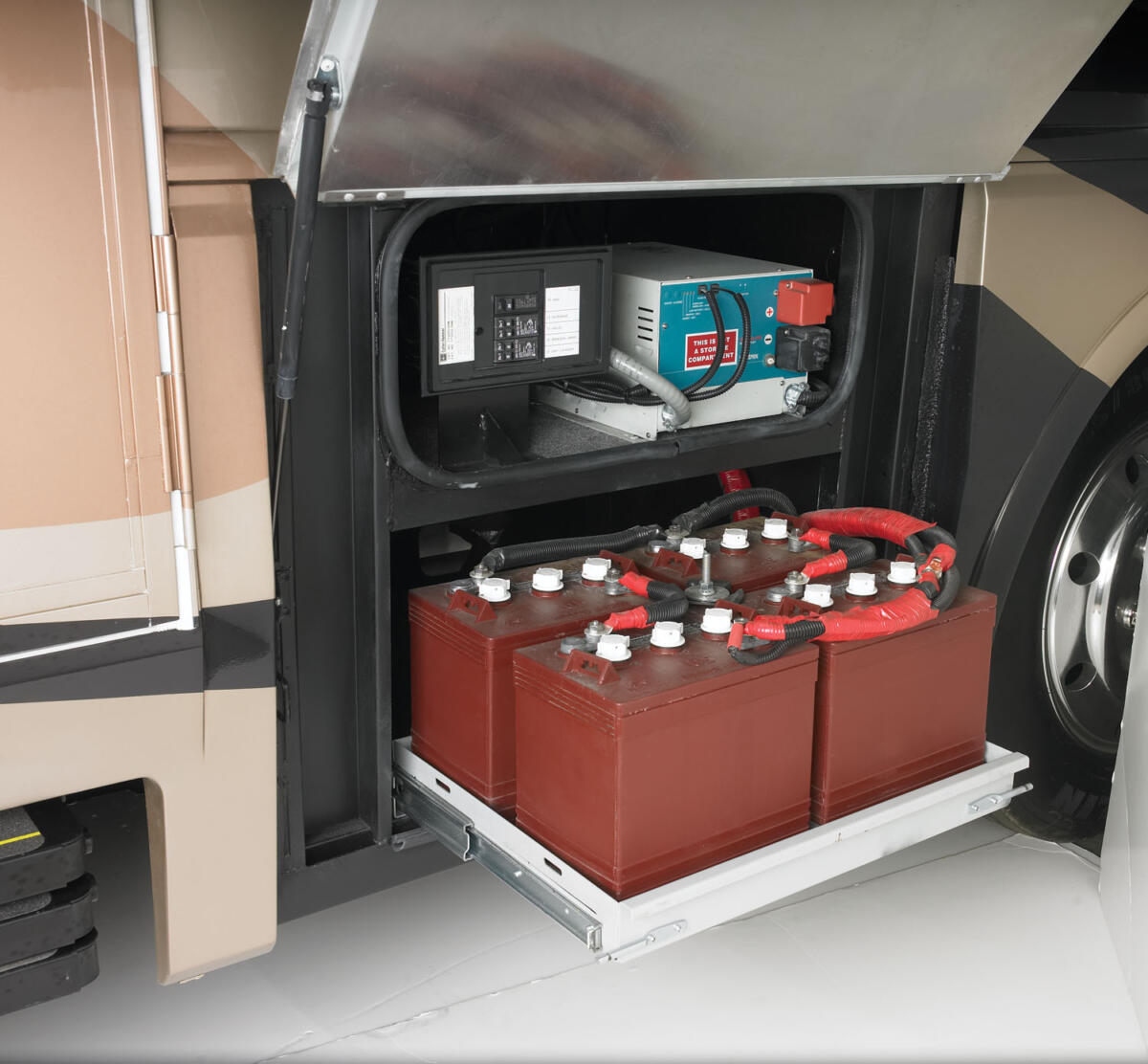
Batteries connected in series and parallel
With this battery bank, you should have at least 285 amp hours (Ah) from each battery. However, they would be connected in series, which is two batteries connected positive (+) to negative (-) providing 12-volts, but not doubling the Ah. The second two would be connected the same way.
Then the (now) two 12-volt battery banks would be connected in parallel. That is one positive post in the first bank connected to the positive post in the second, and the negative connected in the same manner. This would still provide 12-volt power but then double the Ah from the two banks. That means your rig would have 285 Ah X 2 or 570 Ah of available 12-volt power.
However (I use that word a lot!), since they are flooded lead acid (FLA) batteries, you should only drain them down to 50% State of Charge (SOC). That means you actually have 285 Ah power available.
Lithium iron phosphate (LiFeP04) batteries can be drained to almost 100% SOC. So, you could replace the four 6-volt batteries with three 100 Ah lithium batteries, or a single battery that has 300+ Ah.
Questions to be addressed
There are several questions that need to be addressed, with the first one being: How much power do you need? If you are going to be dry camping or boondocking for longer periods of time, you will need to calculate the power consumption of 12-volt components as well as any 120-volt ones that will be powered by the battery bank through an inverter.
High consumption appliances such as residential refrigerators will drain the batteries very quickly, especially if they have an auto defrost feature. The propane (LP) furnace also is a huge draw due to the fan running and drawing 12-volt power.
I would assume you already have a fairly good idea of your power requirements from using the unit with your current 6-volt battery bank and most likely it was not adequate as you are looking to upgrade.
Calculating power requirements
To help calculate power requirements I like to send owners to the Go Power! resource center and their solar calculator. It’s not a perfect science but does get you started in calculating what will be running and for how long. This will not only help identify the battery bank you need, but a recommended solar panel system to help recharge if you don’t already have one.
Selecting battery brand
Next is selecting the brand of battery. That can be confusing as it is hard to tell what is inside some of the “cheap” batteries that are flooding the market from overseas manufacturers.
I have posted several articles regarding what to look for, and cheap is not always the best. However, I have seen the price of what I feel are the better-quality batteries come down to a reasonable price. I would suggest taking a look at this three-part article on lithium battery quality. [That link goes to part 3, and parts 1 and 2 are linked at the beginning of the article.]
Why type of charger does your RV have?
Then the last question is: What type of charger does your Tiffin have? Typically they used an inverter/charger with the four 6-volt batteries. It might not be compatible with lithium. Most lithium batteries want 14.6 volts for approximately 2 hours. If you do have an inverter/charger, it is most likely a multi-stage charger that puts out higher voltage for a bulk charge. It also has a battery management system (BMS), which is the battery’s computer and will shut down the charge to protect the batteries.
Check your charger to see if it has a lithium setting. If not, you will want to get a new charger such as the Go Power! GPC-45 like this one on Amazon.
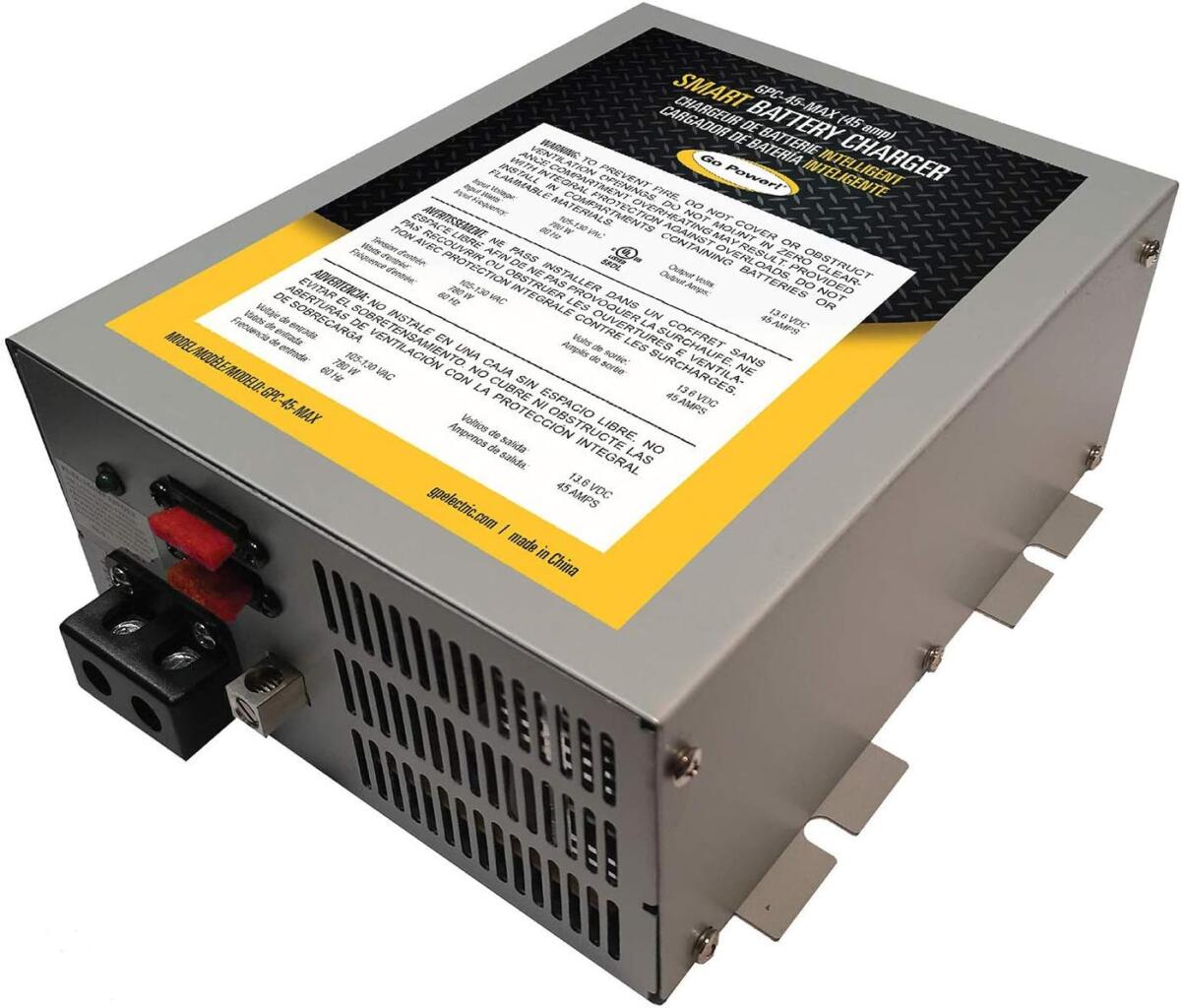
Prices are coming down
Some good news is that prices are coming down. Lithium batteries that were once $1500 for a 100 Ah battery are now listing for $900, and the chargers are only about $200. Plus, they have a 10-year warranty backed by companies that have been in the RV business for many years, so I feel confident they will be there for many more.
This may not be the cheapest, but it is what I feel is the best value for long-term RVing.
You might also enjoy these posts from Dave
- What is your opinion of these new lithium batteries?
- What monitor do you recommend for lithium batteries?
- My RV’s “larger” batteries are dead. Can I replace them with lithium?
- Can different type and age RV batteries be mixed? Can I add a lithium battery?
- Will RV’s house batteries ‘play nice together’ if I replace chassis battery with lithium?
- Will my RV’s charger be sufficient for new lithium batteries?
DAVE HAS ANSWERED MORE THAN 1,000 readers’ maintenance and repair questions. Read a directory here. There is so much to learn!
Dave Solberg is a leading expert in the RV industry and the author of the “RV Handbook.”
RVDT2770

Dave, could you also address what needs to be done to the motorhome’s Battery Isolation Monitor (BIM) to keep the lithium batteries from damaging the motorhome’s alternator? Most likely the current BIM was not designed to protect against the high draw of the lithiums.
It’s a pretty common practice to install a DC-DC charger in LiFePO4 battery systems. It both regulates the power draw on the alternator, and boosts the voltage to the 14.4 – 14.6 range needed to fully charge lithium batteries. If you prefer a BIM, there are lithium-specific models available.
Where are you seeing 100Ah batteries for $900? Even BattleBorn isn’t that expensive now. You can get a high quality – USA built and serviced, 300 – 315Ah battery like an SFK for around that price. https://www.sunfunkits.com/
Check them out and I think you’ll be impressed. Everything you could possibly need to know about your battery is right on the side of the case, and in the owner’s manual. You can call and talk with the owner and the people who build the batteries. Their comprehensive app makes it easy to monitor your batteries.