


Hi, Dave,
I want to know how can I find my RV’s fresh water tank drain. To fill it up is easy. But when I want to drain it out for the winter, I can’t find any semblance of a tank drain anywhere near it. The way I’ve done it so far is to run my water pump and open up the valves to drain it. If that’s the way to do it, so be it. But, that doesn’t make sense to me. Thanks in advance! —Lou, 2021 Fleetwood Fortis 33HB
Hi, Lou,
I have not found any unit that did not have some type of drain valve to empty the fresh water tank, although some were very hard to find. According to RVIA (Recreation Vehicle Industry Association) code, every unit must have a low-point drain for the hot and cold. It is outlined as a procedure for final inspection in the RVTI (RV Technical Institute) training certification.
Fleetwood fresh water tanks
Typically, Fleetwood located the fresh water tanks between the chassis rails, and they are notoriously hard to get to. I found a copy of your owner’s manual on the Fleetwood website. It shows there is a hot and cold drain line located in the service compartment.
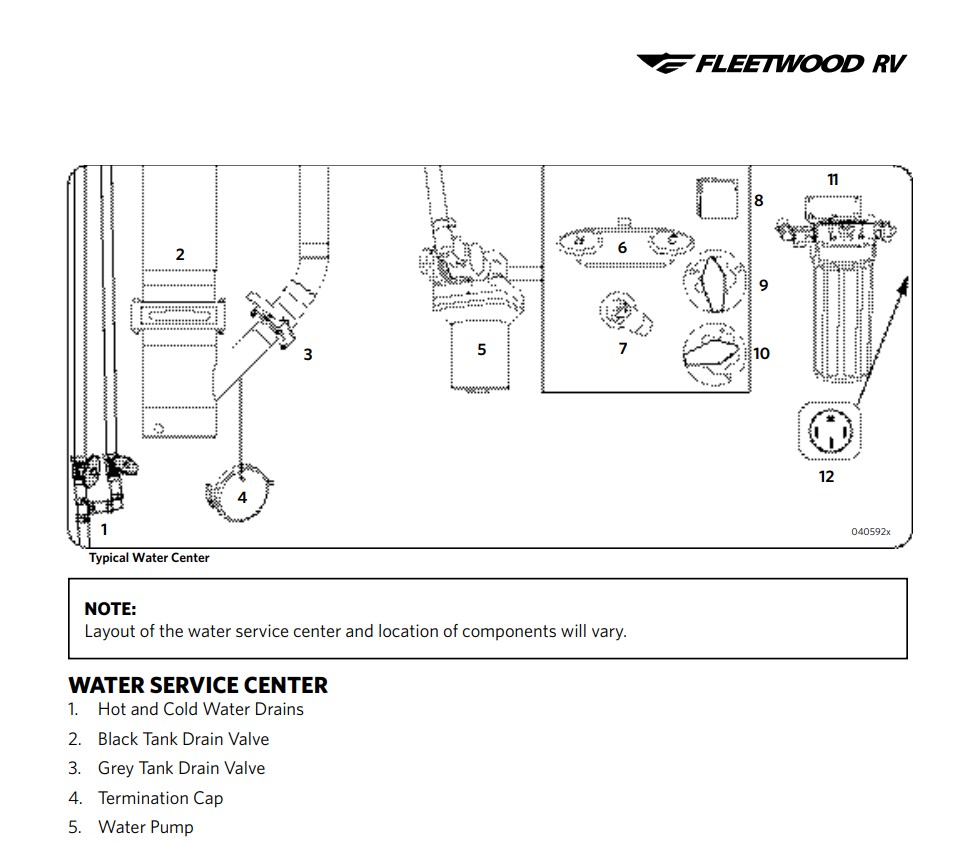
These are 1/2″ PEX lines with a small valve, so it will most likely drain about the same speed as turning on the pump and opening the valves, as you have been doing. Some RV manufacturers install 1 1/2″ piping with a larger valve to drain the large volume fresh water tanks faster.
I did some searching on the internet and found a picture of a service center that should be what yours is like. Notice the red and blue PEX lines going down to valves in the middle of the compartment.
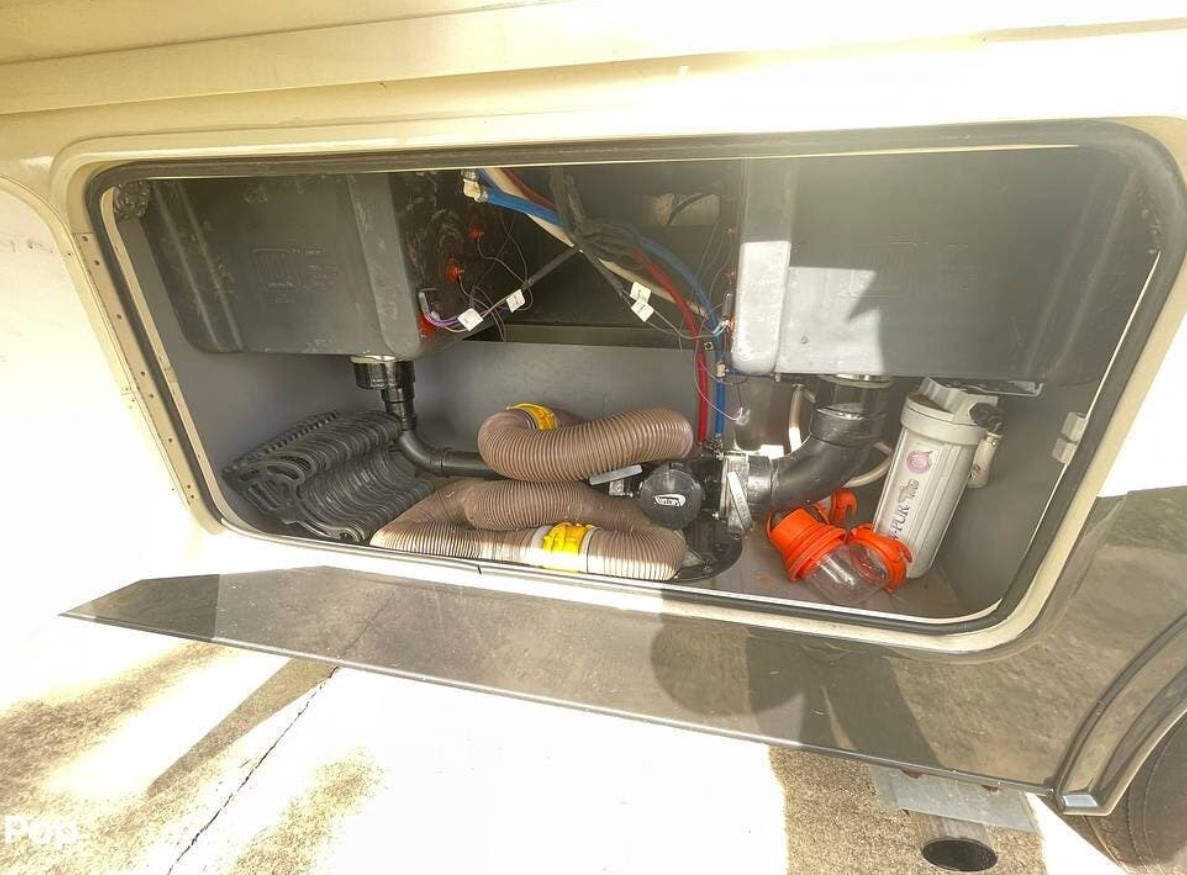
These are the hot and cold lines coming off the fresh water tank and from the water heater. You should be able to drain the water heater faster by removing the drain valve on the back of the water heater directly. However, still open the red pipe valve to get all the water out of the piping. Also, do not start up the water heater in the spring on 120-volt mode without water in the tank or you will burn out the heating element.
Another way to find low-point drain for RV fresh water tank
Another way to find a low-point drain on just about any unit is to look underneath and find the pipe sticking out the bottom. Sometimes there will be a valve directly above inside the unit; other times there is a cap on the pipe.

*****
You might also enjoy this from Dave
Your RV’s fresh water system: What you should know
This is Part 5 of Dave Solberg’s “Everything you need to know about RVing” series. In this installment, Dave looks at RV fresh water systems and tells you just about everything you need to know about them, whether this is your first or 101st trip.
Dave Solberg is a leading expert in the RV industry and the author of the “RV Handbook.”
Read more from Dave here.
HAVE A QUESTION FOR DAVE?
Send your inquiries to him using the form below.
##RVDT2461

My Outdoors RV Back Country has a large fresh water drain that even Ray Charles could see…easy to see and operate.
Our 2012 Arctic Fox probably has the same large water drain. It’s up by the rear axle and when I pull it (same type handle as on the black/grey tank), I have to quickly move to not get soaked.
Thank you, Dave! 🙂 I appreciate your willingness and ability to find manuals and diagrams that others cannot. Thank you for having the patience and willingness to look until you locate them! Have a great week, safe travels, and safe stays! 🙂
I have a low point drain for my fresh water tank but searched hi and lo for the low point drain for the main water system on my Heartland Bighorn 5th wheel. I phoned Heartland and was told by their tech department that my RV doesn’t have a main low point drain. No problem. Just worked around that. I use air at 50 psi then a cup of anti-freeze in each P-trap and in the toilet.
People need to know that there are 2 types of freshwater drains. The first one you described only drains the hot and cold plumbing that connects to all plumbing lines to the faucets’ toilet, water heater etc. It does not drain your freshwater tank. There is usually another valve located near/under your freshwater tank/s. This will drain the actual freshwater tank but won’t drain the plumbing inside the RV. You need to find and become familiar with the two types. And like one of the posters stated, when opening the hot and cold low point drains, you can apply air pressure to a faucet which will help get the last of the water out of the lines. Especially in hard freeze areas.