


This is Part 5 of Dave Solberg’s “Everything you need to know about RVing” series. Today, Dave looks at RV fresh water systems and tells you just about everything you need to know about them, whether this is your first or 101st trip.
Most new RV owners just jump in, take off, and take their fresh water system for granted. After all, how much different can it be than the one in their home? Actually, quite a bit different, as the system in a residential home is first conditioned by the city municipal water treatment plant to ensure it is pure. Also they make sure it has the proper pressure. Then, many homes have a water softener and filters so we can just turn on a faucet or jump in the shower and have an endless supply of hot and cold water. Well, maybe not endless supply of hot water, if my granddaughters do a sleep-over and use the shower!
In an RV, WE need to regulate the pressure from an outside source and use a filter as the hard water will clog pipes, pumps, and faucets. My folks went to visit my brother’s family in their new Class A motorhome and connected a hose to their outside faucet—only to find the floor completely soaked when they went to tuck in for the night! Unfortunately, most owner’s manuals and dealer orientations have very little information or tips regarding the fresh water system and what you can do to prevent leaks, clogs, and skunky-tasting or even contaminated water.
Water can be supplied by either a pressurized connection from a campground source, which is commonly called “city water,” or by the fresh water tank in your rig with an onboard water pump. Here is a typical setup for a trailer that has the city water connection with a 3/4” female connection that would fit most garden hoses for pressurized water.
Filling the RV’s fresh water tank

Water from an outside source provides pressurized water throughout the rig.

The fresh water tank can be filled by a gravity fill on the side of the rig using a hose from a potable or clean drinking water source. Check your gravity fill to see if the opening is large enough for a conventional metal hose end or if you need to cut off the fitting.

As you fill the fresh water tank, there is a small vent that allows air to escape from the tank, which can be seen in the above photo. Make sure this vent is clear and if the water flow is gushing back out of the gravity fill, turn the pressure down or check the vent hose as it could be kinked.
When the fresh water tank is full, excess water should flow out the overflow fitting or come back out of the gravity fill. However, it is a good idea to know how much water your fresh water tank can hold and keep an eye on the fill level either visually or by watching the monitor panel. If you fill the fresh water tank to full capacity, you add 8.34 lbs. per gallon to the carrying capacity of the rig. That can cause a swelling effect that could add pressure to braces and even the floor, if mounted underneath. It is a good idea to not carry a full water tank when traveling, and do some testing to see what issues might be caused by filling the tank to full capacity.
Pressurized water is supplied from the fresh water tank by the onboard 12-volt pump that is typically located close to the water tank. This is an on-demand pump that starts as soon as a faucet is opened.

As stated earlier, some models have a valve in the service department that will divert the city water to the fresh water tank. That way you can fill it with a simple turn of the valve rather than disconnecting the hose from the city fill and putting it into the gravity fill.

This is great if you always have access to a traditional faucet and hose with the proper connections. I spent five years on the road in demo units training dealers. For a few years, Winnebago did not have a gravity fill. The company thought everyone would be connected to city water and use the diverter valve. What I found was that many rest stops and campground fill stations had a potable water fill hose attached to a pole with a spring. The end of the hose was cut off and could only be used for a gravity fill.
RV fresh water system gadgets
You will need a “potable” water hose—one that is approved for drinking water and will not have chemicals or a plastic taste. It is a good idea to get one with a bend protector. I also like the quick disconnect, as some campground faucet angles are a real challenge.
This is the hose I recommend.

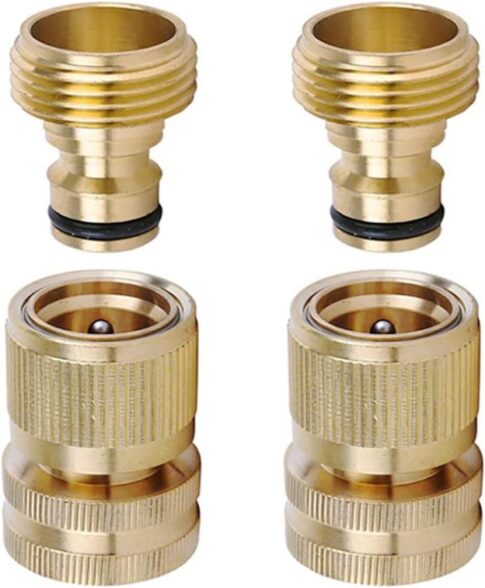
Most hose connections in the service center are awkward to get to and the hard water makes them tough to thread on. A set of brass quick disconnects (QD) makes the job a breeze. Find them on Amazon here.
Water filter
You will want a good filter connected to the water supply as the campground water supply is typically from a local well and is hard water with calcium, rust, lime, and other minerals that can clog up faucets and pipes in a hurry. You can find the filters I recommend along with a bend protector here.

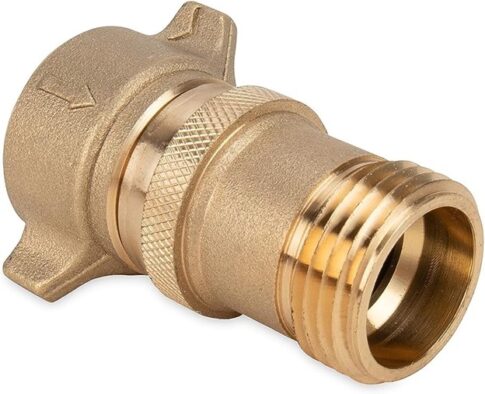
Water pressure from a campground source can vary from low pressure to more than 70 psi when your site is close to the well and pump. A pressure regulator is a must to make sure you don’t have a flood inside the rig. A standard version like this one automatically regulates the pressure to 40 psi, which most plumbing can handle. You can find it on Amazon here. If your rig has a higher-rated plumbing system, you can get a regulator that can adjust the pressure higher.
If you plan to do some cold weather camping, you will want a heated supply hose that has heat tape incorporated throughout the hose cover. It is available on Amazon. If you want to learn more about heated water hoses, click here.

Drinking water
Tip: Campground water is typically hard water and not good for drinking or cooking. It is a good idea to bring bottled water for drinking, cooking, and especially for making coffee or tea!
Campgrounds are required to have their well tested yearly for purity and items such as E.coli, arsenic, and bacteria. The MSDS (Material Safety Data Sheet) is posted in the campground office. However, it is a good idea to test the water yourself if you think it smells or looks bad.
Tip: A telltale sign of bad water is if a pet will not drink it!
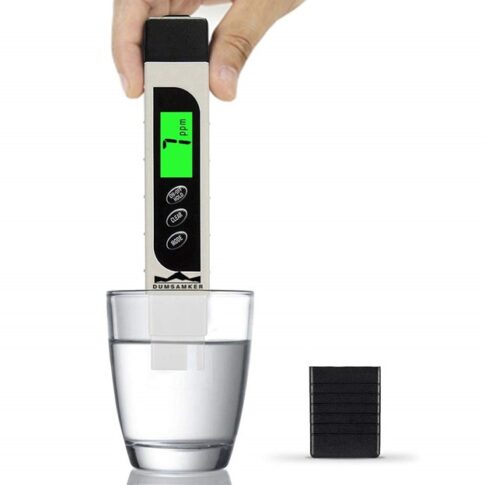
This water purity tester is a handy device to determine the purity of the water by particles per million. Simply pour some water from the campground source into a cup and place the tester in and read the gauge.
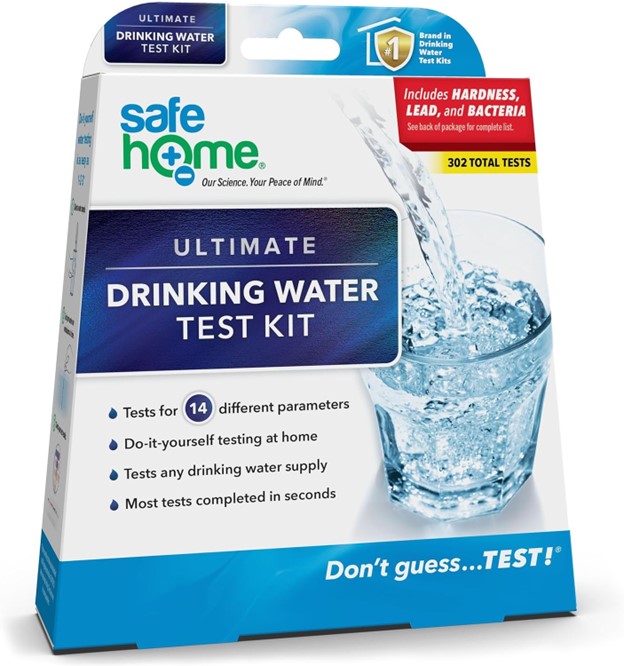
If you want to test further for specific minerals and chemicals, get the Safe Home drinking water test kit. It tests for hardness, lead, chemicals, minerals, and bacteria in any drinking water source.
Tip: Water weighs 8.34 lbs. per gallon and the cargo carrying capacity (CCC) in some RVs is very limited. If you have a 50-gallon fresh water tank, it will add more than 400 lbs. of weight to the rig! I recommend traveling with little or no water in the fresh water tank, but rather have a few “spare” gallons stored for an emergency toilet break that you can use to flush with. This will save weight and you can always fill up the fresh water tank when you get close to the final destination or connect to a city source.
Cleaning your RV’s fresh water system
Any water that sits in a fresh water tank or in the pipes for a long period of time can get a bad taste or even skunky, especially hard water from a campground source. It is a good idea to drain the fresh water tank between trips and periodically rinse it out. Some owners use a small amount of bleach mixed with a full tank of water and let it sit overnight. According to our local DNR and city officials, 1/4 cup to every 30 gallons will help sanitize and is diluted enough to safety and legally dump at an authorized dump station. You can also use vinegar mixed to the same proportions.
Another option is to use the Thetford Fresh Water Tank Sanitizer that has a cleaner and sanitizer. You can find it on Amazon here.

Did you miss the first 4 installments of this series? Here they are.
- Part 1: Tips to make your first RV trip more enjoyable: Pre-trip preparation
- Part 2: The ABCs of RV terminology: Every word and term you should know as an RVer
- Part 3: Powering your RV: Essential 120-volt electricity tips and gadgets for every RVer
- Part 4: Understanding everything about 12-volt house batteries
Dave Solberg is a leading expert in the RV industry and author of the “RV Handbook” as well as the Managing Editor of the RV Repair Club.
Read more from Dave here.
RELATED
- Small RV-sized Brita Water Filter Pitcher—fresh water all the time
- Stinky fresh water hose? Here’s the solution
- Can you use dump station faucet to fill your RV’s fresh water tanks? Should you?
##RVT1163
Hi Dave
I’m 100% in agreement with you about using a pressure regulator regardless of the type used. It is my humble opinion that a fixed orifice style regulator will equalize pressure downstream after the faucets are closed and some time has elapsed. I use an adjustable spring type regulator installed at the source to protect my hose and outside filter plus my potable water system. You have some great articles thanks.
I had been using the Camco water hose for years. One big problem was trying to roll it back up, especially in cool weather. Another problem was with the ‘plastic’ female end. It was very easy to cross thread on the hose bib and the thin metal on the male end was easily damaged.
I now carry a Flexzilla hose. Very flexible even in cold weather and the fittings are heavy duty anodized aluminum. The only problem I’ve found is the aluminum fittings seem to gall to the brass bib.
A little plumbers grease on the fitting stops the problem.
2 comments-
I use quick connectors. However, they are pinch points for water flow. If the volume of water flow in your RV is less than desired, try removing the quick connectors and see if it improves.
Dave, thoroughly enjoy your articles and insights. I have one I think does a little disservice to a lot of campgrounds by lumping them mostly all together with the comment their water is not good for cooking or drinking. Since 1985 i’ve only found 2 or 3 cg that had really hard water and/or off smell. Since a lot of campgrounds are on municipal systems they are almost always good. Our yearly hosting cg in Missouri ozarks has a great water supply, is tested daily and treated. I’m not sure your statement is fair to those that have good water which the number I think might be surprising! Thanks for your contributions to RVing!
Bruce,
I do apologize for lumping the good water campgrounds into the “pool” of bad water. There are many good and great campground owners and managers out there that do the right things. Just a good idea to be prepared and test.
Thank you, Dave! 🙂 Good stuff here! I have used this (https://a.co/d/05aYHjSL) in our fresh water tank without incident. What do you think about it? Thanks again, have a great week, and safe travels! 🙂
Hi, Neal. Out of curiosity, I looked up the TastePURE Drinking Water Freshener. It is a sodium hypochlorite (bleach) solution (12%). That reminds me of when my mom would store water in gallon jugs for emergencies. She would put, if I remember correctly (from 70 years ago!), 4 drops of bleach in each jug. Have a good evening/night. 😀 –Diane (the always curious one)
Hi Diane! 🙂 Cool. So, it is a time-tested treatment, huh? Well, that is extremely encouraging; thank you and good night! 🙂
Hi again Diane,! I just noticed that my comment with the link (above) was approved, but I got no notification of your comment, or Bill’s. Interesting. It is as if the approval notice eliminated any additional notifications relative to the approved comment. Hmmm, … I wonder if Kim agrees, or if it was just the internet burping or otherwise missing the comments? Oh well, good night. Gotta get up early to take Weagle to day-care so we can get a good day’s-worth of work done tomorrow. Good night! 🙂
I’m not sure how that technically works, Neal. I’ll see if Kim knows. Have a good night, and a productive day tomorrow. Don’t work too hard! 😀 –Diane
Good tip Neal, thanks !
You are very welcome, Bill! We happened to be at a campground in Trapper Creek, Alaska in 2019 and our next-site neighbor was from near where we’d lived for 26 years in Virginia. During our conversation, he showed me a bottle of the water freshener and recommended it. So, I am just passing along what I hope is useful information. 🙂 Have a great week, Bill, safe travels, and safe stays! 🙂
Will do, and the same right back at you !
(I’ll order the freshener in the next few days and see how well it works)
Thanks, Bill! 🙂 Will do! 🙂
I have not used this specifically but looks like it should work and has good reviews. I see Star Brite has a product as well as several that are popping up. Thanks for the tip.
Thank you, Dave! 🙂 You are very welcome! Have a great week, safe travels, and safe stays! 🙂
No, not a good idea to bring bottled water. It wastes plastic. Filtered is better. We have a filter under the sink and pour that water into Pur pitcher. MUCH cheaper.