

By Tony Barthel
Recently, Mike Sherman, previously a full-time RVer, made a very good case for the reasons to go big and have a larger RV. I saw that and, as a small trailer enthusiast, I wanted to share my thoughts on why I think small trailers have the advantage.
Simple minds
The first thing I have to clear up is that the RV industry is incredible. There is literally “something for everyone.” In fact, there’s almost no “right” or “wrong” answer. I’ve seen people adapt to all sorts of RVs.
The question of whether to go motorized or towable doesn’t have a single answer either.
There are as many reasons to do things as there are humans making decisions. What’s right for you is what’s right for you. But some people are shopping, based on the popularity of my RV review articles. So I thought I’d highlight some things that may not be immediately apparent.
Really obvious
But first, let’s talk about the obvious. Smaller RVs cost less than larger ones. That alone might be why some folks choose smaller RVs.
If you’re talking towables, which we are here, then there are circumstances where the vehicle required to tow a smaller trailer is far less expensive than one required to haul around a huge fifth wheel, for example.
Better mileage?
What may not be very obvious is the fact that RVs are horrible in the aerodynamics department. If you’re thinking of getting a smaller travel trailer to save fuel, keep shopping. One of the biggest factors in fuel economy in RVs is overcoming the lousy aerodynamics of a giant box. I get almost the same fuel economy, or lack thereof, no matter what is hooked to the ball of my pickup.
Size matters
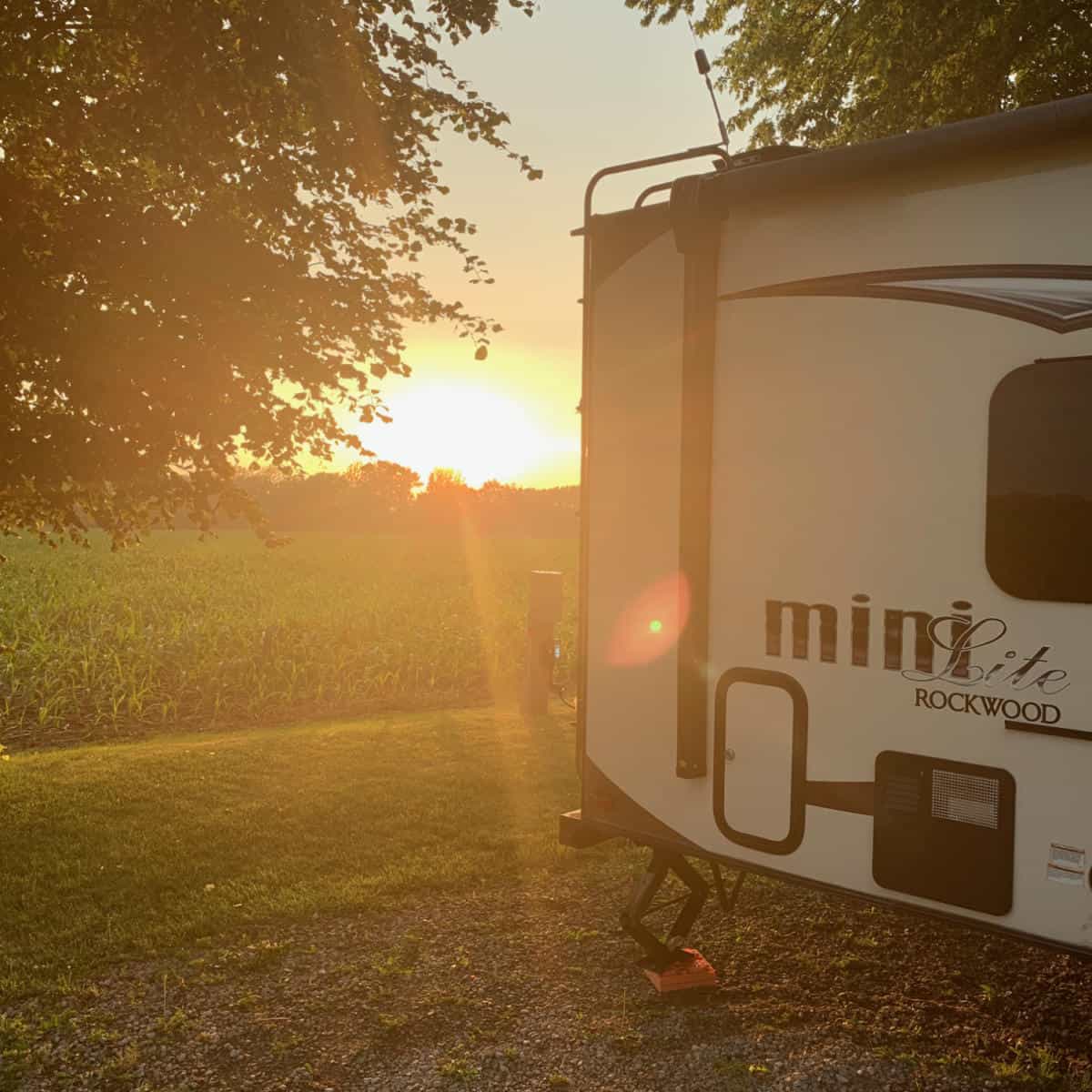
What I generally tow is a Rockwood Mini Lite 1905S. It is a single-axle travel trailer with no slides, just the way I like ‘em. We also have a 1970 Aristocrat Land Liner. Why?
Moochdocking in a small RV
I can easily camp in friend’s driveways along the way. Whenever I hit the road I get to visit plenty of my former neighbors and lifelong friends who have chosen to escape California for greener pastures outside the state.
Oftentimes these folks have just enough driveway that I can park my trailer in their driveway and spend a few nights without paying for an RV park. Furthermore, I get to do what I enjoy when I see my friends … see my friends.
This is also true of mooching, er, camping with family.
I don’t have to worry about traveling to an RV park in the dark and hoping I made it before they close the front gate. And, since many of my friends share my love of craft beer, if I’m sleeping in their driveway I don’t have to monitor how much of that we enjoy.
Typically when I do this I don’t impose upon them for any services whatsoever. We have a decent solar system on our trailer and we arrive with our holding tanks empty and fresh water tanks full. Other than my enjoyment of the people I came to see, I don’t really want to take anything other than photos and memories.
Further mooching
I’ve also found that services like Boondockers Welcome and Harvest Hosts, two of my favorites, become really open to the fact that I have such a small rig. I have stayed at a lot of breweries and railroad museums including those that don’t officially have an affiliation with services mentioned.
When my rig doesn’t take up more than two normal parking spaces it’s not much of an imposition to let me stay the night. Then I always make sure to patronize the services of my host, either the day I arrive or the following day.
And there is no challenge in getting me to buy a growler of beer or a T-shirt commemorating my stay at a brewery or something that reminds me of a stay at a railroad museum. In fact, when I mention the size of our rig, many, many restaurants have even let us stay. That means we can have dinner the night before and breakfast before we hit the road.
Campgrounds and a small RV
Lest I sound like the ultimate cheapskate, I also pay to stay at campgrounds. Having a smaller rig has helped me out here, too. Many campgrounds will have limited amounts of space available, as we’ve read here on RVtravel.com. But just as many of those campgrounds seem to suddenly have a spot when you call and tell them you have a small trailer with no slides.
In fact, it’s amazing to me how many times a spot just “opens up” when we tell them the size of the trailer.
Maneuverability of a small RV
I think it must be pretty obvious that a smaller rig is more maneuverable. But I’ve had to make U-turns on two-lane roads, find my way out of tight spots at campgrounds, pull in when the campers across the street at a campground decided to see just how many vehicles they could cram into a spot, and more.
I have zero issues getting into filling stations, and I can park my entire rig in two tandem parking spots. So going to many grocery stores is no problem whatsoever.
In fact, I am so good at backing this thing up that I have parallel-parked it in two adjacent street parking spots. Yes, the other drivers get angry and salute me as I do so. No. I don’t care.

More space
It might seem counterintuitive to say that smaller RVs have more space. What I’m referring to is the space they consume. When I’m in a campground the smaller travel trailer that I have leaves me more space in that spot so I can use my awning and zero-gravity chair to enjoy what I came here to see—the sights.
By not literally filling the entire campsite with an RV, I have the space to wander around and stretch out and enjoy the great outdoors.
My rig has a rail on the side where I hang a flat-top griddle and table. Most of my cooking is done outdoors which is why, if I were to build my own RV, I would have a gateway of some sort to get to the refrigerator in the rig, as is done in the SylvanSport VAST. They’ve also figured this out in the inTech Terra (now Aucta) Oasis travel trailer, which is one my wife and I are considering purchasing.
 Less maintenance on a small RV

When I was handling warranties at the RV dealership, I got plenty of calls from folks at campgrounds whose auto-leveling systems and slide room systems had failed, leaving them stranded. As mentioned, I have a 1970 Aristocrat Land Liner in addition to my modern travel trailer. In that simpler vintage rig, everything still works 50 years later. I like simpler things that just do their job.
Smaller trailers with fewer parts means fewer repairs.
Storing the small RV
Our trailers sit on our own property, but we purposely live in a rural county. For those who live in more populated areas, storing your rig when you’re not using it is a consideration and, again, smaller RVs win here, too.
Fewer resources
 I will admit that most of my time in my RV journeys are spent outside. So that means I go where the weather suits my clothes, as Jimmy Buffett once sang. In fact, I pulled the couch out of my rig and use zero-gravity folding chairs instead, which generally end up outside under the awning. That’s just the way I like to camp.
But on those rainy days when I’m doing more writing than average, I like the fact that I can keep my rig very comfortable with a single 13,500 BTU air conditioner. Bonus, I installed an SoftStartRV™. That means I can run the whole thing off a single 15-amp plug most of the time. Of course, my rig is wired for 30, and there are even fewer issues when using that plug.
Having a single axle means a set of new tires costs less. Repacking the wheel bearings, which I do annually, is also just less time-consuming. I can jack up the trailer with the bottle jack from my truck.
The downsides
Of course, there are a few downsides, and I admit I am looking for a slightly larger trailer.
Since I now work on the road more, I would like a better place to do that work. I would take my dinette out and put in a desk; however, the water heater is under one of the dinette benches in my trailer and a drawer is under the other.
The newer models of Rockwood’s Mini Lite line have 12 more gallons of water aboard. That would translate into 2-3 additional days before I have to fill. Typically what brings us in from boondocking or “moochdocking” is the fact that the fresh water tank is empty. Although we’ve found that Venture Wipes have been a great solution for lessening this issue, i.e., using less water.
There are people who don’t like the Murphy bed that’s in our particular trailer, but I love it. By night there’s a bed, by day there’s space to spread out (on the aforementioned folding chairs). But there is no audio break between the bedroom and the dinette where I work. I tend to get up at 5 a.m. and want a cup of coffee along with a space to tell the stories I do.
My wife, on the other hand, can stay up much later than I can. So there are a good six hours of the day where one of us is up and the other isn’t. A slightly longer trailer would facilitate this, too.
While I’ve read about people hating the bathrooms in their smaller rigs, this one has the bath across the entire rear of the trailer. As such, there is plenty of closet space and legroom on the seat for making those life-changing decisions. The shower is spacious, too, and it uses a real shower curtain, not a glass door that breaks halfway to your destination.
In summary
I guess the trailer we have is almost perfect. It’s paid for. It has almost all the space we could want. And, aside from fresh water tank capacity, it serves the way we camp really well.
And there’s the bottom line. Whatever your style of camping, it’s good to know this in advance. Because there is no one answer.
##RVT1177
Love the small trailer life. We sold our 34’ Tiffin Allegro Breeze deisel pusher in 2021 and bought an 18’ NuCamp Tab 400 Boondock. We don’t regret downsizing. We have put over 25K miles on it since purchase including a 3 month East Coast to West Coast trip and plenty of trips up and down the East Coast. Hope to do a long trip through Canada next year. Time to winterize since ski season is coming soon!
we’ve owned and traveled thousands of miles in various RVs—everything from a tiny towable to a diesel pusher motor home—and find our two favorites are the two smallest. Our favorite of all was our 24’ Lazy Daze mini motor home. We often wish we’d hung on to it. Alas the company recently closed its doors.
Now we’re older and travel less often. We tow a 17’ Casita. Traveling light and simple works best for us because it’s less stressful. We fit into sites others must pass up. We can park in most parking lots. And we’re forced to pack smarter.
We are downsizing from our 40′ DP to a 30 to 33′ class c. We are older and our venue- dog trials- are downsizing due to a lack of help from the next gens. They just want to put a check down and then leave. No help to set-up, run and cleanup.
Bravo for the smaller RV. We own a 22 foot 2020 Coachman Freedom Express Ultra Lite and we absolutely love it for all those reasons you wrote about. When we purchased this TT new it was our first RV. I wanted something that my Tundra could easily pull but has a comfortable interior since we planned to live in it at least three months out of the year. It has queen size bed, full shower, commode, and sink, and a small slide out that provides extra room for two people. My truck pulls this TT like it isn’t even there. I too was concerned about getting stuck where I would not be able to maneuver around. In 5 years I’ve been able to get out of many tight spots. I do recommend the dual axle.
We winter in a 3-slide TT. Stationary, we like the winter vibe in a southern RV park. But we travel with a 21′ TT & SUV. We started even smaller, but the table/bed combo was frankly the pits. The 21′ has a short queen with an excellent mattress and space on both sides, a small dinette, enough kitchen to meet our needs (with a full-size RV absorption frig/freezer) and a full bath. We start another N to S migration in two weeks.
Size really does matter. Once you get over the “bling” factor. Smaller opens up so many more options for camping. Older State Parks generally have smaller, under 30′ sites.
Smaller equals less maintenance.
I Agree 100% with all of your reasons for hauling a small trailer. Ours is a fiberglass egg, a Trillium. The length is 13 feet but that includes the tongue length!!! No bathroom in ours, by choice, but we have an emergency portapotty that is rarely utilized. We love our trailer and the longest length of time we have spent on a trip is 4 months. Like you, we choose to live as much outdoors as the weather will allow. That is our camping style. No regrets. We have owned it for 20 years and it has appreciated in value, something stick trailers do not do.
We have a truck camper, fully solar and large tanks (65 gallon fresh water, 30 & 40 gallon black and grey) we love it! It has opened so many places for us. We don’t use campgrounds except to refill & dump. Otherwise we are out boondocking. The best decision for us.
In many ways that’s us as well, but with a travel trailer instead.
We’ve got the best of both worlds. Class A just to Camp in all over California and a Class B to travel/sightsee in all over the USA/Canada. It has worked out perfectly. Both are kept under metal covers so they are both excellent condition. Bought used low mileage, one owner Motorhomes.
My wife and I went from a 30 foot travel trailer to a 25 foot travel trailer. Smaller trailer doesn’t turn as well.
We have the mini lite 2109s. It has one slide but can access everything with the slide in.
It has a dual axle which saved us on our first trip when we blew a tire.
The bed is a short queen with night stands and storage on each side and under the bed.
I added a storage ottoman for my appliances.
Since it is only a curtain to divide the bedroom I set up an outside kitchen on a table under the awning.
I cover that with a small tarp at night or during rainy weather.
We can pull this trailer with our f150 so no need for a larger or a second tow vehicle. It has fridge and separate freezer.
Love our mini!
Thank you, Tony! 🙂 This reminds me of a frequent saying of the RV Geeks, “Buy the smallest rig that you think that you can be comfortable in.” Thus, we went from a 43′ RV to a 36′ RV. I think that we went a bit too small and will begin to lobby to go to a 38′ RV (also adding a tag axle) after RV #2 makes its promised trip to Alaska, possibly next summer (RV #1 went to Alaska in 2019). Have a great week, Tony and safe travels! 🙂
Sounds like fun adventures ahead!
I think so! 🙂 Have a great day, Tony, and safe travels!
We first had a 22′ travel trailer that we once spent 3 months in on an Alaska-western Canada trip. That experience led to a 27′ fith wheel and a 3/4-ton diesel truck to tow it over the 11,000′ passes in our home state of Colorado. For the past 4 years, we have traveled in a 25′ motorhome. All of these RV lengths were chosen so that we could fit in any national, state, county, or small town campsite because we are “travelers”, not “campers”!
Our current TT is a 2023 RPod 196. With WDH, it is hauled with our 2023 Nissan Frontier 4WD. The RPod has a walk-around queen, Jack-knife sofa, dry bath and solar. The slide-out is only 14″ deep. We upgraded the battery to a lithium 300 mAH.
At 22′ total length, it is perfect for music festivals. I bought orange cones to practice backing up when my husband prefers to stay home. My sister is happy to take his place and I’m planning my seventh trip of the year next week. Love small!!
We started down sizing about 12 years ago from a 38 ft class A to a 30 ft class A then a 30 ft 5th wheel to a 26 ft TT then to our present 21 ft Kestone Hideout 178LST and a 8ft Six Pak Truck camper for off roading and weekend trips. TT pulled with a F-150 half ton 4WD The Six pack only weighs 1360 Wet. Both unit meets our need and both have 400 watts of solar. No more over priced RV parks for us,
Your point is well taken. Thank you….I could not have said it better. We have the smallest InTech OVR..the Expedition. It has everything we need. I like what one person said…”We are travelers, not campers.” We are a little of both. Campgrounds: yes, a lot more availability for our size. We usually are the smallest in the campground other than tent campers..haha Yet, we are 22′. If you are looking to go a little larger, think about the Expedition. We don’t mind the wet bath. Twin bed option gives you more room and the feeling of being larger. A little curtain up and one person can sleep, the other can work.
I’m surprised the first thing on the list wasn’t how much easier it is to drive with a small trailer.
Have you tried backing a single-axle trailer compared to a larger two-axle trailer? I don’t think smaller trailers are necessarily easier to tow and many people tow them with inadequate vehicles.
One word – stealth-camping (OK, that’s two). My micro camper van took some getting used to but the fact that I can pick up and go anytime, anywhere without reservations is pure heaven. No noisy campgrounds for me!