


After many years of living smack-dab in the center of New York City, I returned to the beautiful Pacific Northwest and settled back into a place I thought I knew.
Washington is a place where you can be in a desert (yes, with rattlesnakes), in the mountains, in a rainforest, on the beach of an island, or in a bustling city all within two hours. That’s why so many people love it here. That’s what makes it so special. It’s a hard place to get bored of, or in.
While I once thrived on the loud, busy streets—the constant action perpetuated me into spirals of more, more, more—I now thrive in peace, solitude, pine trees, morning light…
Re-wilding
When I moved back, I hiked my favorite, familiar trails, reunited with old friends, visited the same beaches and rode the same ferry routes… but something was different.
With my camera always glued to my hip and a macro lens as its companion (a specific lens that allows you to focus extremely close to something—think insect wings or dew drops), I began seeing the world, my once-familiar world, in a new light. I saw the way the morning sunbeams came through the moss, I saw the dew drops on the ferns, I saw the texture of the mushrooms. I couldn’t believe how beautiful everything was. Once I slowed down, I noticed.


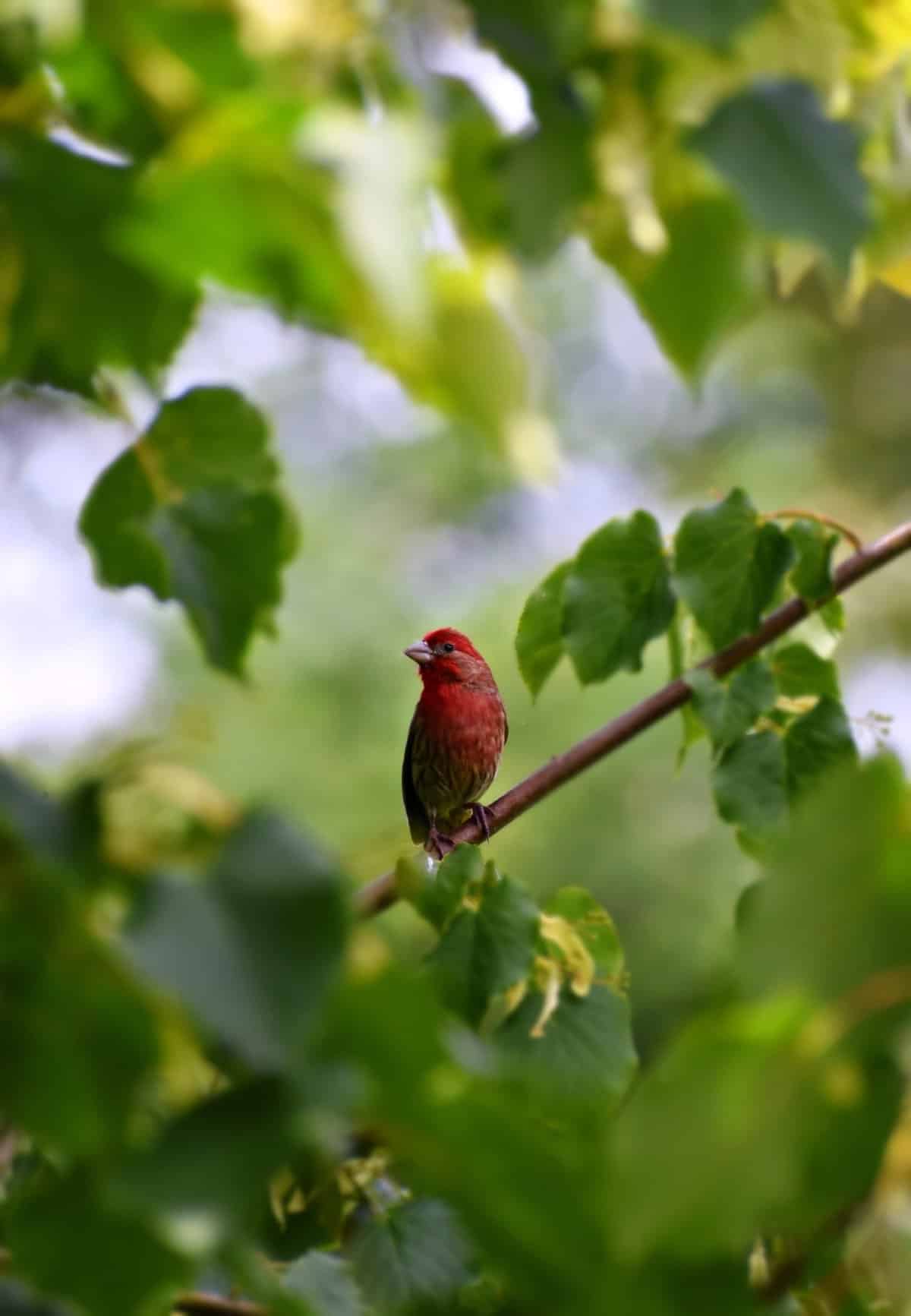 I hung up a bird feeder in my backyard and learned to become friends with the little feathered creatures that visited me. I lost my fear of spiders and other “creepy crawlies” as I look at them, too, as friends. Once us humans realize we’re not “all that,” it’s easy to become friends with, and respect, the other species that share our home. We couldn’t be here without them.
In one of my all-time favorite books, Ishmael, Daniel Quinn writes, “‘No one species shall make the life of the world its own.’ … That’s one expression of the law. Here’s another: ‘The world was not made for any one species.'”
After re-wilding my own soul and owing so much of it to these other lives, how could I ever think I’m better, or above, anything else? That mindset couldn’t be more wrong. How embarrassing.
Looking up
Once I realized how much there was to see when I looked down, I began looking up, too. And what did I see? Big, brown wings that “woooooshed” overhead. Eagles.
I don’t know where or when my love of bald eagles began, but my fascination with them has led me all over Washington, Oregon, and up into British Columbia, Canada, to watch and observe. Next on my list: Idaho and Alaska.
They are such incredible, giant creatures. I could watch them for hours. (I’ve grown quite attached to the family in this live Florida webcam.)

I don’t study eagles, and I can’t tell you too many things about them other than some common facts (like that their nests can be up to 12 feet high, eight feet across, and weigh something like two tons; or that their heads don’t turn white until they’re about five years old), but I’m drawn to them in a way I can’t quite explain.
What this all means
Noticing these seemingly tiny things, whether I’m hiking, on a walk, driving, walking into the grocery store—wherever—makes life a whole lot more beautiful, more interesting. How boring would my daily surroundings become if I didn’t choose to notice?
To most, and I used to be like this, too, a tree is just a tree. A bird is just a bird. Morning light is just morning light. Rainy days are, well, wet and should be spent indoors.
Getting excited to see an eagle every day, getting excited by the way the fog sits in the pines of the Cascade Mountains, getting excited by the unfurling of a new fern bud, by the way an oyster tastes like its ocean, by the way moss dangles and twirls like a trapeze artist, by the way a spider weaves its web, is how I maintain my sense of curiosity. Of wonder.
I’ll leave you with this, a passage from another of my favorite books, Wild Comfort, written by Kathleen Dean Moore:
“I’m thinking it’s a paltry sense of wonder that requires something new every day. I confess: Wonder is easy when you travel to desert islands in search of experiences you have never imagined, in search of something you have never seen before, in search of wonder, the shock of surprise. It’s easy, and maybe it’s cheap. It’s not what the world asks of us.
“To be worthy of the astonishing world, a sense of wonder will be a way of life, in every place and time, no matter how familiar: to listen in the dark of every night, to praise the mystery of every returning day, to be astonished again and again, to be grateful with an intensity that cannot be distinguished from joy.”
I hope your 2026 is filled with wonder. May you, like me, find joy in the smallest of life’s beauties. When you really start looking, nothing is as it seems.
As RVers, we are so fortunate to be exposed to new things, environments, flora and fauna on a near-daily or monthly basis. Never take advantage of that.
This year, I’ll be where the eagles are: in the mist, in the fog, in the morning light, splashing about in rivers, searching for something yummy for my eyes, and soul, to feast on.
I hope I’ll see you out there.
All photos are mine. Copyright Emily Woodbury 2026.
##RVT1087

My word for 2023 is Present – as in, to live and find joy in the present moment because life is a gift. This is exactly how I’d like to slow down and find daily delight… on a walk with a camera. Thank you for a wonderful article to start this new year.
My mom was a wizard at finding “small” things on a hike, like turning over a leaf to see what was underneath. Thank you for reminding me of that!
Emily, we start out as wide-eyed children soaking in all that we see, then grow to think we know it all, only to revert back and see the world for the first time. Most never get to that last stage, and the wonder of a child is lost. But you have found it again, and it will sustain you for the rest of your life. Another great read is a short book by Rachel Carson called “The Sense of Wonder.” It is not her usual scientific writing like “Silent Spring,” but a passionate plea for just what you have found: that wonder of our Earth and the appreciation that comes with it. I’m so happy you wrote about this. You go, girl!
Hear! Hear!
That was a great book. Leave a copy lying around for a pre-teen to find, it could spark a lifelong love of nature.
Emily: Great piece – I really enjoyed it! Perhaps I am reading it incorrectly, but I wonder if you meant “Never fail to take advantage of it.” In the third last paragraph?
All so true. 👍
Something most people do not know is that Southern Indiana has a large and growing number of Bald Eagles . I see them now and then in my home near Corydon Indiana and they are common at Hoosier National Forest Lake Celina, Tipsaw and especially Indian Lake. Patoka lake also is a good place for observing Bald Eagles.
Wonderful article and so very true. We all need to just slow down and look around. This is an amazing world. I can tell from your writings, you are your father’s daughter. People spend thousands of dollars on gadgets to look at things when you could see so much for free.
The National Eagle Center in Wabasha, MN is a great place to visit.
https://www.nationaleaglecenter.org/
Minnesota is one of the few states that maintained a fairly healthy population of bald eagles even during the years their populations were decimated by DDT across most of the US. In SE MN along the Mississippi it is quite common to see dozens of bald eagles in a short drive along the river. You can sometimes see congregations of over 100 in the winter fishing the river. On one of my favorite hikes I pass three different nests in the span of less than one mile.
Two eaglets just hatched this week in Florida, You can check them out live at swfleaglecam.com.
Emily, there are two places in Alaska you shouldn’t miss–Sitka and Haines. The Sitka harbor is not only beautiful, it is full of tiny islets topped with the famous spruce. At the top of the trees on each islet is a bald eagle nest, so dozens may be in the air at any one time! Haines has a bald eagle preserve, where there are dozens of juveniles sitting on the river bank and on tree branches, learning to fish for salmon by watching their parents. After 50 years of working and playing all over Alaska, including the Aleutians, those two and Valdez are still my favorite Alaskan towns to visit. Anchorage, Fairbanks, Juneau, even Seward and Skagway that are so popular with cruise ship passengers, don’t begin to compare to those three places!
Take the raft float trip through the eagle preserve and bring something to protect your camera from the rain…you won’t regret it! Your essay made my eyes leak! Thanks!
Sitka and Haines – incredible, and my next Alaskan favorite is Valdez! Memories of a lifetime from our visits.
Good Morning. Kind of smiled as read your Article & NYC. Was missing the GTA than saw the News on the 401 & was reminded why I live in Alberta. The Rockies are a great place to go Winter to Ski & Summer to Hike & play Golf!! Probably will go out to Vcr. Island in the Spring. Also seem to Laff more!! Hmmmmm!!
Excellent, thanks for letting us “see” Washington through your eyes. Hoping to be able to get there and see it through my eyes.
Bravo!
Loved your article, Emily. With your love of this great Bird and also of reading, this should be next on your list: “The Bald Eagle: The Improbable Journey of America’s Bird” by Pulitzer Prize winner Jack E. Davis. You will be amazed when you learn how our national symbol nearly became extinct!
A beautifully written article. Thank you. We all need to look around ourselves and be “in the moment”. The Pacific Northwest is certainly a place worth being in the moment.
Love your photography, Emily. Brava!
I was never a fan of that “Dominion over Nature” mentality myself.
As much as having read your brilliant essay, I felt it. I’m a lifelong resident of Olympia where the surroundings continue to hold me. The natural world truly does ground us. And it’s good to be reminded to ‘see deeply’ – wherever we are. I met your dad years ago when I was putting together my book, “Exploring Washington’s Backroads,” and I recall haunting the mailbox for the next issue of “Out West”! Best to the Woodburys — praise for RV Travel!
Careful Emily, you’ll have some readers accusing you of being one of “…dem dere environutalists” (like me).
Thanks for a great article and pics!
Great pictures! Both my husband and I were born and lived most of our 60+ years in Ferndale Wa. I absolutely know what you are saying. We go “home” every summer because of our family but also because we will never lose our love for the PNW.
So enjoy your photos and reminder how blessed we are!
Emily – it is not everyday that I read something that “strikes a cord” on the keys of my life. At age 12 I got my first camera which catapulted the first half of my life as a professional photographer, and I still shoot away today. While others wanted 300 mm lenses, I loved my macro lens that allowed me to photograph and see what was “really around me.”
Great article and one to which I can truly relate.
Beautifully written, Emily. Thank you!
The natural beauty of the PNW has no rival. So diverse. After living there for 34 years and venturing from Mexico to Canada along the mountains, high desert and coasts, sneaking along many of those backroads, there is no equal in the USA. Whidbey Island is a favorite. However, once we retired it is nice to get back to family down south. The Left Coast ain’t what it used to be thus we are happy and content here. God bless your new adventures (again). Beauty is in the eye of the beholder and you certainly expressed it well for us readers.
What a wonderful essay. I am so proud of Emily, but then she’s my daughter. Still, what a gift she has as a writer and photographer (it’s hard to be gifted at both). Love you, Sweetheart — Dad
Thank you, Emily… for reminding me to pay attention to the ordinary and extraordinary beauty around me. Perfect!
I was on a slow internet so pictures were last to load, but I could see them from your writing. Very well written. Thanks
Emily,
Beautiful photography, and a beautiful essay. Thank you!
Wonderful essay. Touching and it really makes me realize how much I don’t see and how many things I take for granted. Excellent photography as well. Keep writing!
Emily thank you so much for your beautiful essay, especially the excerpts on wonder. My husband and I spent 6 months last summer traveling through Canada and Alaska. And when people would ask about our trip I didn’t have the words to be able to describe how incredible every day was, but now I do, wonder. Every day of our trip, every day, we encountered something wonderful, the incredible landscape, the animals, the stars, the Northern lights all filled me with wonder. Now I can say, “it was a beautiful trip, full of wonder every single day”. And now I will try to look for that wonder every day because it is all around us no matter where we are. Thank you.
Yes you WILL see me out there! The reason I bought my micro camper van was to explore more nature, my favorite thing to do.
Emily, a beautiful essay. I understand why your dad, who is a friend, is so proud of you. I have often considered how frequently our society uses the word “wonderful” but put in context, their use of the word is missing the “wonder.” I hope I have the opportunity to meet you and see Chuck again in the near future.
I would add a word here: longing. The melancholy, jitters and twitches of longing can best be assuaged by the pursuit of wonder.
Also, you are not the first but one of the (literal) handful of people I’ve met who have also read ‘Ishmael”. I just put a hold on “Wild Comfort” at the library. Oh gosh, are libraries not a reliable source of wonder as well?
Enjoyed your essay. Thank you, Emily!
Liz
Born in Seattle, now in Eastern Wa. where I live in a quieter area, the mountains next to a river.
Love it here and traveling around Idaho-Montana-Wyoming-Oregon-Utah-Nevada also. I’m lucky!
Thank you, Emily! Nicely done! Interesting, thought-provoking, and well-crafted; thank you! One line puzzles me. It is near the end. I don’t quite get “Never take advantage of that.” Given the context, I’d have expected “Never [fail to] take advantage of that,” or “Never take [that for granted.”] Either way, it is a very good essay; thank you!
Not everyone likes to live in a moldy area with constant high humidity…I have seen moss growing on peoples roofs and growing out of cracks in trim on vehicles after living in the Seattle area for a year.
Wow, that is what you got from this article? Push 22 on the elevator and return to your cement cave on the 22nd floor
Emily, great article. From birth (1948), my family lived in the home my father built on the shore of Puget Sound in northern Edmonds. MIles of wooded shoreline before all the houses were built. My mother and I gathered clams, crabs and easily caught fish from local dock. In the woods we found berries, flowers, fiddleheads, and mushrooms, mushrooms, mushrooms. In retirement I moved to Eastern WA and am exploring a whole new landscape along the rivers and hills.
One of your statements brought memories from the days my wife and I used to scuba dive. When we could afford it we went on trips organized by the dive shop to various Caribbean locations. As a photographer I preferred to go slow and see the little things that were right beneath my fins. Other members of the group would swim fast thinking they would see more. As you said, it’s amazing what you see by just slowing down and looking.
Emily: In a word: “Splendid”! You pushed all my buttons having been raised in Mn, lived in LA then on to Anchorage and back to roots in ND/MN. Everywhere has a special meaning to those who wish to take the time to observe. Thanks for this outstanding – dare I say “article”? (It is so much more). PS: I too am an eagle worshiper and collector; we also have a nest about 5 miles from our home.
“For the first time I stood in awe of everything that God made. I couldn’t look at a tree anymore and see so many board feet of timber. Couldn’t look at a beaver lodge and see so many pelts. Now I saw little miracles. We have a wheel that takes you from here to there. They have a wheel that takes you to the stars.”
Character of Jacob Wheeler, End of Episode 1, Into The West. A Steven Spielberg production.
If you have never watched this epoch six-part miniseries from over a decade ago, find it and watch.
Bald Eagle viewers need to make a stop in Minnesota. At the very depths of the bald eagle decline from DDT, Alaska and Minnesota still had viable populations. From the latest population estimates I can find, Alaska has 30,000 and Minnesota has 9800. The next closest states are Florida and Wisconsin with 1500 each.
https://worldpopulationreview.com/state-rankings/bald-eagle-population-by-state
Minnesota also has the National Eagle Center in Wabasha, MN right on the bank of the Mississippi.
https://www.nationaleaglecenter.org/
It appears this was written a little while ago, but nonetheless, Emily, welcome home!
Hi, Jack and Jean. Yep, Emily’s been here for awhile. But wasn’t that a beautiful essay that she wrote? She goes back to visit her mom and friends in New York fairly frequently, but I think she’s always happy to get back “home” here in the Pacific Northwest. I’ve lived here my entire 77+ years and can’t even imagine living anywhere else.🙁 Have a good night. 🤗 –Diane