

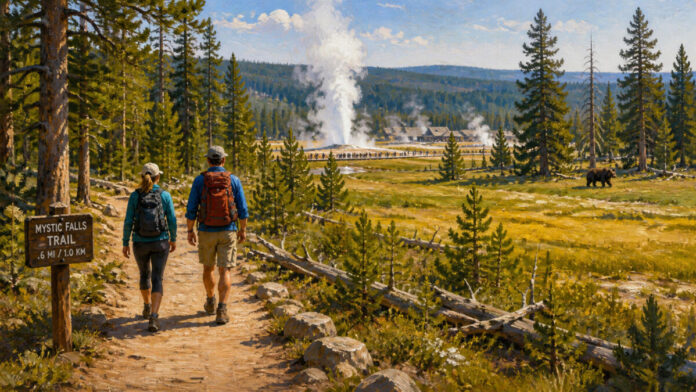
A bear attack that injured two hikers in Yellowstone National Park this week didn’t happen deep in the backcountry. It happened near one of the most visited parts of the park—close to Old Faithful—on a trail many visitors walk every day.
What happened
According to the National Park Service, two hikers were injured May 4 on the Mystic Falls Trail, not far from Old Faithful. Rangers responded quickly, and both visitors were treated and removed from the area. Officials have not yet released details about the severity of the injuries or exactly what led to the encounter.
The case remains under investigation.
Where it happened
This wasn’t some remote, seldom-used path.
The Mystic Falls Trail sits in the Old Faithful area, one of the busiest zones in Yellowstone. Nearby are heavily traveled spots like the Midway Geyser Basin, Fairy Falls, and the Firehole River corridor. These are places that draw steady foot traffic once the season begins to ramp up.
In other words, this is exactly the kind of place where:
- First-time visitors go exploring.
- RVers stop for a day hike between campground stays.
- Families stretch their legs after a drive.
That’s a key distinction. Encounters like this don’t just happen “out there.” Sometimes they happen right where people feel most comfortable.
Closures came quickly
In response to the attack, rangers temporarily closed a broad section of trails and backcountry campsites in the immediate area. That included multiple connecting trails and access points around the Midway Geyser Basin and Firehole River region.
For visitors, that means plans can change fast, even in high-profile areas that usually feel predictable.
Why now
Timing plays a big role. Early May is when bears in Yellowstone are newly active after hibernation. They’re hungry, covering ground, and more likely to be encountered at lower elevations: closer to roads, trails, and developed areas.
That overlap between people and wildlife increases quickly this time of year. And while attacks remain rare, this is the window when incidents are most likely to happen.
What the park is reminding visitors
The Park Service used the release to reinforce familiar guidance, but in this context, it carries more weight:
- Keep at least 100 yards from bears.
- Carry bear spray and know how to use it.
- Hike in groups when possible.
- Make noise, especially in areas with limited visibility.
What this means for RVers
For many RVers, early-season Yellowstone trips are about getting ahead of peak crowds. Cooler weather, easier reservations, and quieter roads all have their appeal.
But this incident is a reminder that “early” doesn’t mean inactive. Wildlife is already moving. Trails are already busy. And conditions—whether closures, hazards, or wildlife activity—can shift quickly.
If you’re heading into Yellowstone now, it’s worth planning with a little more flexibility—and a little more awareness—than you might expect for what feels like the start of the season.
RELATED
- Bear activity near Yellowstone triggers tent bans, RVers allowed to stay
- Grizzly bears are waking up and hungry. Watch out
- Yellowstone grizzly bear deaths at alarming high due to humans
- Hiker attacked by bear in Yellowstone National Park
- See what damage a bear can do to an RV
- How fast can a bear run? Very fast!
RVT1260b


Let me guess: another unlabeled piece of AI imagery? The Dark Side powerful is!
Thanks, Andy. I hadn’t noticed it wasn’t identified as such. I’ve just added that to the caption. Have a good evening/night. 😀 –Diane