

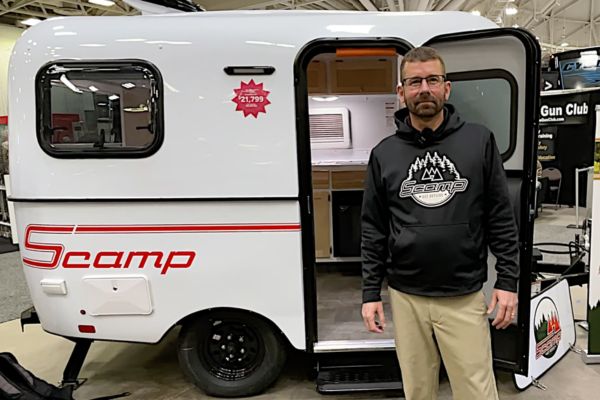
Small campers often ask for a compromise, but Scamp’s 2025 lineup doesn’t feel that way. At the Northwest Sportshow in Minneapolis, Dayton from Scamp Trailers walked through the company’s small fiberglass campers and explained why they still have such a loyal following. The big draw is because of their low weight, lots of layout choices, and a design that has barely needed changing because it still works.
Check out the tour in the video from Two Guys and a Ride at the end of this post.
Why Scamp still gets attention
Scamp has been building trailers for 54 years, and the Minnesota-based company is still third-generation and family-owned. Dayton also called Scamp the originator of the lightweight fiberglass camper.
The shell design is still the headline feature. Instead of a roof seam, Scamp uses a top mold and a bottom mold joined at the belly band. That leaves one main seam around the trailer, which helps explain the long-running reputation for being close to leak-proof.
Across the line, Scamp offers about 17 layouts in its 13-foot and 16-foot trailers, plus a 19-foot fifth wheel. That gives shoppers a lot of room to match weight, floor plan, and features.
What the 13-foot Scamp offers
The standard 13-footer starts around 1,300 pounds and can reach about 1,800 pounds with options. Outside, it carries a 2-inch rear receiver for a bike rack or luggage rack, a spare tire, stabilizers, a third brake light, a detachable power cord, a city-water hookup, and a seven-pin plug.
Inside, the rear dinette drops into a bed. Buyers can choose a 44-inch or 54-inch width, and the usable length is about 6′ to 6’2″ because of the curved shell. The standard trailer shown had a sink, a two-burner stove with a glass cover, and a 2.0 cubic-foot 12-volt compressor fridge. Its freezer section can be removed for more fridge room.
A Maxxfan handles ventilation, and new double-pane acrylic flip-out windows arrived for 2025. They open wide and include built-in screens and shades.
The Scamp Light and the 16-foot wet bath model
Scamp also offers a Light version for tow vehicles capped at 1,500 pounds. That dry camper skips propane, water, stove, fridge, and heat. Even so, it keeps the same small-footprint appeal, and it adds useful storage where tanks and plumbing would normally sit. The fold-down bunk up front is rated for 150 pounds.
The 16-foot layout 6 adds one of the line’s most practical setups. It puts a wet bath in the front, with a 6-gallon black tank, a 21-gallon gray tank, and an inset floor for more standing height. This layout also keeps a side dinette, so the rear bed can stay made up.
That trailer can be fitted with a furnace, awning, air conditioner, outdoor shower, and an upgraded three-way fridge that runs on battery, shore power, or propane. Water-system models use an on-demand tankless water heater, plus tank and battery monitors inside.
Ordering, pickup, and warranty
Scamp sells factory-direct, not through dealers. Current build time is about 6 to 8 weeks, and Dayton said the company also keeps 60 to 70 trailers in stock. Ordering takes a $500 deposit, with the balance due at pickup.
Pickup includes a full orientation at the factory, a walk-through inside the plant, and a hitch-up lesson with the tow vehicle. The whole process takes about 90 minutes to 2 hours. Warranty coverage is one year on the frame and shell, while appliances and components vary by supplier, usually 1 to 3 years.
For owners far from Minnesota, Scamp handles warranty support through its service team and can help find repair work closer to home.
Final thoughts
Scamp’s appeal is still easy to see. The trailers stay light, the layouts make smart use of space, and buyers can order only the features they want.
For campers who want small size without giving up real function, the 2025 Scamp line makes a strong case.
Learn more on the Scamp Trailers official website.
MORE LIKE THIS:
- Escape 5.0 fiberglass fifth wheel—warm and cozy
- New manufacturer debuts fiberglass travel trailer — Goodbye, leaks
- First look: Escape 13’—The smallest and lightest in the Escape fiberglass lineup
RVDT2898


Among the 6 RVs I have owned, one was a Scamp. Unfortunately, without exception, every trip I took something malfunctioned or broke. It changed RVing from a pleasure to a huge frustration. The day I divested myself of the Scamp was far more happy than the day I picked it up. I did have an acronym for “SCAMP” but will not mention it here. I do hope others have had a much better experience with Scamp than I did.
Thanks for sharing. I was seriously thinking of one, however, the useless response I received when I contacted the sales team with a few questions has me rethinking that. If the sales team is apathetic, I can only imagine what the rest of the company must be.
2025 model review??? That’s almost two model years old!
RV parks should charge half or less for a tiny RV like this.