

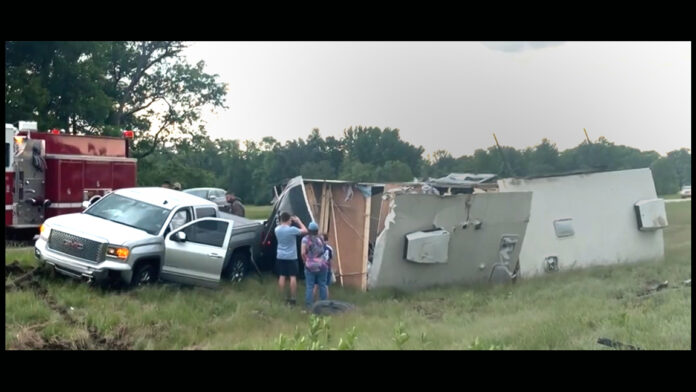
An Indiana highway crash is serving as a harsh reminder about RV trailer safety after a disconnected trailer struck and flipped a camper on U.S. 41, near Evansville, sending two people to the hospital. Authorities are still investigating exactly what happened. But incidents like this highlight a reality many RVers already know: A trailer disconnect at highway speed can become violent in seconds.
For many RV owners, the unsettling part is how ordinary these situations can begin. Often, the rig looked perfectly fine pulling out of the driveway or campground. The problem may not show up until a bump, sway event, hard brake application, or highway-speed vibration exposes a weak point in the towing setup.
Why trailer disconnects can become so dangerous
When a trailer separates from the tow vehicle, several things can happen almost instantly and none are good.
The trailer tongue can slam into the pavement. The trailer may begin fishtailing violently. Safety chains can either help stabilize the trailer or fail if they were improperly connected. In some cases, the trailer crosses lanes or strikes nearby vehicles before the driver even has time to react.
With travel trailers, the danger increases because of their size and high center of gravity. Once the trailer begins whipping sideways, rollover forces build quickly.
That appears to be part of what happened in the Indiana crash. Photos from the scene showed the RV, a towable, overturned beside the highway after being struck by the disconnected utility trailer.
The hitch mistake many owners never realize they made
One of the most common towing failures involves the coupler not fully seating onto the hitch ball.
Sometimes the latch appears closed when it really is not locked completely into place. Other times the wrong ball size is being used, or the coupler itself has worn enough to create excessive play.
Experienced RVers often develop a routine specifically to avoid this.
Many perform what is commonly called a “pull test.” After hitching up, they raise the tongue jack slightly off the ground and gently apply the trailer brakes by manually engaging the brake controller while easing the tow vehicle forward just enough to confirm the coupler is securely locked onto the ball.
It takes only a few seconds, but it can reveal a problem before the trailer reaches highway speed.
Safety chains are not just backup hardware
Many RV owners think of safety chains as little more than a legal requirement. In reality, they may become the last line of defense between a controllable emergency and a catastrophic crash.
 Properly crossed safety chains should pass underneath the trailer tongue in an “X” pattern before attaching to the tow vehicle. That crossing creates a cradle designed to help catch and support the tongue if the coupler disconnects. Without that support, the tongue can slam directly into the pavement, potentially triggering violent whipping or even pole-vault-style flipping forces at highway speed.
“A trailer disconnect at highway speed can become violent in seconds.”
Chain length matters, too. Chains that are too long can allow the tongue to hit the road. Chains that are too short may bind during turns.
And the breakaway cable matters just as much. That cable is designed to activate the trailer brakes if the trailer completely separates from the hitch. But safety experts warn that many owners attach the cable to the same removable chain loops or hitch hardware involved in the towing connection itself. If that hardware fails or tears loose during a disconnect, the breakaway system may never activate. Instead, the cable should be attached to a solid, independent point on the tow vehicle or hitch assembly that would remain attached even if the coupler and chains fail.
Why loading and sway still matter
Not every trailer separation begins with the hitch itself.
Improper tongue weight, overloaded rear cargo areas, soft suspension components, or underinflated tires can create severe sway conditions that place enormous stress on the hitch system.
A trailer that repeatedly jerks and oscillates at highway speed can eventually expose weaknesses in worn hardware or marginal connections.
That is one reason experienced towers often recommend rechecking the hitch after the first few miles of travel, especially after the RV has been sitting in storage for weeks or months.
Metal settles. Loads shift. Hardware loosens. Tires warm up.
A setup that looked perfect at the campsite may not stay that way after 20 miles of rough pavement.
The five-minute walk-around many RVers swear by
Many longtime RVers eventually develop a personal pre-departure routine. The exact checklist varies, but most include the same basic ideas:
Check that the coupler latch is fully locked. Confirm the hitch pin and retaining clip are installed. Verify the chains are crossed and not dragging. Test trailer lights and brake operation. Inspect tires visually. Make sure storage doors, steps, stabilizers, and antennas are secured.
It sounds simple because it is simple.
But many towing incidents begin with small oversights made during rushed departures, distractions, bad weather, or simple fatigue after a long stay.
The Indiana crash is still under investigation. But for RV owners watching from afar, it serves as another reminder that towing safety is rarely about one dramatic mistake. More often, it is the small things overlooked before the trip even begins.
Sources include:
MyWabashValley report on the Indiana crash
RELATED
- 11 of the most common towing mistakes and how to avoid them
- Improper trailer hitch extension—A disaster in the making
- Is your RV tow package safe? You sure?
- How do we educate the RV consumer about towing capacity?
RVT1261

My safety chains are attached to a single loop, welded to the tongue. Crossing them is impossible. Grand Design Transcend 221RB
Same here. And so was our previous trailer.
+3. I wonder what the were thinking by using only one attachment point.
Maybe saved them 50¢ during construction.
Plus, I don’t think that little loop would hold up in a separation.
As an RCMP, I investigated a fatal accident involving a towed 15 ft. trailer. The ball hitch broke, and the safety chains took over, which were so loose that they would have barely cleared the road surface. The safety chains now became the towing devices and were controlling the car from the rear. Tire tracks showed the wild ride the car took before it entered the median ditch. The trailer tongue dug a furrow about two feet deep into the soil, bringing everything to a sudden stop, except the trailer. It did a somersault, landing upside-down squarely on the roof of the car, crushing it down and killing the two occupants. With a proper chain hook-up, they would likely have had a safe stop.
A poorly secured 12-foot trailer came loose on I-24 in Chattanooga, striking the car behind it and causing the driver to lose control. Her 16-year-old daughter was ejected and killed. The person pulling the trailer didn’t stop and was never caught. A terrible tragedy.