


Dear Dave,
Is there something to use to clean my fresh water tank and for yearly maintenance? —Robert, 2016 Coachmen Catalina
Dear Robert,
There are several methods to clean and sanitize your fresh water tank. For years, owners have been using a small amount of bleach in water, letting it sit for a period of time before flushing and rinsing it out.
How to use Clorox bleach to clean RV fresh water tank
According to the Clorox bleach website, a bleach solution must be made fresh each day, so only make enough for the current job.
Clorox recommends 500 ppm for disinfecting a water tank, which is 1/3 cup bleach for every 3 gallons of water.
Here is their recommendation:
To clean out a water tank, thoroughly flush the tank using a bleach solution made with 1/3 cup Clorox® Disinfecting Bleach per 3 gallons water (a 500ppm bleach solution). I’m not sure of the size of your tank or how much bleach solution you will need to clean the tank, but here’s one example: To make approximately 9 gallons of bleach solution, then you would start with 9 gallons of water, and then add 1 cup bleach. After flushing the tank with the 500ppm bleach solution for 5 minutes, then rinse with a 10ppm bleach solution (1 teaspoon bleach per 10 gallons of water).
You may also want to get some chlorine test strips to confirm the bleach concentration of the solutions you mix up. These can usually be found at pool supply stores.
Since you did not provide the floorplan model, we can only approximate the size of the fresh water tank. According to what I can find on the website, it lists anywhere from 44 gallons to 56 gallons, which most likely includes the water heater.
NOTE: A high concentration of bleach in contact with rubber seals for an extended period of time can deteriorate the rubber.
I believe this concentration is too high, designed to kill bacteria salmonella and not recommended to clean and sanitize your water tank. Most of the time I use 1/4 cup bleach with 50 gallons of water, which would be approximately 50 ppm, and let it sit overnight.
Is using bleach to sanitize fresh water system safe?
There has been a lot of controversy about using bleach, with some comments stating it is not safe and cannot be flushed down a municipal sanitary system.
According to the Clorox website, bleach has been certified by the Food and Drug Administration (FDA), Environmental Protection Agency (EPA), and National Sanitation Administration. I also talked with our local Sanitary District Manager and he stated that bleach in lower concentrations of 500 ppm or less will not harm a septic system or the district’s treatment process.
You will find dozens of different variations of the ratio. Some even recommend vinegar and water.
Thetford Fresh Water Tank Sanitizer
If you are worried about bleach or the lingering smell afterwards, Thetford has a product that can be used to clean and sanitize the fresh water tank. It is a two-step process. It is available on Amazon here.
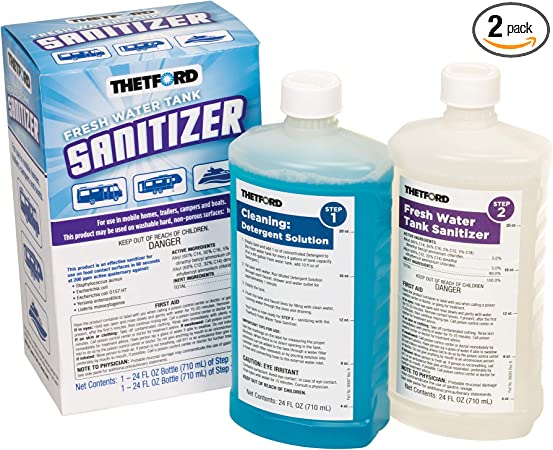
Step 1: Clean with the detergent
- Empty the tank and add 1 ounce of concentrated detergent solution to the fresh water tank for every 4 gallons of tank capacity.
- Fill the tank with water and run the diluted detergent through each faucet, shower, and water outlet for 1 minute or more.
- Empty the tank and rinse the faucet lines and tank by running fresh water through them.
Step 2: Sanitize the water
- Shut off incoming water line and prepare a solution of 2 ounces of product per 8 gallons of water.
- Apply or circulate solution to wet all surfaces, allowing it a minimum contact of 60 seconds.
- Drain the solution and return to service by reopening incoming water lines.
The treatment is effective even in hard water and will not leave grit or soap scum. Not a drinking water additive.
How to add bleach or Thetford to the fresh water tank
If you have a gravity fill on the side of the rig, adding the bleach solution, vinegar, or Thetford product is easy. Mix up the recommended amount of product in a 5-gallon bucket with water and pour it in with a funnel.
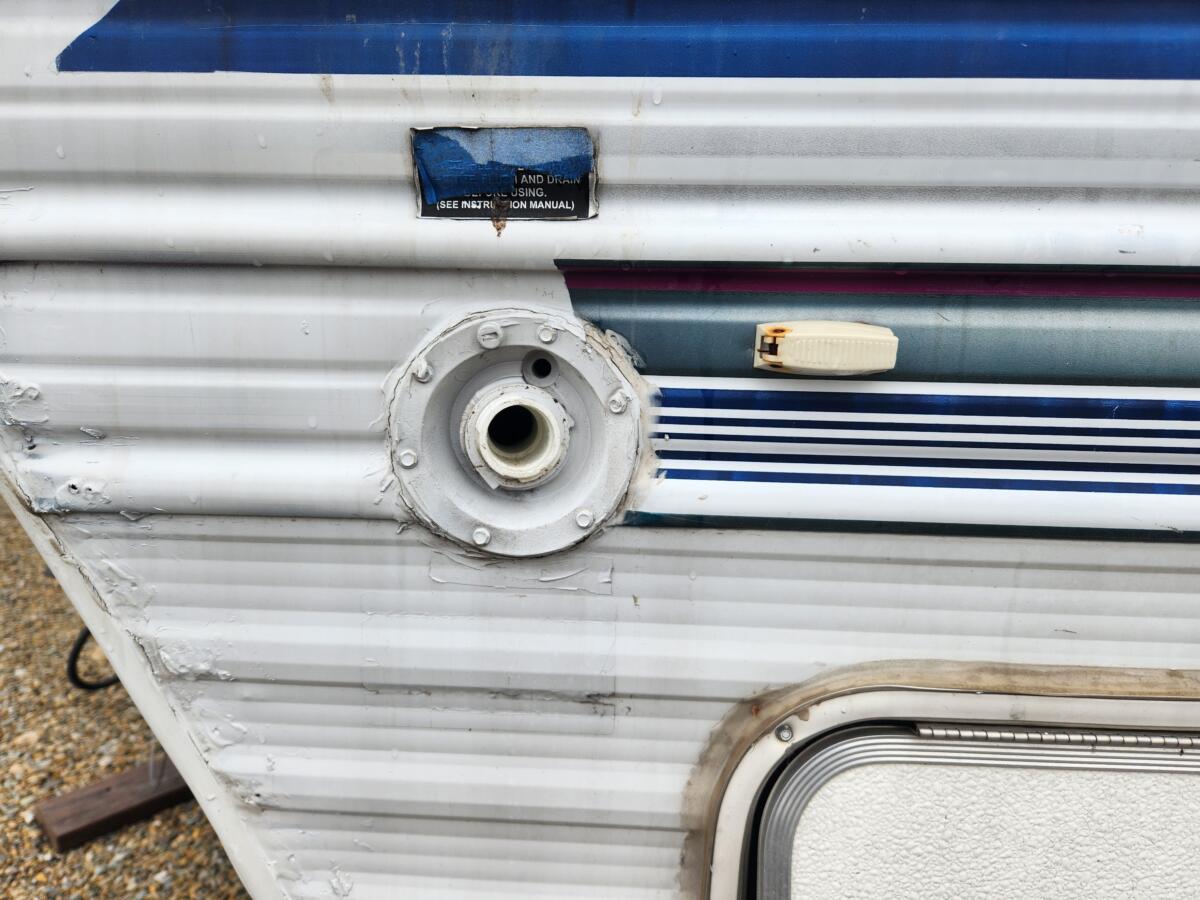
If you do not have a gravity fill or your tank has a vent at the top that would restrict filling, you can use the tube for winterizing, if you have that feature.
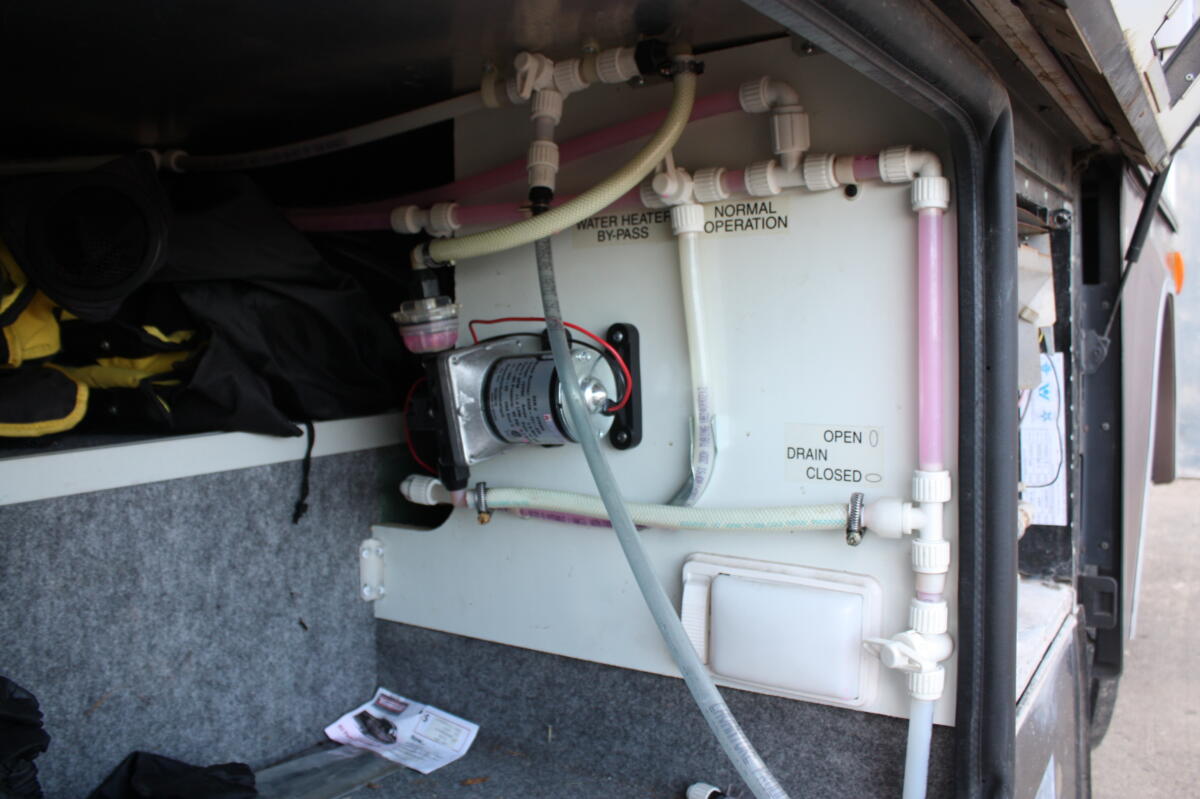
By turning the valve, the onboard water pump will draw from the winterizing hose and allow you to insert it into the bucket and draw the water in. Then use the city water fill to fill the rest of the tank.
If you do not have a winterizing kit with the hose, use a clean water supply line like you would for connecting to a pressurized source. Before connecting the hose to the pressurized source, use a funnel to fill the hose with the diluted solution, then connect to the city source and turn on the water. The solution will be pushed into the fresh water tank. However, if you are planning to do this each year, I would install an aftermarket winterizing valve.
You might also enjoy these posts from Dave
- Your RV’s fresh water system: What you should know
- How to fix RV’s leaky black tank dump valve
- Where is RV fresh water tank’s low-point drain? I can’t find it
- How to get excessive mold out of RV’s freshwater tank
- How long can fresh water be stored in the RV’s tank?
Dave Solberg is a leading expert in the RV industry and the author of the “RV Handbook.”
Read more from Dave here.
HAVE A QUESTION FOR DAVE?
Send your inquiries to him using the form below.
RVDT2678

“Most of the time I use 1/4 cup bleach with 50 gallons of water, which would be approximately 50 ppm, and let it sit overnight.” I use the same recipe…been working for years.
Be aware that if you have an Aqua hot system bleach will destroy the tubes in the boiler. That damage won’t be covered by warranty either. Chlorine bleach and aluminum tubing don’t mix.
No gravity feed to fresh water tank – just a diverter valve? Several options-
One thing to be sure is to use the Clorox DISINFECTING BLEACH, not the scented bleaches. They do not all have the same concentration of bleach.
Plus don’t use the non-splash type.
Also check the label. You want at least 7% sodium hypochorite. Some of the store brands and off brands only contain 4-5%. If you use the cheap stuff, double the concentration.
Thank you for the suggestions, Dave! Have a great day and safe travels!