

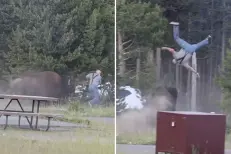
Yellowstone National Park delivered another sobering reminder this weekend that wild animals deserve both respect and plenty of space.
A grandfather was seriously injured after an agitated bull bison charged him near the Bridge Bay Campground. The agitated animal flipped the park visitor an estimated eight feet into the air, while his grandson escaped unharmed.
The dramatic incident serves as an important lesson for anyone traveling through America’s national parks in an RV.
What happened
According to eyewitnesses, the bull bison had already been acting aggressively around the campground before the attack. Wildlife photographer Mike MacLeod said the animal had charged at children and appeared unusually agitated.
After briefly lying down in the dust, the bison suddenly became aggressive again. The man attempted to get away from the enraged animal; however, it chased the grandfather through a stand of trees. The animal eventually caught the man and tossed him high into the air with one of its horns. Bystanders distracted the animal until emergency responders arrived. The man suffered serious injuries and is hospitalized. The victim’s name has not been released.
One detail makes this incident especially noteworthy. Witnesses said the victim and his grandson appeared to be giving the animal a respectful amount of space and were not harassing it.
That doesn’t mean Yellowstone’s safety recommendations failed. Instead, it highlights an important reality about wildlife: Maintaining the recommended minimum distance greatly reduces your risk, but it cannot eliminate it entirely when dealing with unpredictable wild animals.
Why RVers should pay attention
Campgrounds often create a false sense of security. It’s easy to assume that because you’re parked among other campers, wildlife will stay away.
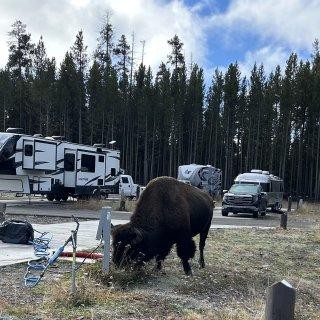
Yellowstone’s bison frequently wander through roads, picnic areas, and campgrounds. Elk, bears, and other large animals do the same. From an RV window, these encounters can make for incredible photos. Outside your RV, however, they require constant awareness.
Many RV owners enjoy walking pets, riding bicycles, cooking outdoors, or simply relaxing around their campsite. Any of those activities can place you unexpectedly close to wildlife, especially if you’re not paying attention.
Keep your distance—and stay alert
The National Park Service recommends staying at least 25 yards away from bison, elk, deer, and other large animals. Bears and wolves require an even greater buffer of at least 100 yards. Those are minimum distances, not guarantees of safety. Animals can cover surprisingly long distances in just a few seconds, and they can change direction without warning.
The safest approach is to stay farther away whenever possible and continually watch the animal’s behavior.
Warning signs can include:
- Pawing or kicking at the ground
- Snorting or blowing
- Raising or swinging the head
- Staring directly at people
- Tail movement or obvious agitation
- Sudden changes in posture or direction
If you notice any of these behaviors, increase your distance immediately. Never assume an animal that appears calm will remain that way.
Around your campsite
RVers can reduce their risk by making wildlife awareness part of their daily routine.
Before stepping outside, scan the area around your RV. Wildlife often moves quietly through campgrounds early in the morning and near sunset.
Keep children close and never allow them to approach animals for photos.
If you see wildlife blocking your path, wait patiently or choose another route.
Avoid surrounding animals with crowds. Giving wildlife multiple escape routes helps reduce stress and lowers the chance of defensive behavior.
If a ranger closes an area because of animal activity, respect the closure without exception.
Respect wildlife—even from a distance
One of the biggest misconceptions about Yellowstone is that animals become tame because they’re accustomed to seeing people.
They don’t.
Bison can weigh up to 2,000 pounds and run much faster than most people expect. They remain completely wild regardless of how often they wander through campgrounds or along busy roads.
This latest incident is a reminder that every wildlife encounter deserves your full attention. Even if you’re following park guidelines, continue watching the animal. Be prepared to move farther away and never let your guard down until you’re safely out of the area.
Have you witnessed an incident like this? Tell us in the comments below.
RELATED
- Bison safety: If a bison does this… RUN!
- Tale about Yellowstone tourist milking bull buffalo almost fools us
- Viral video shows bison flipping over a motorhome—Is it real?
- Another Yellowstone tourist gored by bison
RVT1270b
