


Hello Dave,
We purchased a brand-new Imagine XLS travel trailer a couple of months ago. While installing a cover I noticed there are pockets along the edge where it meets the front cap, along both sides. There are wrinkles at every seam that are continuous from one side to the other. The air pockets in the front are close to 3 inches wide. Bubbles on the sides are close to 2 inches in width. Grand Design is recommending the dealer pull the roof membrane tight, without any adhesive, then replace the transition pieces. I looked around at other RVs in the lot and no one else has any bubbles. —Carlos, 2024 Grand Design Imagine XLS

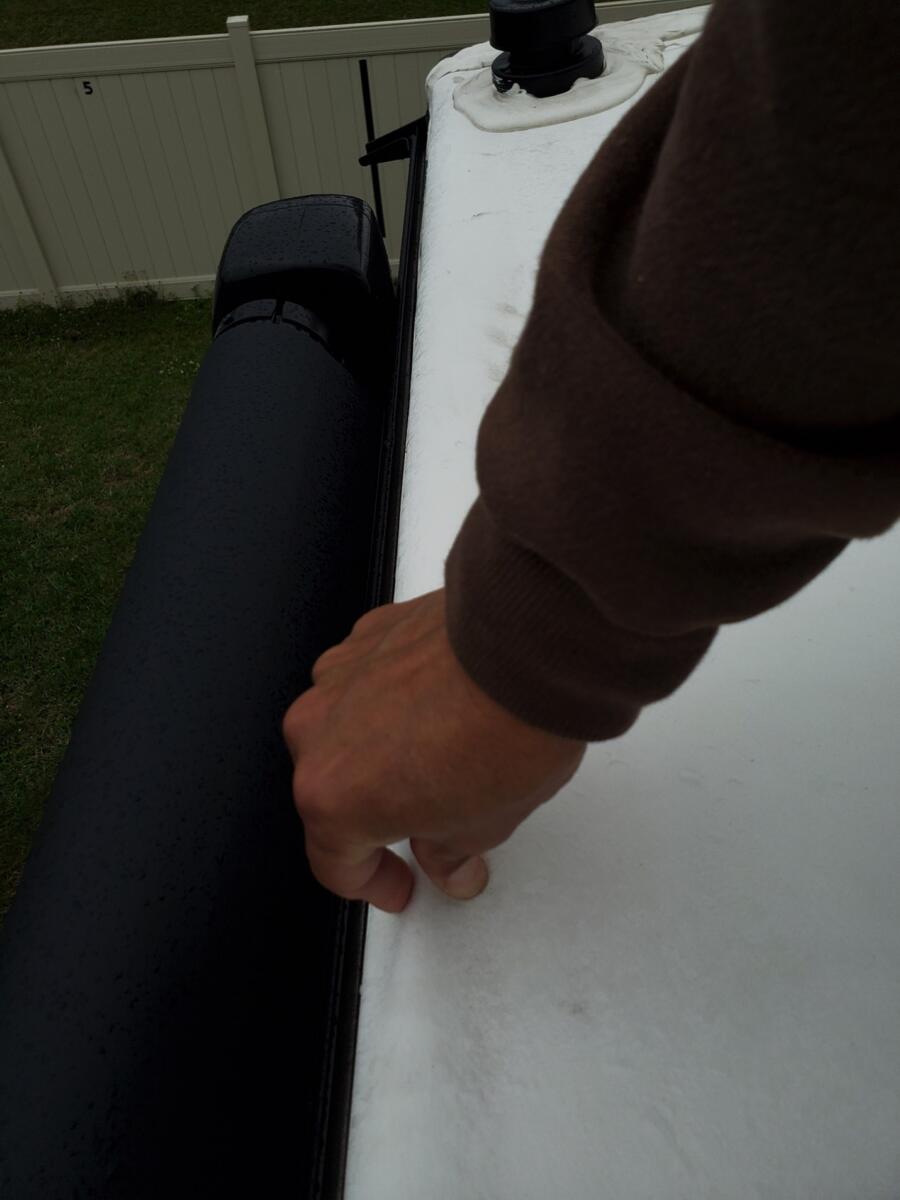
I asked Carlos to send more photos to give me a better idea of what part of the rig he was referring to. Here is what I got.

With these photos I got another comment from Carlos.
Here is a larger view of the membrane where it meets the front.
Here is one side of the RV. There is a 2-inch portion that although is secured by the trim, it is not adhered to the roof to the point that can pinch it up.

In a related area, while taking pictures of the roof, I noticed the solar panel has a warped shape to it. Is this a common issue?

Dear Carlos,
Let’s address the roof material issues first. According to their website, Grand Design uses a TPO roof membrane. That is better than the cheaper EPDM but does expand and contract during temperature changes, which can cause issues with adhesion.
Material on the RV roof
From what I can find on the website and brochures, the TPO is applied directly to a chip board substructure which, in theory, is stronger than traditional layered paneling and particle board. However, what I have found when building over six different homes, this type of paneling uses heavy adhesives and resins to bond the chips. That does make it stronger, but it also creates a slick or glossy finish to the outer surface versus the porous wood of traditional paneling. That is why several manufacturers use a thin layer of luan, as the adhesive seeps into the wood and creates a superior bond.
To me it looks like they did a very poor application of the adhesive to the substructure before installation of the rubber membrane, especially at the edges. Typically the adhesive is applied manually with spray guns or even with paint rollers. It is common to stop short at the edges rather than over-spraying, which gets all over the sides and windows. This creates additional cleanup work down the line.
How the roof membrane should be repaired
I would rather see them loosen the rubber membrane and inspect the substructure to make sure there are no impurities or loose wood chips. Then, instead of just stretching the rubber membrane tight, I would recommend spraying adhesive in that area to help hold the membrane in place. I would suggest working with the dealer service department and stay on Grand Design to get it fixed correctly. If they are going to all the work of pulling the transition trim off and pulling the membrane tight, it won’t take any more work to apply a little extra adhesive.
I also notice they “globbed” on a ton of sealant, which is a little sloppy!
Solar panel
As for the solar panel, the roof is curved or crowned to provide water shedding capabilities and would create an uneven surface like you are seeing with your solar panel. I would suggest using a level and getting a measurement on just how much twisting has occurred. You should be able to put the level across the frame and raise the low end until it levels out. Then record the distance and contact Lippert to verify what they recommend. I would be concerned about the stress on the panel, especially in cold weather and with road vibration. It might need to be adjusted with shims.
You might also enjoy this from Dave
RV’s roof membrane has ripples. Factory rep says it is normal. What?!
Dear Dave,
After washing my roof and doing an inspection after it dried, I noticed “ripples” from the board particles underneath. Getting down on the roof, I noticed these were areas where the fabric was not glued to the board underneath. The entire roof is this way (see pictures). Is this a problem? It looks good otherwise. Thanks for your advice! —Phil, 2019 Coachmen Chaparral 381RD
Dave Solberg is a leading expert in the RV industry and the author of the “RV Handbook.”
Dave will be giving several seminars each day at the Nashville RV Show, today through Sunday. Stop by to say “Hi” and learn lots from Dave.
Read more from Dave here.
HAVE A QUESTION FOR DAVE?
Send your inquiries to him using the form below.
##RVDT2300


I keep hearing a lot of complaints about Grand Design. Which isn’t good from a company that thinks they have a superior product.
Thank you, Dave! Sounds like lots of work for someone. 🙂
Just more shoddy work from the factory. These manufacturers should be ashamed! Instead, they just ignore it. Very sad…
I had the very same problem with a new 2017 Grand Design Reflection fifth wheel…among a volume of other problems with this unit… and after contacting GD along with sending a lot of pictures I was told by the factory to just “keep an eye on it”. I did..as it went to a consignment yard for sale…no more junky GD products for me. Any manufacturer that won’t stand behind their product deserves to be put out of business.
GD, like most RV manufacturers, is in the business producing junk. They get away with this because buyers look at the glitz and ignore bulild quality.
Guess where roofs fail from … The edges! That is not acceptable. I work in the commercial/industrial roof industry. One of our most critical areas for correct fastening is the perimeters and the corners. They receive extra fasteners or adhesive based on the system being used. Once wind gets under it, it will fail.
We had a GD solitude, got everything but solitude. Everything rusted, broke and leaked, piece of crap