

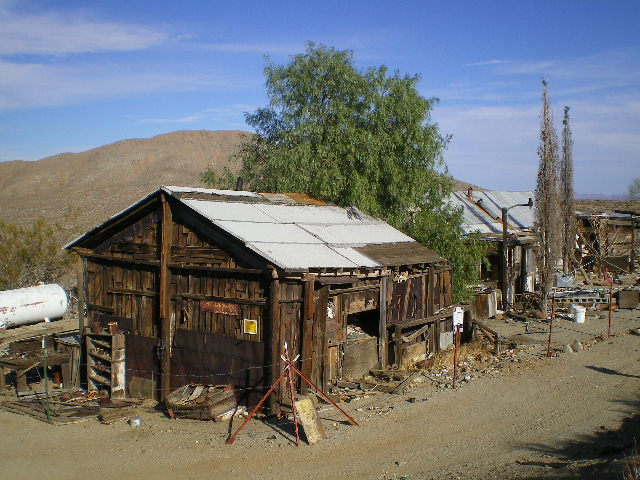
The Burro Schmidt Tunnel is this month’s featured ghosted place in Ghost Town Trails.
I chose Burro Schmidt Tunnel as it is very near last month’s featured location of Bickel Camp. Not only is the proximity of the two sites convenient for explorers today, but it also leads to a friendship between Burro Schmidt and Walt Bickel, featured in last month’s Ghost Town Trails. Both were a bit eccentric.
History of “Burro” Schmidt and his tunnel
Born in Woonsocket, Rhode Island, in January of 1871, William Henry Schmidt faced a challenging start in life. As a young man, he was frail and small in stature, and, tragically, six of his siblings succumbed to tuberculosis. With the looming threat of a similar fate and on the advice of a doctor, Schmidt sought refuge in the hot and dry climate of the Southwest. In 1894 he made his way to the California desert.
Schmidt began prospecting around Kern County and eventually secured claims in the then-remote interior of the El Paso Mountains near Last Chance Canyon. This canyon had historical significance, having been traversed by William Lewis Manly in February of 1850 during his escape from Death Valley. The El Paso Mountains, particularly the eastern region near Garlock or “Cow Wells,” were recognized as a mining area.
For a successful mining operation, certain factors were crucial. Those included a valuable ore body, a transportation infrastructure, and proximity to processing facilities. Mojave, located about 20 miles to the south, served as the local transportation hub. However, Schmidt faced a challenge as the El Pasos lacked proper roads, with only scant trails available. His primary route was through Last Chance Canyon.
Burro Schmidt conceived a plan
In the early 1900s, amid a period of innovative ideas and ambitious projects like the Panama Canal, Burro Schmidt conceived a plan. He envisioned building a tunnel through Copper Mountain. That would create a direct route to the flatlands on the other side, offering easier access to Garlock or Mojave. This route would also be less labor intensive for his beloved burros, Jack and Jenny, to pack supplies and ore.
Despite lacking formal training in mining or engineering, and without power tools, Schmidt embarked on the arduous task of tunneling. Using a pick, a four-pound hammer, and a hand drill, he tirelessly pounded through solid rock. The broken rock was initially carried out on his back and later in a wheelbarrow. Over time, Schmidt installed iron tracks and a mine car to transport debris from the lengthening tunnel.
Living a solitary and frugal existence in the high desert, Schmidt’s only companions were his two burros. Locals affectionately dubbed him “Burro” Schmidt. His frugality included using short lengths of fuse cord to set off explosives. Once the fuse was lit, he literally would run for his life toward the end of the tunnel and throw himself to the ground to avoid being struck by the force of the blast and debris. Sometimes either his fuses were too short, or he didn’t run fast enough. More than once he showed up at the door of his neighbor, Walt Bickel, needing medical attention. When he could afford it, Schmidt burned kerosene in his lamps. When kerosene became an unobtainable luxury, he used candles, but limited himself to one two-cent candle each day.
The tunneling project became an obsession
As work progressed slowly, Schmidt’s tunneling project turned into an obsession. He supported his digging by working on Kern River ranches during the summer months. Even with the construction of a good road through Last Chance Canyon in the 1920s, Schmidt continued tunneling until 1938, when daylight finally illuminated the far end of his tunnel. A staggering 5,800 tons of rock had been hollowed out of Copper Mountain. Sadly, the far end of his tunnel was high above the valley floor, thus providing no benefit of an improved route for transporting ore via his burros.
Now in his late 60s, stooped and gnarled from over 32 years of tunneling more than 2,000 feet of excavation, he sold the claim to another miner, Mike Lee, and moved elsewhere in the El Pasos. Schmidt remarked, “I never made a damn thing out of it,” but retaining ownership in several other claims until his death in January of 1954 at the age of 83. He is buried in the Johannesburg Cemetery, leaving the question of whether Schmidt conquered the mountain or the mountain conquered Schmidt. The tunnel was never used for transportation purposes.
“Although Burro Schmidt’s Tunnel is located in a remote location, it has gained some notoriety, primarily through media exposure such as the Time/Life book Odd And Eccentric People and the old Ripley’s Believe It Or Not television show. It has attracted people from as far away as Europe, drawn primarily by the universal human fascination with the notion of a single man, working with small tools, realizing a big dream.” Per Desert USA
Our visit
My wife and I visited Burro Schmidt during the fall after the heat of summer had passed, but the weather was still warm and sunny, providing comfortable weather for exploring. This was our first visit to the El Paso Mountains. While I had a good idea of where we were going, I was lacking a good map of the area. We dropped our travel trailer at a pull-off just off California Hwy 14 and proceeded towards upper Last Chance Canyon with our tow vehicle, stopping to visit other historic mining sites along the way.
Given the sandy conditions upon reaching Last Chance Canyon Road, we decided to unload the ATV from the back of the tow vehicle and proceed without the tow vehicle. While doable in the truck, the ATV was much better-suited for the conditions. It allowed us to cover ground faster and soak up the bumps better. It also allowed us to enjoy the incredible scenery and colors of upper Last Chance Canyon. Luckily, most of the major junctions to Burro Schmidt Tunnel had been “signed” by other explorers, making it relatively easy to find even given our lack of a good map.
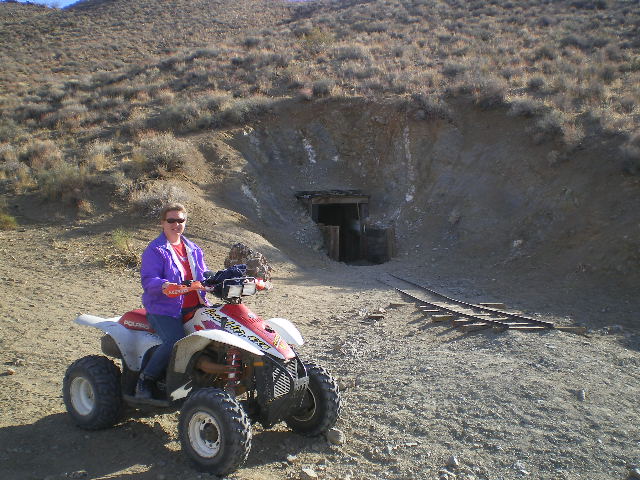
Upon arriving at the portal of the tunnel, we met another couple. After pleasantries were exchanged, they began to tell us other areas worth seeing and produced a very detailed map of the area! After admiring their map, we proceeded into Burro Schmidt Tunnel. (The other couple was done exploring for the day and were headed back to pavement.)
No posted restrictions at the Burro Schmidt Tunnel
Typically, the BLM (Bureau of Land Management) discourages visitors from exploring manmade underground excavations, like mines. As a safety precaution, my wife normally stays near the entrance in the event I don’t return from underground explorations. In this case, there are no posted restrictions or barriers preventing anyone from entering the Burro Schmidt Tunnel, so my wife was able to join me on an underground exploration for a change. The fact that we knew there was “light” at the other end of the tunnel (the second entrance) was reassuring, as the chance of being trapped inside a two-ended tunnel is low.
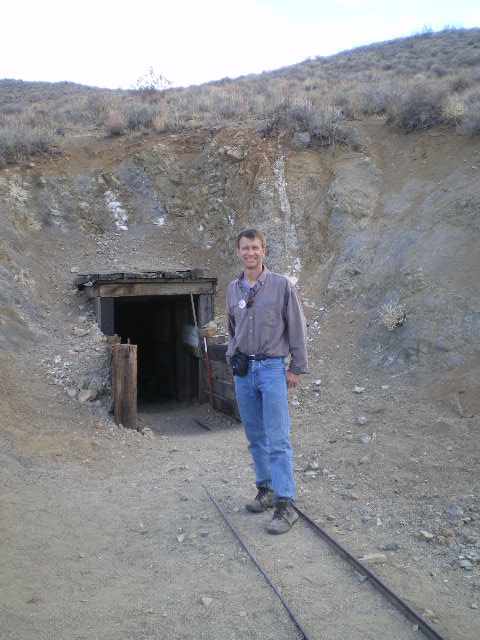
With flashlights in hand, we took our time exploring the nearly half-mile-long tunnel and marveling at the effort it would have taken for one person to excavate it. About halfway through, a locked steel door is encountered on an off-chute from the main tunnel. Rumor has it that Burro Schmidt discovered a rich pocket of gold ore at this point during his tunneling, which was known as the Crystal Room. Hence the need for the steel door.
Just a storage area?
Shining my flashlight around small openings on the door revealed no “crystals” or any type of mineralization and that it just served as a storage area. From the steel door, the tunnel veers right on the straight course until daylighting on the other side of the mountain over 2,000 feet above the valley below.

As we hiked up and over the ridge back towards the tunnel opening we originally entered, I stopped to enjoy the view. From that vantage point it was obvious that boring a horizontal tunnel from one side of the mountain to the other had no chance of gaining better access to the valley far below, as Burro Schmidt had envisioned. This furthered my understanding that his tunnel was more of an obsession than serving a practical purpose.
An unexpected gift
Upon arriving back to our ATV at the entrance, where we started, we were surprised to find an unexpected gift. The couple we had met earlier had left the map I had been admiring on the seat of our ATV. From our travels we have learned you meet some of the nicest people in the middle of nowhere!
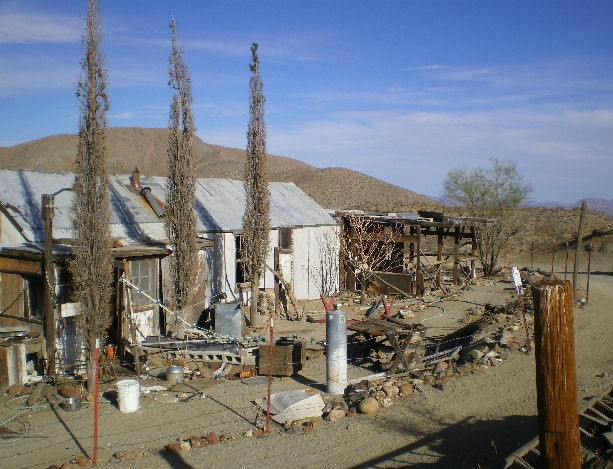
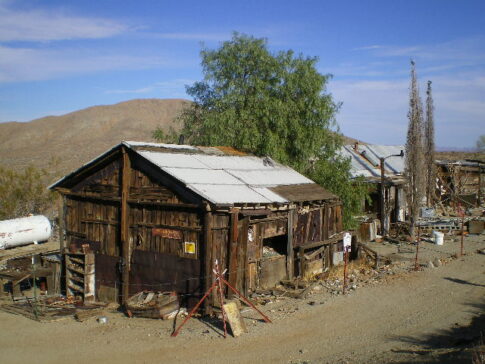
From the tunnel, we went to see what remained of Burro Schmidt’s home and outbuildings. Sadly, unlike nearby Bickel Camp overseen by a caretaker, Burro Schmidt’s home/camp has been severely looted and vandalized even though it is fenced and posted against trespass.
Burro Schmidt Tunnel—Getting there:
You will find the north entrance of Burro Schmidt Tunnel (the one you can drive to) at N35° 24.626 W117° 52.564 and his camp at N35° 24.631 W 117° 52.481

Burro Schmidt Tunnel is accessible from either Harts Road, from Hwy 14, or from the Mesquite Canyon Road (EP 100), off Garlock Road. Trail EP 15/26 leads to the site. A four-wheel-drive vehicle with high ground clearance is recommended, although the couple that gave us the map were driving a two-wheel-drive Ford Ranger. Note: Entering via Last Chance Canyon Road from Redrock Randsburg Road is not recommended. Check road conditions in the area here before going. Flooding recently (early February 2024) has washed out some roads.
For safety, take at least three light sources into the tunnel with you.
Where to camp:
Boondocking: If entering from Highway 14 from the “billboards” via EP15 (there are large billboards on both sides of the highway north and south of the intersection of road EP15), the first decent camping spots can be found at N35° 29.600 W117° 56.565
If entering from the Garlock side via Mesquite Canyon, there is a nice boondocking spot less than 300 yards off the pavement on the route to Burro Schmidt Tunnel at N35° 23.443 W117° 48.982
The nearest developed campground is at Red Rock Canyon State Park. There are no hookups, so you might as well camp for free in the boondocks.
Previous Ghost Town Trails entries you might enjoy:
- Bickel Camp: Explore this treasure trove of relics in California
- Ruby, AZ – Southern Arizona’s ‘best-preserved’ ghost town
- Finding the Christmas spirit in Poinsettia Mine, Nevada
- Dublin Gulch, California – Cave dwellers of the 20th century
- Berlin, Nevada: Ghost town with ancient marine creatures
- Rhyolite, Nevada – An easy ghost town for RVers to visit
- Deadwood Mine, Idaho and its mysterious vault
- Eureka, Utah – Visit easily accessible old mining town
- Silver City, Utah – Heartbreak and thanksgiving
- Fort Macomb, LA – Does this picturesque Civil War-are fort look familiar
- Castle Dome City, Arizona – Perfect for nearby snowbirds
- Fort Selkirk, Yukon Territory
- Coolidge, MT – ‘Montana’s Mystery Camp‘
- Ballarat, California
- Greenhorn, OR – Oregon’s smallest incorporated city
- Elkhorn, Montana – The cover photo of popular “Ghost Towns of the West” book
- Tunnel Camp, Nevada
- Bonnie Claire, Nevada
- Tumco, California
- Mackay’s Mine Hill, Mackay, Idaho
##RVT1144

Thank you, Dave! Extremely interesting story with a somewhat sad ending for Burro Schmitt, including the vandalazation of his camp. Thank you, Cheri for the great pictures! Safe travels! 🙂
Neal, You inspired me to start featuring more eastern locations. Next month’s featured location will be in your neck of the woods. Stay tuned!
Thank you, Dave! You going to do the part of Oak Ridge, Tennessee in which people lived before Y-12 (of atom bomb fame) was created? I’m not sure people are legally allowed there, so probably not. In any case, I am excited and anxious to see to what you’re referring. Thank you, Dave, and safe travels! 🙂