

By Dave Helgeson
During my ghost town travels, I have found plenty of safes strewn about the rubble of old businesses, Wells Fargo express offices, and the like. The doors are typically missing and the contents are long gone. However, the Deadwood Mine was never more than a remote mining camp. It wasn’t even close to being a full-blown town that would have contained banks, businesses, stage stops and the like, where cash and bullion would need safekeeping.
Lead and zinc mined at the Deadwood Mine
Most of what was mined at the Deadwood Mine was lead and zinc, which would have been too heavy and bulky for thieves to easily steal, let alone carry up a flight of stairs to a vault. Yet, the main office/residence of the Deadwood Mine contains a very ornate walk-in vault reminiscent of where safe deposit boxes are safeguarded today. What is even more interesting is that the door to the vault has been removed with a cutting torch in recent years.

I expect those who found this place long before me had visions of what riches might lay behind the vault door, as did Geraldo Rivera and The Mystery of Al Capone’s Vaults. However, whoever used a cutting torch to remove the outer door at the Deadwood Mine wasn’t about to share what lay behind via a live two-hour TV special event. Did they walk away with riches or just find it empty with a bit of debris, as Geraldo did? Maybe it was Geraldo himself who torched off the door to the Deadwood Mine vault! The world may never know!
Deadwood Mine history
Placer deposits in Deadwood Basin first attracted miners in the early summer of 1863, followed by a second Deadwood Basin placer gold rush in 1867. By 1868, miners discovered quartz outcrops, which would lead to the discovery of the Deadwood lead-zinc deposits. However, many of the miners left the following year for richer ground.
Interest waned until 1915, when the Hall Brothers organized The Hall Interstate Mining Company to explore what lay underground. Development of the mine eventually started in 1926–27, when 2,200 feet of tunneling took place and construction commenced on a mill, along with a 250-horsepower hydroelectric power plant and camp buildings, including a large combination office and residence building.
By 1929, things were rolling along when the mill treated 2,729 tons of lead-zinc ore, which yielded 415 tons of lead and zinc concentrates, which together yielded 25 ounces of gold, 17,723 ounces of silver, 13,118 pounds of copper, 165,208 pounds of lead, and 324,164 pounds of zinc.

However, by May 1931, worthwhile ore had become scarce, and the mine was closed with just a small crew left behind to maintain the property. In June 1932, all the supplies were removed from the property.
World War II brings revival to the Deadwood Mine
The mine lay dormant until the early 1940s, when new management rehabilitated it along with the mill the following year. In 1942, a total of 7,733 tons of zinc-lead ore were mined, which yielded 240 tons of silver-lead-copper concentrates and 590 tons of zinc concentrates, which were in high demand due to World War II. Again, commercial ore in the mine became hard to locate, but with bonuses being paid by the federal government on badly needed metals like copper, lead and zinc for the war effort, the mine continued to operate.
Once the war ended and the bonuses ended, the mine struggled and eventually closed for good in 1950. Total production from 1929 to 1950 from the Deadwood Mine produced 125,793 tons of ore, which yielded 2,658.46 ounces of gold, 634,277 ounces of silver, 444,343 pounds of copper, 4,978,449 pounds of lead, and 10,176,833 pounds of zinc. (Source: History of the Deadwood Mine by Victoria E. Mitchell)

Our visit
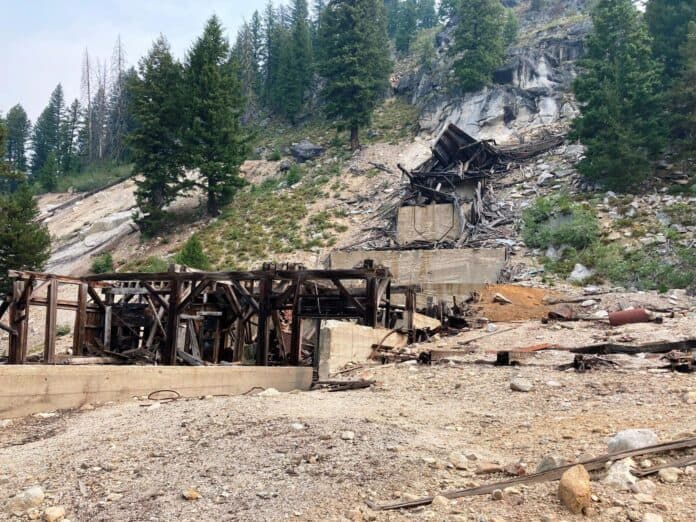
Upon arrival at the Deadwood Mine, we found ruins of the mill with some machinery, a huge boarding house that had partially collapsed, and, oddly enough, a vintage travel trailer that has been crushed like a pancake by the winter snows. The three-story office/residence built in 1926–27 is still fully intact. It contains many lavish features you wouldn’t expect to find in a 1920s off-grid mining camp located deep in the wilds of Idaho.
The entire building was fully electrified, complete with a stout distribution panel. Baseboards and trimmed window frames grace the office and living space. Fine-grain tongue-and-groove floors are found in the office and main living areas. You will find double-hung windows that utilize window weights throughout most of the structure. The basement contains a wood-burning furnace rather than the typical woodstove found in most mining camps.

Along the north side of the second-floor office, you will find the ornate walk-in vault mentioned at the beginning of this article. The torched outer door is off its hinges leaning up against an adjoining wall. The inner doors still swing on their hinges, allowing entry to the concrete vault.

Third-floor residence with a great view
The third-floor residence features a full bathroom with a built-in porcelain bathtub, built-in dressers in the bedrooms, along with a dining area, China hutch, and a pass-through to the kitchen. A side room features rows of windows along both sides of the room that drop down into the wall cavity when opened. I assume this unique feature allowed for a cooling cross breeze on warm summer days. Large windows on the third floor living room provide a commanding view of the valley below. If you have an interest in architecture or old buildings, as I do, you will enjoy touring this nearly 100-year-old structure at the Deadwood Mine.

Getting there
From the junction of Hwy 95 and Warm Lake Road near Cascade, Idaho: Head east on Warm Lake Road to the end of the pavement. Once the pavement ends, continue approximately 300 yards straight ahead to the junction at N44° 39.147 W115° 32.622. At the junction take a right (heading south) on the somewhat rough Landmark Stanley Road (aka NF 579) and drive approximately 14 miles to N44° 28.170 W115° 35.100, where you will find the Deadwood Mine approximately 200 yards up a side road to the east.
The entire route is suitable for two-wheel drive vehicles with medium clearance. Many “crazy Idaho RVers” travel this road all the way down to Deadwood Reservoir, but I wouldn’t recommend doing so. If you choose to travel with your RV past Warm Lake to the end of the pavement on Warm Lake Road, please read my experience doing so here.
Camping

Campgrounds
- South Fork Salmon River Campground located just before Warm Lake
- Shoreline Campground and Group sites along the north shore of Warm Lake
RV parks
RV parks in the vicinity include the Chalet Family Campground and Mountain View RV Park.
Boondocking
Much of Warm Lake Road passes through USFS land where boondocking is permitted. During our visit we camped at the last boondocking campsite just prior to the end of the pavement on Warm Lake Road. To find it take a right at N44° 39.196 W115°32.951 and travel into the woods approximately 200 feet, where you will find a nice campsite (pictured above) capable of holding multiple RVs. However, this campsite requires traveling up and back down the pass I shared here previously.
Past installments of Ghost Town Trails you may enjoy:
- Ruby, AZ – Southern Arizona’s ‘best-preserved’ ghost town
- Eureka, Utah – Visit easily accessible old mining town
- Silver City, Utah – Heartbreak and thanksgiving
- Castle Dome City, Arizona – Perfect for nearby snowbirds
- Fort Selkirk, Yukon Territory
- Coolidge, MT – ‘Montana’s Mystery Camp‘
- Ballarat, California
- Greenhorn, OR – Oregon’s smallest incorporated city
- Elkhorn, Montana – The cover photo of popular “Ghost Towns of the West” book
- Tunnel Camp, Nevada
- Bonnie Claire, Nevada
- Tumco, California
- Mackay’s Mine Hill, Mackay, Idaho
- Does picturesque Civil War-era Fort Macomb, LA, look familiar?
- Ghosts of the Yankee Fork, Idaho
- Comet, Montana – This former off-limits mining town surrendered $20 million in riches
RVT1219
Thank you, Dave! These are fascinating and something we’ll only explore in the Jeep or its successor, whatever that may be. Have a great week and safe travels!