


When we first reported on the Evotrex travel trailer, the company’s pitch was straightforward: hybrid travel trailer power claims centered on letting RVers roam farther off-grid and rely less on campground hookups. An ambitious idea, especially as more RVers move into solar, lithium batteries, and generator-free camping.
Since then, Evotrex has taken that message to a much larger stage—CES, the annual consumer electronics trade show held in Las Vegas. There, it introduced its trailer as what it calls the “world’s first power-generating RV.”
It raises a question: How do those hybrid travel trailer power claims hold up once the show floor lights dim and the trailer heads for real-world RV travel?
A quick refresher on the Evotrex concept
In our original story, we described Evotrex’s basic idea in plain terms: Build a travel trailer with a large onboard battery, solar panels on the roof, and a generator, then make them work together automatically. The trailer manages its own power behind the scenes, instead of RVers having to juggle switches and settings.
The idea is to make off-grid camping feel less like a series of tradeoffs. Instead of choosing between running an appliance or saving battery power, the trailer is meant to handle those decisions quietly in the background, letting RVers focus more on where they’re camping than on what’s turned on.
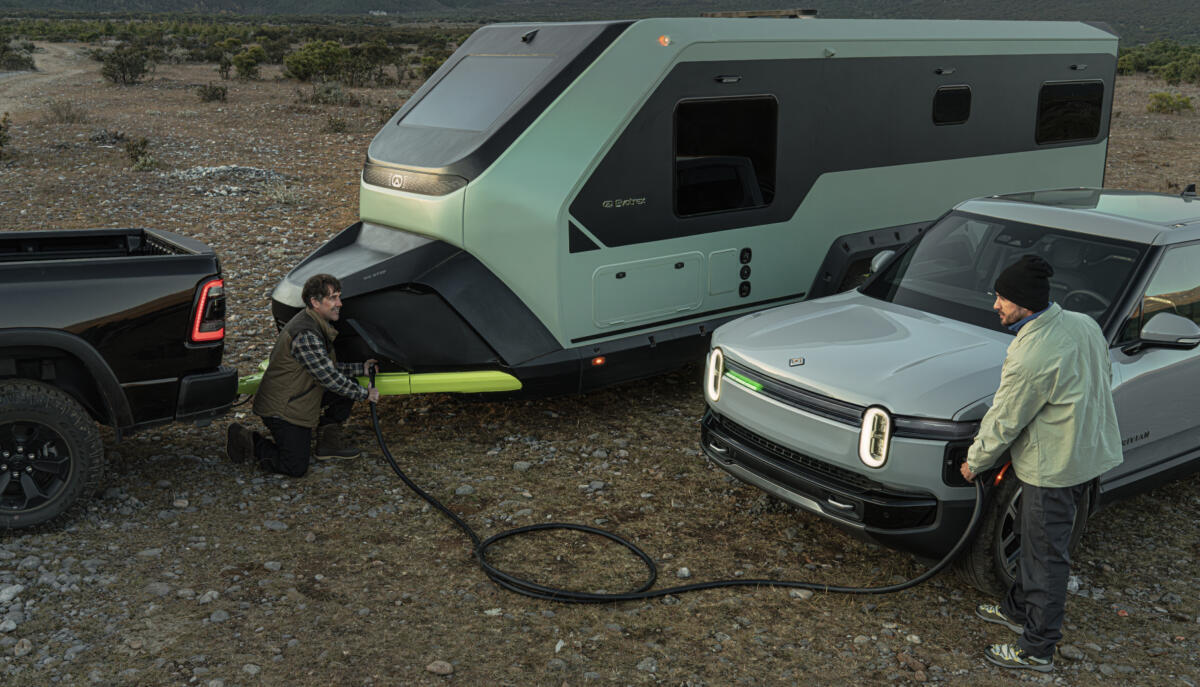
When Evotrex took that same idea to CES, the language shifted. The company began talking about “power generation,” energy independence, and even the ability to share electricity with an electric tow vehicle or a home during a power outage.
What does “power-generating” really mean?
That wording is where outside coverage, including a skeptical take from The Autopian, began asking questions.
RVs have generated their own electricity for decades. Gas and diesel generators have long powered rigs off-grid. Solar panels and large battery banks are now common on many travel trailers. In that sense, Evotrex isn’t introducing a new source of energy.
The trailer still relies on familiar inputs:
- Fuel for its generator
- Sunlight for its solar panels
- Stored electricity in its batteries
What really sets Evotrex apart isn’t a brand-new power source, but how much power it carries onboard and how those pieces are meant to work together. Instead of treating batteries, solar panels, and a generator as separate systems, the trailer is designed to coordinate them automatically. That’s more like how modern vehicles manage fuel and electricity than how most RV electrical systems work today.
For RVers, that difference matters more than the marketing label. It’s less about what the system is called, and more about whether it makes daily camping easier.
Regenerative charging: promise vs. physics
Evotrex also highlighted regenerative charging while towing. In simple terms, that means trying to capture a small amount of energy from the trailer’s movement—such as when slowing down or coasting—and feed it back into the trailer’s batteries, somewhat like the regenerative braking used in electric vehicles.
It’s an appealing idea, but it needs real-world context. Any energy recovered this way still has to come from the tow vehicle’s effort. Pulling a heavier trailer takes energy, whether the tow vehicle runs on gasoline, diesel, or electricity. Regenerative systems may reclaim small amounts under certain conditions, but they don’t make towing a source of free power.
The practical question for RVers isn’t whether regenerative towing exists. What matters is whether it makes a noticeable difference once the trailer is parked and living off its batteries—something no show-floor demonstration can fully answer.
Along the way, there’s another question many boondockers will ask: How long would a system like this actually let someone live off-grid before the generator has to come on?
Big batteries and solar can stretch that window by days, in some cases, depending on the weather and how RVers use power. But daily realities still apply. Air conditioning, cooking electrically, and cloudy conditions can drain even large battery banks faster than expected. For most RVers, the real benefit may be fewer generator hours—not eliminating the generator altogether.
Extended off-grid living, not unlimited power
Where Evotrex’s idea starts to make the most sense is in longer off-grid stays. Big battery systems really can change how long RVers can camp without plugging in, especially when solar helps take some of the load off the generator.
Even so, batteries still have their limits. Running air conditioning, cooking electrically, or dealing with cloudy weather can drain power faster than many RVers expect. In real-world use, a system like this is more likely to cut back on generator run time than make it disappear entirely.
That’s still a real step forward—but it’s not the same thing as unlimited energy.
How different is this from what RVers already use?
Many experienced RVers will recognize much of this technology. High-capacity lithium systems, solar arrays, and inverter-driven appliances are already common among boondockers and full-timers.
What sets Evotrex apart isn’t one breakthrough feature, but how everything is meant to work together. Power isn’t treated as an afterthought—it’s built into the trailer’s design from the start, more like how modern vehicles handle energy than how most RVs do today.
Who this trailer is really for
Given its projected pricing and complexity, Evotrex isn’t likely to appeal to the average weekend camper. Instead, those with greater interest will probably be:
- RVers who regularly camp off-grid for extended periods
- Buyers comfortable with advanced electrical systems
- Owners willing to pay a premium for integrated technology
That doesn’t make the concept impractical—but it does put it firmly in a niche category, at least for now.
From show floor to campsite
CES is built for big ideas and bold claims. The RV world, by contrast, has a way of testing those ideas in heat, cold, dust, and long stretches away from help.
Evotrex’s trailer points toward a direction the industry is clearly heading: bigger batteries, smarter systems, and less dependence on hookups. RVers won’t decide whether this approach works as promised on a show floor—they’ll make this decision out on the road and at the campsite.
In the end, it comes down to the same question it always has: How long can you camp comfortably before you have to start the generator?
RELATED
- New Evotrex travel trailer lets RVers roam farther with hybrid system
- GM shuts down BrightDrop electric vans amid slow EV sales
- Meet the Coachmen RVEX, the first all-electric Class B motorhome
- Thor promises 450-mile range on new Embark electric motorhome
- This $46K electric van might be the perfect off-grid camper platform
- Vamonos Vans make building camper vans easy and affordable
- Lightship RV’s quarter-million all-electric RV offers innovation but lacks important features
- Thor’s EV RV revolution begins: Harbinger delivers first electric chassis
- All-electric RVs: Boon or bane for boondockers?
RVT1244b

The question is one of cost-effectiveness (forgetting that RVing itself really isn’t cost-effective to start with). But a dozen solar panels, 800 AH of lithium, the 3KW Victron inverter, the Victron solar regulator and so forth might set you back about $20K. At $3.50/gallon for diesel, that’s the equivalent of 5714 gallons. Assume your generator burns 1 gal/hr and you might use it up to 8 hours/day, then the break-even point would be at 714 days. 5714 gallons = 5714 hours, which is a huge number of generator hours. After 19 years of part-time RVing, we had only used about 400 hours. So, this would not be cost-effective for the average RVer, but it could be for the full-time, off-grid RVer.
Interesting concept, but so is the Lightship trailer that does the same without a generator. For a roadtest using a Ford Lightning tow vehicle, watch the following video:
https://m.youtube.com/watch?v=cypM23jI8JA&pp=4gcKEghoc19lbWFpbA%3D%3D
Of course, this test trip took place in the sunny SW U.S., not in the cloudy, rainy PNW or Midwest. But million or more RVers spend the winter in that area for 4-6 months every winter, so maybe this type of RV just might have a market between the 100th Meridian and southern California!
Thank you for the news and discussion of it, Russ and Tina! Have a great day and safe travels!